
The Legacy of the Cold Heat Soldering Iron
For decades, the "Cold Heat" soldering iron has occupied a controversial space in the electronics community. Originally marketed through late-night infomercials and hobbyist catalogs, the cordless resistance soldering tool promised instant heat, portability, and the ability to melt solder without a traditional heating element. But as surface-mount devices (SMDs) shrank and logic voltages dropped from 5V to 1.8V and below, the fundamental physics of the original Cold Heat design became a liability for modern printed circuit boards (PCBs).
In this comprehensive 2026 guide, we dissect the electrochemical reality of the classic Cold Heat soldering iron, evaluate its modern retail availability, and compare it against the current generation of "instant heat" smart irons and professional resistance stations that actually protect your components.
The Electrochemical Reality: How Cold Heat Actually Works
The original Cold Heat iron does not use a ceramic heating core or a nichrome wire. Instead, it relies on a proprietary conductive chemical compound at the tip (often referred to as Athlonite) and the principle of electrical resistance. The tool is powered by three AA batteries, providing roughly 4.5V DC.
When you press the tip against a solder joint, the tool completes an electrical circuit. Current flows from the battery, through the conductive tip, across the solder joint, and back through the workpiece to the ground clip. Because the interface between the tip and the solder has a specific electrical resistance, the localized I²R (current squared times resistance) heating causes the solder to melt almost instantly.
The Hidden Danger: DC Voltage Injection
While the thermal mechanics are sound for heavy-gauge wires, applying 4.5V DC directly across the leads of a semiconductor is a recipe for catastrophic failure. According to reliability guidelines from the NASA Electronic Parts and Packaging (NEPP) Program, introducing foreign voltage potentials directly across component junctions can lead to immediate or latent defects.
When you solder a 3.3V microcontroller or a sensitive CMOS logic gate with a Cold Heat iron, the 4.5V potential is applied directly to the component pins. This can cause:
- Gate Oxide Rupture: Exceeding the absolute maximum voltage rating of thin-oxide MOSFET gates, permanently destroying the transistor.
- SCR Latch-Up: Triggering parasitic silicon-controlled rectifiers inside the IC, causing a short circuit that melts the silicon die the moment power is applied.
- Electromigration: The DC current flowing through the molten solder and copper traces can cause metal ions to migrate, leading to brittle joints or micro-shorts over time.
Classic Wahl ColdHeat Cordless Tool: 2026 Status Review
You can still find the Wahl ColdHeat Cordless Soldering Tool on retail shelves and online marketplaces in 2026, typically priced between $18.00 and $24.99. It remains a staple in plumbing and heavy-duty wire splicing kits, but its role in electronics is heavily restricted.
Expert Warning: Never use a DC-powered resistance soldering pen on populated PCBs, microcontrollers, or sensitive sensors. Reserve it strictly for heavy-gauge automotive wiring, RC battery tabs (with disconnected cells), and basic plumbing where no solid-state components are present.
Pros and Cons of the Classic ColdHeat
| Advantages | Disadvantages & Failure Modes |
|---|---|
| True cordless operation (3x AA batteries) | Tip material degrades and crumbles over time |
| Instantaneous heat at the joint interface | 4.5V DC destroys CMOS and low-voltage logic |
| Inexpensive entry price (~$20 USD) | Requires a physical ground clip connection |
| Excellent for thick, high-thermal-mass wires | Poor thermal recovery for continuous soldering |
The Modern Paradigm: Instant-Heat Smart Irons
The desire for "instant heat" that drove the original Cold Heat infomercials has been entirely solved by modern USB-C Power Delivery (PD) smart irons. By utilizing high-efficiency DC-DC buck converters and advanced thermal algorithms, modern irons heat up in under three seconds without passing any current through the workpiece.
For adherence to strict IPC workmanship standards and component safety, the heating element must be galvanically isolated or carefully managed so that zero voltage potential transfers to the solder joint.
Comparison Matrix: Legacy vs. Modern Fast-Heat Solutions
| Feature | Wahl ColdHeat (Classic) | Pine64 Pinecil V2 | Miniware TS101 | American Beauty 3158W |
|---|---|---|---|---|
| Technology | DC Resistance (Electrochemical) | Ceramic Core + Smart PID | Ceramic Core + Smart PID | AC Step-Down Resistance |
| Heat-Up Time | Instant (at joint) | ~2.5 Seconds | ~3.5 Seconds | Instant (at joint) |
| PCB Safety | Extremely Poor (Lethal to ICs) | Excellent (Isolated) | Excellent (Isolated) | Excellent (Safe AC) |
| Power Source | 3x AA Batteries (4.5V) | USB-C PD (65W-88W) | USB-C PD (65W) | 120V AC Mains |
| 2026 Price | ~$20 | ~$28 | ~$45 | ~$450+ |
Deep Dive: The Best Cold Heat Alternatives for 2026
1. Pine64 Pinecil V2 (The Ultimate Fast-Heat Replacement)
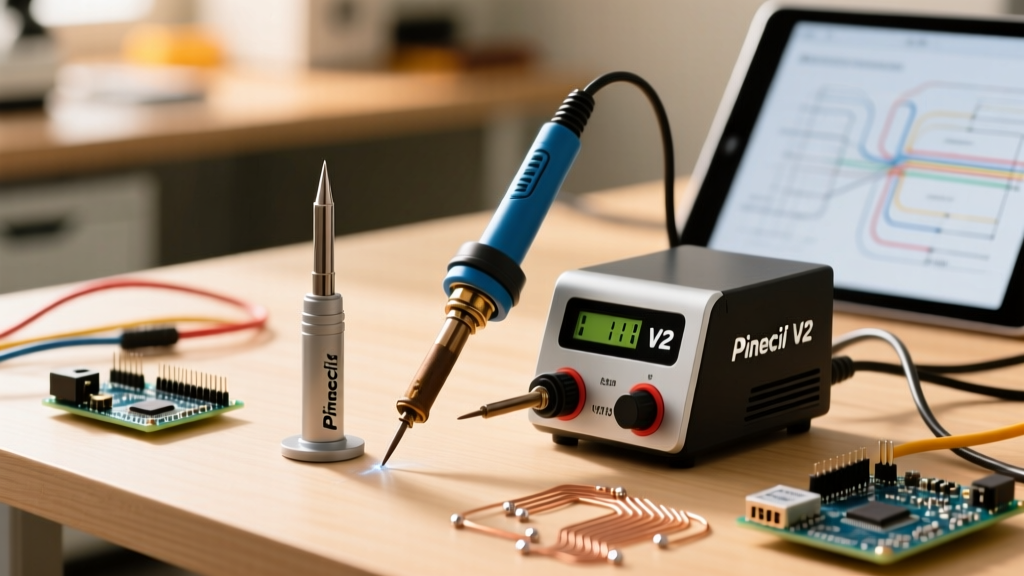
If you want the "instant on" gratification of a Cold Heat iron without the component-destroying side effects, the Pine64 Pinecil V2 is the undisputed champion in 2026. Powered by a Bouffalo Lab BL706 RISC-V microcontroller, the Pinecil V2 negotiates USB-C PD 3.1 protocols to draw up to 88W (with compatible 20V/4.5A power supplies).
Why it beats Cold Heat: The Pinecil heats its ceramic core to 350°C in roughly 2.5 seconds. Because the thermocouple and heater are isolated from the tip's outer copper sheath, zero electrical current passes through your PCB. You get the speed of resistance soldering with the safety of a professional station. Furthermore, the open-source IronOS firmware allows you to calibrate the PID loop, set sleep timers, and even use the accelerometer for auto-wake functionality.
2. Miniware TS101 (The Rugged Competitor)
The TS101 remains a heavy hitter in the portable soldering space. While slightly slower to heat than the Pinecil V2 and lacking the same level of open-source firmware flexibility, its physical build quality and robust OLED interface make it a favorite for field technicians. It uses standard Hakko-style tips, meaning you can easily swap to a heavy-duty chisel for soldering 12 AWG wires—the exact scenario where the old Cold Heat iron used to shine.
Professional Resistance Soldering: Doing It Safely
There are specific scenarios in electronics manufacturing where passing current through the joint is actually preferred, such as soldering massive ground planes, RF shielding cans, or heavy multi-layer vias where a standard 65W iron simply cannot overcome the thermal mass. In these cases, professionals use AC resistance soldering stations, like those manufactured by American Beauty.
Why AC Resistance is Safe (Unlike DC Cold Heat)
Professional resistance stations use a massive step-down transformer to convert 120V AC mains into a very low voltage (typically 1V to 3V AC) at extremely high amperage (up to 100A).
- Zero Net DC Potential: Because the current is alternating (60Hz), there is no net DC voltage applied to the component. This completely eliminates the risk of SCR latch-up and DC electromigration.
- Below Junction Thresholds: The 1V-3V RMS output is generally below the forward bias threshold required to turn on sensitive silicon junctions, keeping the IC safe while the massive current melts 63/37 tin-lead solder in seconds.
- Tweezer Probes: Instead of a ground clip, technicians use carbon or tungsten tweezer probes to localize the current path strictly to the solder pad, bypassing the component body entirely.
Final Verdict: Should You Buy a Cold Heat Iron?
In 2026, the classic battery-powered Cold Heat soldering iron is a relic of a bygone era. While it holds nostalgic value and remains marginally useful for emergency automotive wire splicing in a glovebox, it has absolutely no place on a modern electronics workbench. The risk of silently destroying a $15 microcontroller or a delicate sensor with a 4.5V DC spike far outweighs the convenience of cordless operation.
Our Recommendation: Invest the $20 you would have spent on a Cold Heat pen into a Pine64 Pinecil V2 and a high-quality 65W USB-C GaN charger. You will achieve the sub-three-second heat-up times you crave, gain precise digital temperature control, and most importantly, keep your sensitive PCBs completely safe from electrical damage.