
The Core Difference: How Temperature Control Actually Works
When shopping for a temperature controlled soldering iron, the market is flooded with options ranging from $25 USB-C sticks to $500 professional workstations. But what does 'temperature control' actually mean across these tiers? At the most basic level, a budget iron might use a simple triac dimmer or a rudimentary bimetallic switch to pulse power to a ceramic heating element. Premium stations, however, utilize sophisticated PID (Proportional-Integral-Derivative) microcontrollers paired with high-resolution thermocouples or RTD (Resistance Temperature Detector) sensors embedded directly into the tip.
The true measure of a soldering station isn't just its ability to hold a static 350°C in free air; it is its thermal recovery time. When you touch a cold, high-mass component—like a 1000µF electrolytic capacitor or a multi-layer PCB ground plane—the component acts as a massive heat sink. A premium iron detects the micro-voltage drop at the sensor and dumps maximum wattage into the heater in milliseconds, preventing the joint from stalling. Budget irons often lack the sensor sensitivity or the wattage overhead to recover quickly, leading to cold joints and pad delamination.
Budget Tier Analysis ($25 - $80): The USB-C Revolution vs. Dial-Adjusted Relics
The budget category has been entirely disrupted by open-source, DC-powered smart irons. However, traditional AC-powered budget irons still linger on the market.
The Smart Disruptor: Pine64 Pinecil V2 ($26 - $35)
The Pinecil V2 is a marvel of modern engineering. Powered by a RISC-V chip, it supports USB-C Power Delivery (PD) and Qualcomm Quick Charge. When paired with a 65W GaN charger, it reaches 350°C in roughly 10 seconds. Its PID algorithm is highly responsive, and because it operates on DC power, it eliminates the risk of AC leakage on the tip.
- Pros: Unbeatable price-to-performance, open-source firmware (IronOS), highly portable, safe for sensitive CMOS logic.
- Cons: Relies on external power bricks; tip thermal mass is relatively small, meaning it struggles slightly with heavy 4-layer motherboard ground planes compared to high-wattage stations.
The Traditional Workhorse: Hakko FX-601 ($55 - $65)
The Hakko FX-601 is a dial-adjusted iron featuring a ceramic heating element with an integrated sensor. While it is technically 'temperature controlled,' it lacks a digital PID feedback loop. It uses a basic analog control circuit that can overshoot the target temperature by up to 20°C before cycling off.
- Pros: Extremely durable, no firmware to update, excellent for heavy through-hole components and stained glass/plumbing (with appropriate tips).
- Cons: Analog overshoot accelerates tip oxidation; no digital readout; mains-powered without advanced isolation.
Premium Tier Analysis ($150 - $500+): Active Cartridge Technology
Stepping into the premium tier introduces two massive advantages: transformer isolation and active cartridge tip technology.
The Mid-Tier Standard: Weller WE1010NA ($130 - $150)
Weller's WE1010NA offers 70 watts of microprocessor-controlled power. It features a digital interface, programmable temperature offsets, and a robust heating element. It is the quintessential 'step-up' station for serious hobbyists and small repair shops.
The Gold Standard: JBC CD-2BQF with T245 Handle ($450 - $490)
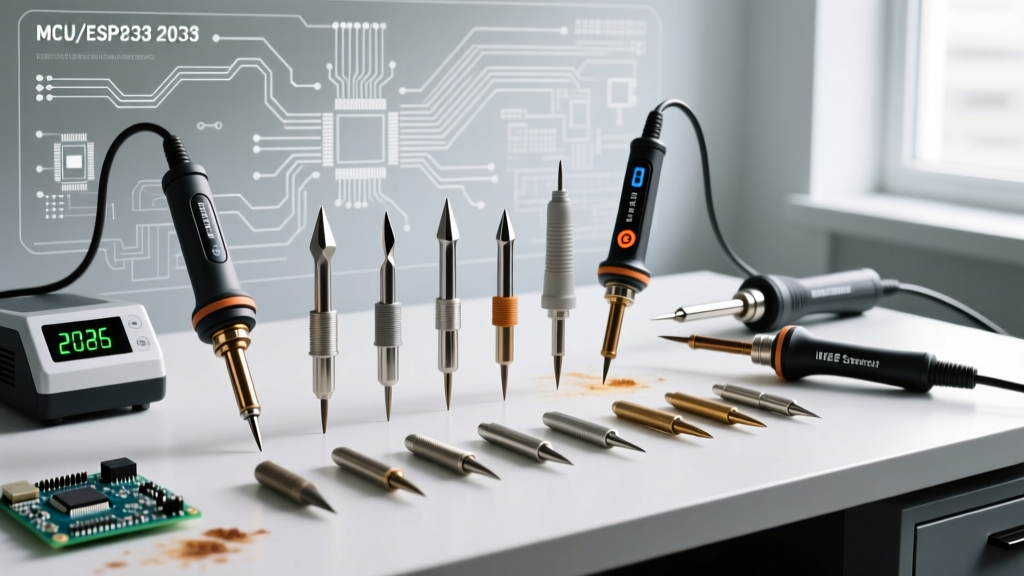
JBC Tools revolutionized the industry with their Cartridge System. In traditional irons (like the Hakko T18 series), the heater is a separate ceramic rod that slides into a hollow copper tip. This creates a microscopic air gap, and air is a thermal insulator. JBC embeds the heating element and the thermocouple directly inside the tip itself. The result? The JBC T245 cartridge reaches 350°C in under 2 seconds and offers instantaneous thermal recovery, making it the undisputed king for micro-soldering and heavy ground-plane work alike.
Feature-by-Feature Comparison Matrix
| Feature | Pinecil V2 (Budget) | Hakko FX-601 (Budget) | Weller WE1010NA (Mid) | JBC CD-2BQF (Premium) |
|---|---|---|---|---|
| Price Range | $26 - $35 | $55 - $65 | $130 - $150 | $450 - $490 |
| Max Wattage | 65W (via PD) | 67W | 70W | 130W |
| Control Type | Digital PID (RISC-V) | Analog Dial | Digital PID | Digital PID (Cartridge) |
| Heat-Up Time (350°C) | ~10 Seconds | ~25 Seconds | ~20 Seconds | < 2 Seconds |
| Tip Technology | Sleeve-over-heater | Sleeve-over-heater | Sleeve-over-heater | Integrated Cartridge |
| AC Leakage Risk | None (DC Powered) | Low (Grounded) | None (Isolated) | None (Isolated) |
The Hidden Danger: Ground Loops and AC Tip Leakage
One of the most critical, yet rarely discussed, aspects of budget mains-powered irons is AC leakage. In cheap, unisolated AC soldering irons, the heating element is wrapped directly around the ceramic core. If the internal insulation degrades, or if your wall outlet lacks a proper earth ground, alternating current (110V/220V) can capacitively couple onto the soldering tip.
When you touch that tip to a sensitive microcontroller or MOSFET gate, the AC voltage seeks the path of least resistance to ground—often straight through the silicon die, instantly destroying a $50 component. Premium stations like the Weller WE1010NA and JBC use heavy, isolated step-down transformers or advanced DC-DC conversion topologies, ensuring the tip remains at absolute earth potential. For those on a budget, using a DC-powered iron like the Pinecil V2 completely bypasses this risk, as it operates entirely on low-voltage DC.
Calibration, Dwell Time, and IPC Standards
Professional electronics manufacturing is governed by strict standards, such as IPC J-STD-001 and the NASA NEPP Program's NASA-STD-8739.3 workmanship manual. These standards dictate that solder joint dwell time (the time the iron is in contact with the pad and lead) should ideally be kept between 2 to 5 seconds.
Expert Insight: Prolonged dwell times caused by poor thermal recovery don't just slow down production; they cause catastrophic physical damage. Excessive heat exposure leads to Intermetallic Compound (IMC) overgrowth, making the joint brittle, and causes FR4 fiberglass delamination or pad lift-off.
Premium stations allow for precise offset calibration. Using a tip thermometer (like the Hakko 191 or Weller WSDCB), a technician can measure the actual tip temperature and input an offset into the station's EEPROM. Budget irons lack the ADC (Analog-to-Digital Converter) precision and firmware support for accurate offset mapping, meaning the dial might read 350°C, but the tip is actually sitting at 320°C, forcing the user to hold the iron longer and violate IPC dwell-time standards.
Total Cost of Ownership (TCO): Tip Depreciation
When evaluating a temperature controlled soldering iron, the initial hardware cost is only half the equation. Tip longevity is heavily dictated by temperature stability.
- Budget Irons: Analog overshoot causes the tip to spike to 380°C+ during idle cycles. At temperatures above 400°C, the iron plating on the copper tip oxidizes rapidly and dissolves into the tin-lead or SAC305 solder. A $6 budget tip may need replacing every few weeks in a production environment.
- Premium Irons: Tight PID loops maintain the temperature within ±2°C. However, cartridge tips (like JBC C245) cost between $45 and $65 each. While they last significantly longer due to superior thermal transfer and lower required idle temperatures, the upfront consumable cost is high.
Final Verdict: Which Tier Do You Actually Need?
The decision between budget and premium ultimately hinges on your specific use case, PCB layer count, and component density.
Choose the Budget Tier (Pinecil V2) If:
You are a hobbyist, a student, or a field technician who primarily works on 1-layer or 2-layer PCBs, through-hole components, and general wire splicing. The Pinecil V2 offers 90% of the performance of a $150 station for a fraction of the cost, provided you have a quality 65W USB-C GaN charger.
Choose the Mid-Tier (Weller WE1010NA) If:
You run a small repair shop or engage in heavy DIY audio builds. The 70W isolated transformer provides the safety and thermal mass needed for larger joints without the massive capital expenditure of a cartridge system.
Choose the Premium Tier (JBC CD-2BQF) If:
You perform micro-soldering (0201 SMD components, BGA rework), work on 4-layer+ motherboards with massive ground planes, or operate in a professional production environment where IPC compliance and 2-second dwell times are mandatory. The instantaneous thermal recovery of the cartridge system pays for itself in saved components and eliminated rework time.