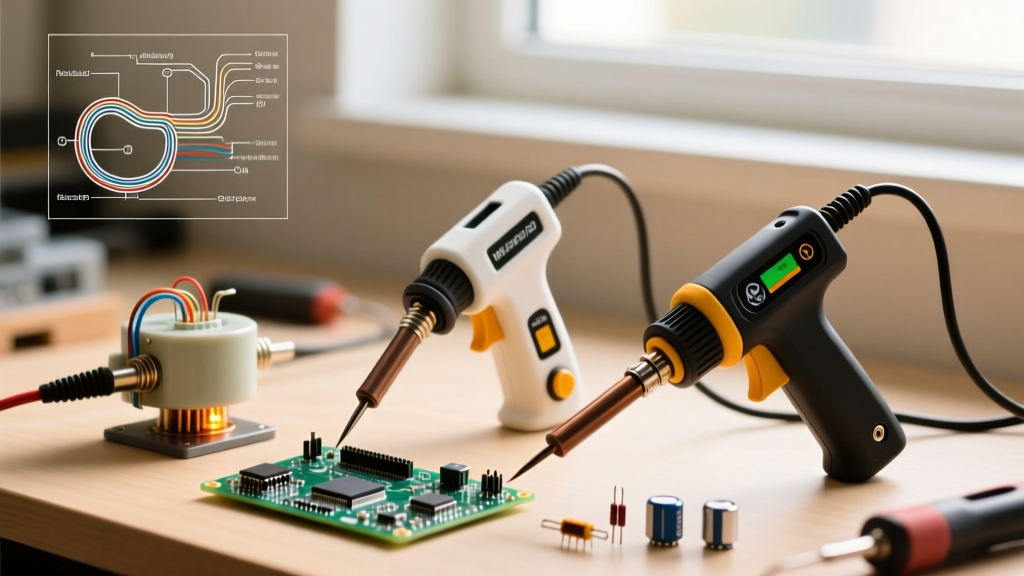

Understanding the Soldering Gun vs. the Soldering Iron
In the realm of electronics and heavy-duty wiring, confusing a soldering iron with a soldering gun is a common novice mistake. While a standard 40W to 60W soldering iron relies on a continuous, low-thermal-mass ceramic or nichrome heating element designed for delicate printed circuit board (PCB) work, a soldering gun is an entirely different beast. Soldering guns are engineered for high thermal mass applications—think 10 AWG automotive wires, heavy ground lugs, stained glass copper foil, and RC battery connectors.
According to the soldering fundamentals taught by the MIT Edgerton Center, successful soldering relies on transferring enough heat to the joint to melt the solder alloy without degrading the substrate. When dealing with thick copper, a standard iron simply cannot overcome the wire's thermal conductivity fast enough, resulting in cold joints. This is where specific types of soldering guns excel. In this technique guide, we will break down the primary types of soldering guns available in 2026, their underlying physics, and the exact techniques required to master them.
1. The Transformer Trigger Gun (Instant-Heat)
The classic transformer soldering gun, popularized by the Weller D550 and the modern Weller 8200PK (retailing around $65 to $85), operates on the principle of a step-down transformer. When you pull the trigger, mains voltage (120V) is stepped down to a fraction of a volt, while the amperage surges to hundreds of amps. The soldering tip itself acts as the secondary winding, and its electrical resistance causes it to heat up almost instantly—usually reaching 500°F (260°C) in under two seconds.
Technique: The "Pulse and Dwell" Method
The biggest mistake DIYers make with transformer guns is holding the trigger down continuously. This leads to oxidized tips, melted wire insulation, and destroyed components.
- Step 1 (Pre-Tin): Pulse the trigger for 1 second, touch the tip to your rosin-core solder to tin it, and release. A shiny, silver tip is mandatory for thermal transfer.
- Step 2 (Apply Heat): Place the tinned tip against the heaviest part of the joint (e.g., the copper lug, not the wire strands). Pull the trigger and hold for 2 to 4 seconds.
- Step 3 (Feed Solder): While the trigger is still engaged, feed solder into the joint, not the tip. The capillary action will draw the molten solder into the wire strands.
- Step 4 (Release and Hold): Release the trigger immediately after the solder flows, but keep the tip in place for 1.5 seconds to allow the joint to cool uniformly without disturbing the crystalline structure.
⚠️ Edge Case Warning: Transformer guns generate a localized electromagnetic field (EMF) when the trigger is pulled. Never use a Weller D550 near unshielded Hall-effect sensors, magnetic storage media, or sensitive microcontroller logic gates, as the EMF spike can induce parasitic voltages and corrupt data or damage silicon.
2. Cordless Ceramic / Lithium-Ion Guns
As battery technology has advanced, the cordless soldering gun has become a staple for automotive technicians and field electricians. The Milwaukee M18 Soldering Gun (Model 2688-20), priced around $199 (bare tool), utilizes a high-density ceramic heating element powered by a lithium-ion battery. Unlike the transformer gun, it provides a continuous, regulated temperature output (up to 800°F / 426°C) with an 18-second heat-up time.
Technique: Thermal Soaking for High-Gauge Wire
Cordless ceramic guns excel at "thermal soaking"—the process of bringing an entire heavy-gauge wire mass up to temperature evenly.
- Flux First: For heavy automotive wires (4 AWG to 2/0 AWG), apply a generous amount of liquid or paste flux (meeting IPC J-STD-001 standards) to the stripped wire before heating. High-wattage guns burn off rosin cores too quickly on large joints.
- Wrap the Tip: Use a broad chisel tip and physically wrap it around the cylindrical wire to maximize surface area contact.
- The 15-Second Rule: Allow the heat to soak into the copper for 10 to 15 seconds before introducing solder. If you apply solder too early, it will melt on the tip and form a "heat bridge" that insulates the inner strands from the necessary heat.
3. Butane Catalytic Soldering Guns
For off-grid plumbing, heavy outdoor electrical grounding, and stained glass work, butane-powered catalytic guns like the Blazer Big Shot GT8000 (approx. $75) are unmatched. They do not use a direct flame; instead, butane gas passes over a platinum catalyst, creating a superheated, flameless ceramic tip that reaches 1,000°F (537°C) and outputs the thermal equivalent of a 125W iron.
Technique: Wind Management and Pre-Heating
Because catalytic guns rely on gas flow and ambient oxygen, they are highly susceptible to drafts. When working outdoors or in drafty garages, use a physical windbreak. To solder thick copper pipes or heavy ground straps, use a sweeping circular motion to pre-heat the surrounding metal mass before focusing on the joint. Always use a high-temperature, water-soluble paste flux for these extreme-heat applications to prevent severe copper oxidation.
Comparison Matrix: Choosing the Right Gun for 2026
| Gun Type | Example Model | Peak Output / Temp | Heat-Up Time | Best Application |
|---|---|---|---|---|
| Transformer (Trigger) | Weller 8200PK | 260W / 500°F | 1.5 Seconds | Stained glass, quick 12 AWG splices, RC connectors |
| Cordless Ceramic | Milwaukee 2688-20 | 90W / 800°F | 18 Seconds | Automotive harnesses, continuous field work |
| Butane Catalytic | Blazer GT8000 | 125W equiv / 1000°F | 30 Seconds | Plumbing, heavy outdoor grounding, thick copper |
Advanced Troubleshooting and Failure Modes
Even with the right tool, heavy-duty soldering presents unique failure modes. Understanding these will save you time and materials.
Transformer Tip "Mushrooming" and Arcing
If you notice your Weller transformer gun taking longer to heat up, inspect the tip mounting screws. The high-amperage current causes micro-arcing if the screws are loose, leading to a "mushroomed" or pitted copper tip. The Fix: Unplug the unit, file the contact points flat, apply a tiny dab of high-temperature anti-seize compound to the screw threads (avoiding the electrical contact faces), and torque them down firmly. Replacement tips (like the Weller 7150) cost around $9, but proper maintenance extends their life by years.
Cold Joints from Premature Flux Burn-Off
When using a 260W transformer gun on a thick joint, the intense heat can vaporize the rosin flux before the copper core reaches the solder's melting point. Without flux, the solder will ball up and refuse to wet the wire. The Fix: Apply an external drop of No-Clean or Water-Soluble liquid flux directly to the wire strands before touching the gun to the joint. This provides a secondary flux reservoir that survives the initial thermal shock.
Safety and Fume Management
Soldering guns operate at higher wattages and temperatures than standard irons, meaning they vaporize flux much more aggressively. Inhalation of rosin colophony fumes can cause occupational asthma and severe respiratory sensitization. Furthermore, if you are still using leaded solder (60/40 Sn/Pb) for heavy-duty applications, the high heat increases the risk of lead dust transfer. Always adhere to OSHA guidelines regarding lead safety and ventilation. Use a dedicated HEPA/Carbon fume extractor positioned within 6 inches of your joint, or work in a highly ventilated environment with cross-breeze airflow.
Final Thoughts
Mastering the different types of soldering guns comes down to respecting thermal mass. Transformer guns are your rapid-response tools for intermittent, high-heat bursts. Cordless ceramic guns are your marathon runners for continuous, regulated field work. Catalytic butane guns are your brute-force solution for off-grid plumbing and massive ground straps. By matching the correct gun type to your specific joint requirements and applying the proper pulse or soak techniques, you will achieve flawless, mirror-finish solder joints every time.