
The Great Misconception: Soldering Guns vs. Pulse Arc Welders
If you are searching for a 'permanent jewelry soldering gun,' you are likely encountering the most common terminology trap in the modern jewelry industry. Traditional soldering guns—like the classic Weller D550 or generic plumbing soldering irons—rely on heating a filler metal (solder) and using chemical fluxes to join two pieces of metal. In the context of permanent jewelry (seamless bracelets, anklets, and necklaces), traditional soldering is entirely obsolete and highly discouraged.
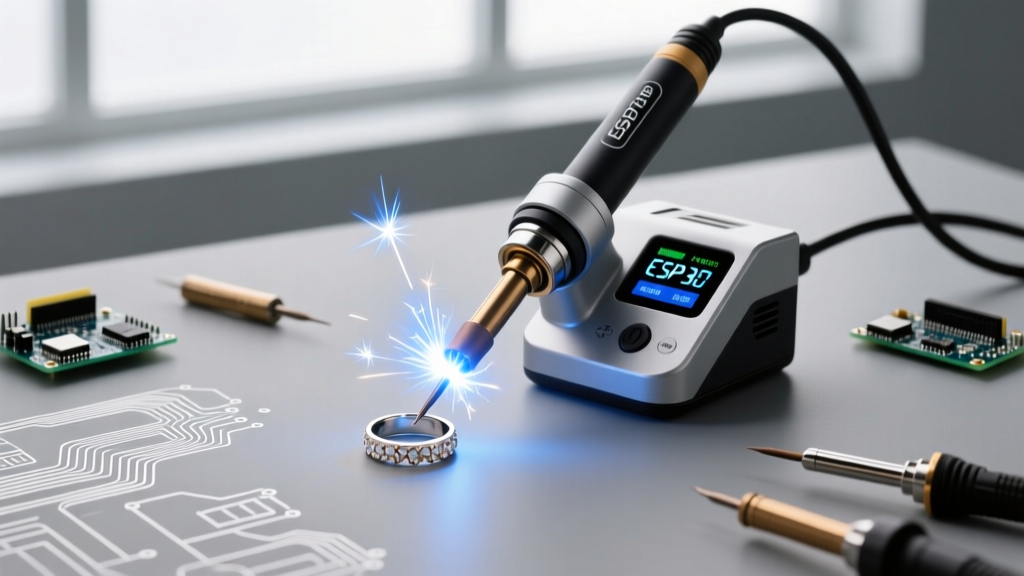
Flux residues cause skin irritation, filler metals create visible, discolored joints, and the broad heat spread of a soldering gun will melt delicate 14k gold-filled or sterling silver chains. The industry standard for permanent jewelry is the Pulse Arc Welder (often referred to as a micro-TIG welder). These machines use a concentrated electrical arc to fuse the base metals together at a molecular level without any filler material, resulting in a seamless, virtually invisible weld.
Below, we break down the best pulse arc welders dominating the permanent jewelry market in 2026, providing exact settings, pricing, and metallurgical insights to help you choose the right equipment for your studio.
2026 Comparison Matrix: Top Pulse Arc Welders
| Model | Max Energy | Avg. Price (2026) | Best For | Interface |
|---|---|---|---|---|
| Sunstone Orion 250s | 250 Ws | $5,800 - $6,200 | High-volume studios, thick chains | Color Touchscreen |
| PepeTools Ultra Pulse Arc | 110 Ws | $3,100 - $3,400 | Mid-tier studios, gold-filled | Digital / Dial |
| Generic 110V Import Welder | 90 Ws | $600 - $850 | Beginners, low-budget startups | Analog Knobs |
In-Depth Equipment Reviews
1. Sunstone Orion 250s (The Industry Gold Standard)
The Sunstone Orion series remains the undisputed heavyweight in the permanent jewelry space. The 250s model provides up to 250 watt-seconds (Ws) of energy, which is critical when welding higher-mass items like heavy Cuban link chains or solid 14k gold clasps.
- Pros: Unmatched arc stability, auto-darkening optical sensors built into the microscope, intuitive touchscreen with pre-programmed metallurgical profiles, and advanced pulse-shaping capabilities.
- Cons: Premium price point; requires a dedicated 20A circuit in older buildings to prevent tripping breakers during high-Ws discharges.
Expert Settings: For a standard 5mm sterling silver jump ring (0.8mm wire thickness), set the Orion 250s to 45 Ws with a 5ms pulse width. Ensure your argon gas post-flow is set to 2.0 seconds to prevent oxidation as the silver cools.
2. PepeTools Ultra Pulse Arc (The Mid-Tier Workhorse)
PepeTools has carved out a massive niche for studios that need professional reliability without the $6,000 investment. The Ultra Pulse Arc is a 110V system that excels at welding 14k gold-filled and delicate sterling silver chains.
- Pros: Excellent capacitor longevity, compact footprint, and highly reliable foot-pedal actuation. The arc focus is tight enough to weld near delicate gemstone settings without causing thermal shock.
- Cons: Lacks the advanced touchscreen interface of the Sunstone; dialing in exact pulse widths requires more manual trial and error.
Expert Settings: When welding 14k gold-filled jump rings (which have a brass core and a thin gold exterior), you must use lower energy to avoid burning through the gold layer. Set to 25 Ws with a very short 3ms pulse width.
3. Budget 110V Import Welders (The Starter Gamble)
Available on various e-commerce platforms under brands like VEVOR, Sismart, or unbranded generic names, these $600 to $850 machines use basic capacitor-discharge technology. While they can weld permanent jewelry, they come with significant caveats.
- Pros: Highly accessible entry price; includes basic argon gas tubing and a standard stereomicroscope.
- Cons: Inconsistent capacitor charging (leading to blowouts or weak welds), poor quality tungsten electrode holders, and lack of precise pulse-width control. You are essentially trading money for a steep learning curve.
Industry Warning: Budget welders often suffer from 'capacitor drift' after 6 to 12 months of heavy use. The energy output displayed on the analog dial may no longer match the actual arc discharge, leading to sudden blowouts on delicate chains. If you start with a budget machine, plan to upgrade within your first year of profitable operation.
Mandatory Ancillary Gear: Do Not Skip
Buying the welder is only 60% of the battle. To achieve seamless, oxidation-free welds, you must invest in the following support equipment:
Argon Gas Setup
Pulse arc welding in ambient air will cause sterling silver and copper alloys to oxidize instantly, resulting in a brittle, black, and porous weld. You must flood the weld zone with Argon gas. According to metallurgical standards referenced by major jewelry suppliers like Rio Grande, you need 99.995% pure Argon. Set your regulator to a flow rate of 0.5 to 0.8 CFH (Cubic Feet per Hour). Any higher, and the gas turbulence will actually pull oxygen into the weld pool.
Optical Eye Protection
The micro-TIG arc emits intense ultraviolet (UV) and infrared (IR) radiation. Staring at the arc without protection will cause 'arc eye' (photokeratitis) within minutes. While most machines include a microscope with an auto-darkening filter, you must ensure your secondary protective eyewear meets OSHA standards for welding shades. A minimum of Shade 10 is required for peripheral viewing, though Shade 11 is preferred for prolonged sessions.
Expert Troubleshooting: Failure Modes & Fixes
Even with a $6,000 Sunstone welder, poor technique will ruin your jewelry. Here are the most common failure modes and how to fix them:
1. The 'Blowout' (Hole in the Chain)
The Cause: The jump ring gap is too wide, or the energy (Ws) is too high. When the gap exceeds 0.2mm, the arc has to bridge empty space, causing the metal on either side to vaporize rather than fuse.
The Fix: Use high-quality flush cutters (not bevel cutters) to snip your jump rings. The two ends must meet with zero light passing between them. If you hold the closed jump ring up to a light source and see a sliver of light, recut the ring.
2. Porosity and Black Soot
The Cause: Inadequate argon shielding or surface contamination. Lotions, oils from fingers, and polishing compounds will vaporize during the weld, trapping gas bubbles inside the molten metal pool.
The Fix: Always wipe the jump ring and chain ends with isopropyl alcohol (90% or higher) before welding. Ensure your argon hose has no micro-leaks and that the nozzle is positioned within 3mm of the weld zone.
3. The 'Pull-Apart' (Weak Weld)
The Cause: The pulse width is too short, meaning the arc didn't stay on long enough to achieve full thermal penetration through the cross-section of the wire.
The Fix: Increase your pulse width by 1ms to 2ms. For a 1.0mm thick gold chain, a 3ms pulse might only fuse the outer 30% of the wire. Bumping it to 5ms ensures the core reaches melting temperature, creating a structural weld that can withstand 15+ lbs of tensile pull force.
Frequently Asked Questions
Can I use a standard spot welder for permanent jewelry?
No. Spot welders use two copper electrodes to clamp the metal and pass a current through the workpiece. This requires flat surfaces and leaves distinct pockmarks. Pulse arc welders use a non-contact tungsten electrode to create an external plasma arc, which is the only way to weld a 3D jump ring without crushing the chain.
How often should I sharpen the tungsten electrode?
The tungsten electrode must be sharpened to a precise needle point using a diamond file or dedicated tungsten grinder. In a high-volume studio doing 20+ welds a day, you should lightly dress the tip every 3 to 4 days. A blunt electrode causes the arc to wander, resulting in asymmetrical welds and accidental chain melting.
Is permanent jewelry welding safe for the client's skin?
Yes, when done correctly. The thermal pulse lasts only milliseconds (typically 3ms to 9ms). The heat affected zone (HAZ) is less than 1.5mm. Because the weld is completed before the client's wrist is fully in the loop (the chain is welded while draped over a protective leather pad or ceramic block), there is zero risk of burning the client.