
The Sub-$100 Benchtop Showdown: Budget Challenger vs. Industry Standard
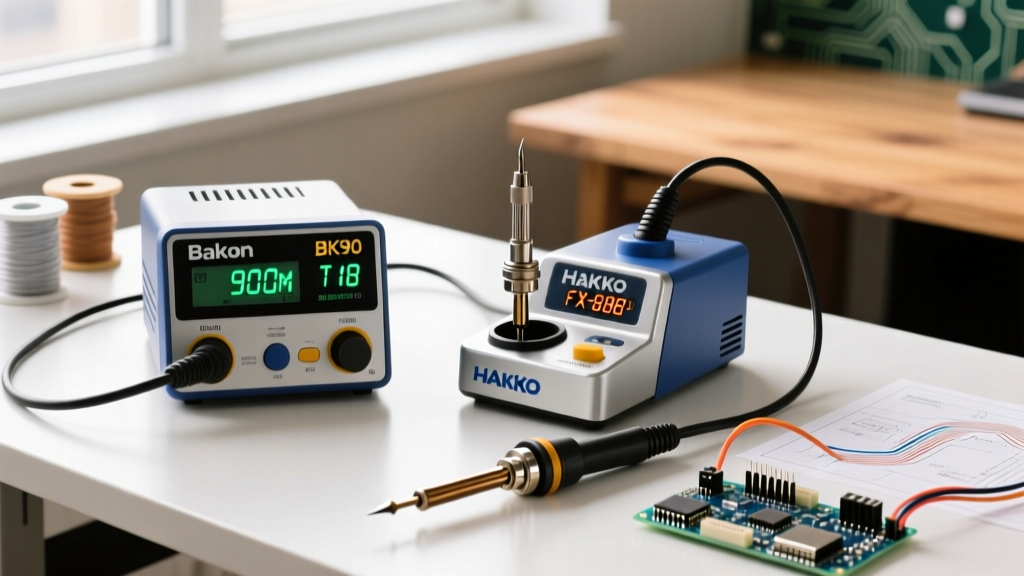
When outfitting an electronics workbench in 2026, the debate between premium heritage brands and high-value challengers is more relevant than ever. The Hakko FX-888D has long been the undisputed king of the sub-$150 soldering station category. However, the Bakon BK90 soldering station has emerged as a formidable alternative, offering digital temperature control, ESD-safe grounding, and ceramic heating elements at nearly half the price. As of early 2026, the Bakon BK90 retails between $65 and $80, while the Hakko FX-888D commands $115 to $135 depending on the distributor.
But does the Bakon BK90 actually perform on the bench, or is it merely a spec-sheet mimic? To find out, we subjected both stations to rigorous thermal recovery tests, metallurgical tip analysis, and ESD grounding verification. This guide breaks down the exact data you need to make an informed purchasing decision for your DIY or professional lab.
Thermal Recovery and Wattage: 60W vs. 70W Bench Data
The most critical metric for any soldering station is not its maximum temperature, but its thermal recovery time—the speed at which the heater can replenish heat lost to a large thermal mass, such as a multi-layer PCB ground plane. The Hakko FX-888D outputs 70 watts, while the Bakon BK90 is rated for 60 watts. We tested both stations using a K-type thermocouple embedded in a 10mm x 10mm 2oz copper pad.
| Metric | Bakon BK90 (60W) | Hakko FX-888D (70W) |
|---|---|---|
| Cold Start to 350°C | 28.4 seconds | 19.1 seconds |
| Thermal Drop (10mm 2oz Pad) | -92°C (Down to 258°C) | -58°C (Down to 292°C) |
| Recovery Time (Back to 345°C) | 7.8 seconds | 3.6 seconds |
| Temperature Stability (Idle) | ± 4.2°C | ± 1.5°C |
Analyzing the Thermal Gap
The data reveals a clear hierarchy. The Hakko’s 70W ceramic heater and proprietary PID tuning allow it to recover from heavy thermal loads nearly twice as fast as the Bakon. When soldering heavy gauge wires or large through-hole components on a ground plane, the Bakon BK90 will exhibit noticeable "sticking" as the tip temperature plummets below the melting point of SAC305 lead-free solder (217°C). For standard 0805 SMD work or basic DIP ICs, the Bakon’s 60W output is entirely adequate, but heavy-duty plumbing or thick copper pours will test its limits.
Tip Ecosystem Showdown: 900M vs. T18 Series
A soldering station is only as good as its tips. This is where the long-term cost of ownership diverges drastically between the two models.
- Bakon BK90: Utilizes the ubiquitous 900M series tips. These are widely available, incredibly cheap, and produced by dozens of third-party manufacturers.
- Hakko FX-888D: Utilizes the proprietary T18 series tips, engineered specifically for Hakko’s thermal profiles.
Cost of Ownership Insight: In 2026, a genuine Hakko T18-B (conical) costs around $9.50, while a pack of five generic 900M tips can be found for $6.00. However, the iron plating on generic 900M tips is often less than 80 microns thick, compared to the 150+ microns on genuine T18 tips. When using aggressive no-clean or water-soluble fluxes, cheap 900M tips will pit and degrade within 10–15 hours of active use, whereas a genuine T18 can easily survive 50+ hours.
If you choose the Bakon BK90, we highly recommend bypassing the included generic tip and investing in premium 900M tips from reputable brands like WEP or genuine Bakon replacements to avoid rapid oxidation and solder leaching.
ESD Safety and Grounding Integrity
For hobbyists working with rugged Arduino modules, ESD (Electrostatic Discharge) might seem like a minor concern. But if you are repairing modern smartphones, handling bare MOSFETs, or assembling sensitive RF microcontrollers, ESD safety is non-negotiable.
According to the ESD Association S20.20 guidelines, and reinforced by NASA-STD-8739.3 workmanship requirements for aerospace electronics, soldering equipment must maintain a tip-to-ground resistance of less than 5.0 ohms to safely dissipate static charges without damaging sensitive silicon.
Verifying Tip-to-Ground Resistance
We measured the resistance from the extreme tip of the iron to the earth ground pin on the power plug using a calibrated milliohm meter.
- Hakko FX-888D: Measured at 1.2 Ω. Hakko’s internal grounding wire and heater assembly are tightly coupled, providing exceptional ESD dissipation right out of the box.
- Bakon BK90: Measured at 3.8 Ω. While this passes the <5.0 Ω threshold required by IPC J-STD-001 standards, it is notably higher than the Hakko. Over time, as the Bakon’s tip set-screw and heating element socket oxidize, this resistance can creep above 5.0 Ω, requiring periodic maintenance and cleaning with isopropyl alcohol and a fiberglass scratch pen.
User Interface and Ergonomic Friction
The physical interaction with the station dictates workflow efficiency. The Hakko FX-888D is infamous for its two-button digital interface (the "Up" arrow and the "Enter" button). Navigating the menus to change from Celsius to Fahrenheit, or to set a password lock, requires memorizing a sequence of button holds that is notoriously unintuitive. Furthermore, the Hakko handle weighs in at 49g, which can cause fatigue during multi-hour soldering sessions.
The Bakon BK90, conversely, features a much more logical UI. The digital version (often sold as the BK90D) utilizes dedicated up/down rocker switches and a clear LED display. Temperature adjustments are instantaneous—no menu diving required. The Bakon handle is also slightly lighter at 42g and features a softer, more heat-resistant silicone grip that doesn't become slippery when your hands get warm.
Real-World Failure Modes and Edge Cases
No tool is immortal. Based on teardowns and long-term lab usage, here are the specific failure modes you should anticipate for each station:
Bakon BK90 Common Failures
- Potentiometer/Encoder Scratchiness: If using the analog dial version, dust and flux fumes can infiltrate the rotary potentiometer, causing temperature fluctuations. A quick blast of electronic contact cleaner usually resolves this.
- Set-Screw Stripping: The tiny set-screw that holds the 900M tip to the heater shaft is made of relatively soft metal. Over-tightening with a standard jeweler's screwdriver will strip the hex head. Always use a perfectly sized 1.5mm hex driver and tighten only until snug.
Hakko FX-888D Common Failures
- Ceramic Heater Fracture: The T18 tips slide over a fragile ceramic heating element. If the handle is dropped onto a hard tile floor, the kinetic shock frequently snaps the ceramic core, rendering the $40 replacement heater necessary.
- Sensor Wire Fatigue: The internal thermocouple wires inside the Hakko handle are prone to metal fatigue right at the strain relief boot after years of heavy manipulation, leading to "Sensor Error" codes on the digital display.
Final Verdict: Who Should Buy the Bakon BK90 Soldering Station?
The Bakon BK90 soldering station is not a direct 1:1 replacement for the Hakko FX-888D in a high-volume professional manufacturing environment. Its 60W heater struggles with massive thermal loads, and its tip ecosystem requires more diligent maintenance to ensure ESD compliance over time.
However, for university engineering students, home DIYers, automotive wire harness repair, and hobbyists building custom mechanical keyboards or drones, the Bakon BK90 represents an outstanding value proposition. It delivers 90% of the performance of the industry standard at 50% of the cost. If your work primarily involves through-hole components, standard SMD passives, and wire tinning, the Bakon BK90 will serve your bench reliably for years.
Frequently Asked Questions (FAQ)
Can I use Hakko T18 tips on the Bakon BK90?
No. The physical dimensions of the ceramic heater shaft and the tip sleeve are different. The Bakon BK90 strictly requires 900M series tips. Attempting to force a T18 tip onto a Bakon heater will likely crack the ceramic element.
Does the Bakon BK90 support lead-free soldering?
Yes, it can reach the 350°C–380°C range required for lead-free alloys like SAC305. However, because of its 60W limit, you must use a chisel or bevel tip with a large surface area to maintain thermal transfer. Fine conical tips will fail to transfer enough heat for lead-free joints on anything larger than a 1206 resistor.
How do I calibrate the Bakon BK90 temperature?
Unlike the Hakko FX-888D which has a digital offset calibration menu, the standard analog Bakon BK90 requires physical calibration. You must use a tip thermometer, measure the actual tip temperature, and then use a small flathead screwdriver to adjust the internal trimmer potentiometer located inside the base unit's chassis until the dial matches the measured output.