
The Metallurgical Reality: What Happens Without Flux?
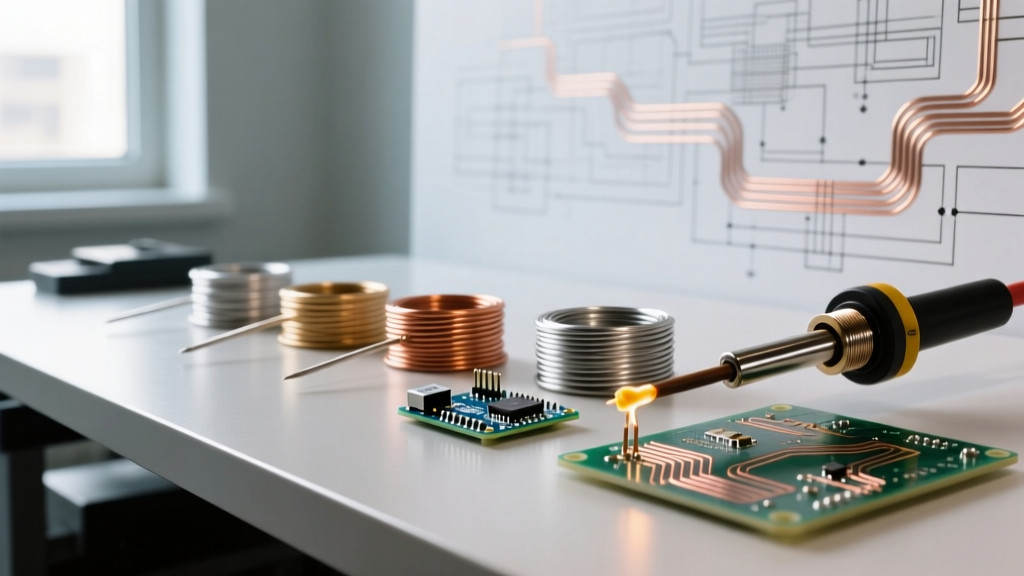
When engineers and hobbyists ask why use flux for soldering, the answer is rarely understood beyond the vague notion that it "helps the solder flow." In reality, flux is not a lubricant; it is a critical chemical reducing agent required to achieve metallurgical bonding. To understand its necessity, we must examine the behavior of copper and solder alloys at a microscopic level.
At room temperature, exposed copper traces and component leads immediately begin to oxidize, forming a thin layer of cuprous oxide (Cu2O). When a soldering iron elevates the joint temperature to typical working ranges (320°C to 380°C), this oxidation accelerates exponentially, creating a thicker, more stubborn layer of cupric oxide (CuO). Molten solder—whether leaded Sn63/Pb37 or lead-free SAC305—has a high surface tension (approximately 550 mN/m for SAC305). When molten solder contacts this oxide layer, it cannot wet the surface. Instead of forming an intermetallic compound (IMC) with the base metal, the solder balls up, resulting in a non-wetting or de-wetting failure.
Flux chemically strips this oxide layer away at the exact moment the solder reaches its liquidus state, exposing pristine, reactive copper and allowing the tin in the solder alloy to form a robust Cu6Sn5 intermetallic layer. According to the NASA Workmanship Manual for Soldering, a proper solder joint requires a wetting angle of less than 90 degrees, a physical state that is entirely impossible to achieve in an oxygen-rich environment without chemical intervention.
Flux Chemistry Matrix: Rosin vs. No-Clean vs. Water-Soluble
Selecting the correct flux chemistry is just as important as understanding why you need it. The IPC J-STD-004 Standard categorizes fluxes by their base material and activity level. Below is an expert comparison matrix for 2026 consumable selection:
| Flux Category | Chemical Base | Activation Temp | Residue Characteristics | Cleaning Required? | Best Application |
|---|---|---|---|---|---|
| Rosin Mildly Activated (RMA) | Pine rosin + mild halides | 150°C - 180°C | Hard, amber, non-conductive | Optional (Aesthetic) | General through-hole, wire tinning |
| No-Clean (NC) | Synthetic resins + organic acids | 140°C - 170°C | Clear, tacky, highly resistive | No (Unless high-frequency RF) | SMD rework, BGA, 0402 passives |
| Water-Soluble (OA) | Organic acids (e.g., lactic, stearic) | 180°C - 220°C | Highly acidic, hygroscopic, corrosive | Yes (Mandatory within 4 hours) | Automated wave soldering, heavy oxidation |
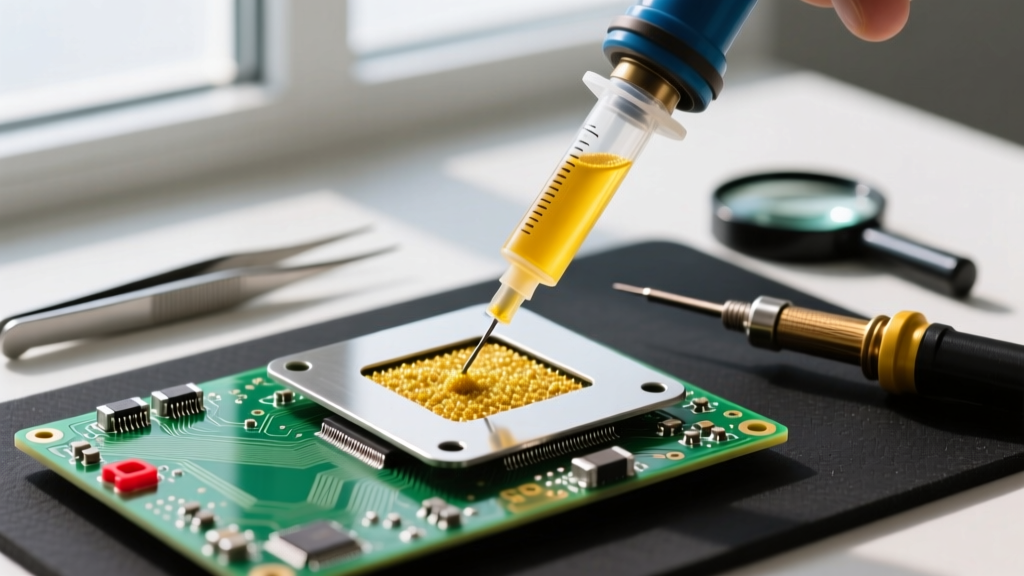
| Tack Flux (Syringe) | Thixotropic no-clean gel | 150°C - 190°C | High viscosity, holds components in place | No | BGA reballing, drag soldering QFPs |
Expert Recommendations: 2026 Flux Selection Guide
Based on extensive bench testing and current market availability, here are the top-tier expert recommendations for specific soldering scenarios.
Scenario A: Precision SMD & BGA Rework
When working with 0402 passives or fine-pitch QFP/BGA ICs, you need a flux that provides physical tackiness to prevent tombstoning while leaving a residue that won't interfere with high-impedance nodes.
- Top Pick: Amtech NC-559-V2-TF (Tack Flux)
- Format: 10g Syringe with 0.5mm dispensing tips
- Price Range: $45 - $52 USD
- Expert Insight: The thixotropic nature of this gel means it flows when pushed through the needle but instantly holds its shape on the pad. It is the industry standard for holding micro-components in place before the solder melts.
Scenario B: General Purpose PCB Assembly & Wire Tinning
For standard through-hole components, DIP ICs, and tinning 22AWG to 14AWG silicone wires, a liquid or paste rosin flux provides the best balance of wetting speed and ease of use.
- Top Pick: Kester 186 (RMA Liquid Flux) or MG Chemicals 8341 (Rosin Paste)
- Format: 1 Liter bottle (Kester) / 50g Jar (MG)
- Price Range: $24 - $32 USD
- Expert Insight: Kester 186 contains a precise 2% halide activator that cuts through light oxidation instantly. For wire tinning, dipping the stripped wire into the MG 8341 paste jar before applying the iron ensures a perfectly bright, uniform solder coating without the mess of liquid splatters.
Scenario C: High-Current Busbars & Heavy Oxidation
Soldering thick copper busbars or heavily oxidized legacy connectors requires aggressive chemistry. Standard rosin will fail here due to the massive thermal mass and thick oxide layers.
- Top Pick: Chip Quik SMD291SNL10 (for SMD) or specialized Acid Flux (for non-electrical plumbing/structural)
- Warning: Never use plumbing acid flux (Zinc Chloride) on PCBs. It will cause rapid galvanic corrosion and dendrite growth, destroying the board within weeks.
Expert Thermal Profiling Tip: Flux activation temperature is not the same as solder liquidus. If your iron is set to 400°C and you touch the joint for less than 1 second, the flux may boil off or burn (carbonize) before it has time to chemically reduce the copper oxide. Always allow 1.5 to 3 seconds for the flux to activate and bubble before feeding the solder wire.
Diagnosing Flux-Starved Failure Modes
Understanding why use flux for soldering also means knowing how to identify joints that suffered from insufficient flux application. Inspect your work under a 10x loupe or microscope for these specific failure modes:
- Icicles and Skips: Common in wave or hand soldering of DIP pins. The solder clings to one side of the pad and bridges to the next, leaving a sharp "icicle" peak. This indicates poor wetting due to localized oxidation.
- Grainy / Dull Cold Joints: While often blamed on physical movement during cooling, a grainy appearance is frequently caused by the solder cooling too slowly because the flux failed to transfer heat efficiently, or the joint was starved of flux, creating a thick, brittle IMC layer instead of a smooth eutectic solidification.
- De-Wetting (Crawling): The solder initially wets the pad but then pulls back into a ball, leaving a thin, discontinuous film of solder behind. This happens when the flux exhausts its chemical activators before the solder fully flows, allowing the oxide layer to reform underneath the molten pool.
- Electromigration (Dendrites): If water-soluble flux is used and not properly cleaned with heated deionized water, the hygroscopic residue absorbs ambient moisture. Under DC voltage bias, this creates an electrolytic cell that grows microscopic tin or silver dendrites between pads, eventually causing a hard short circuit.
Application Techniques: Syringe, Pen, or Paste?
The delivery method of your flux drastically impacts your workflow and joint quality.
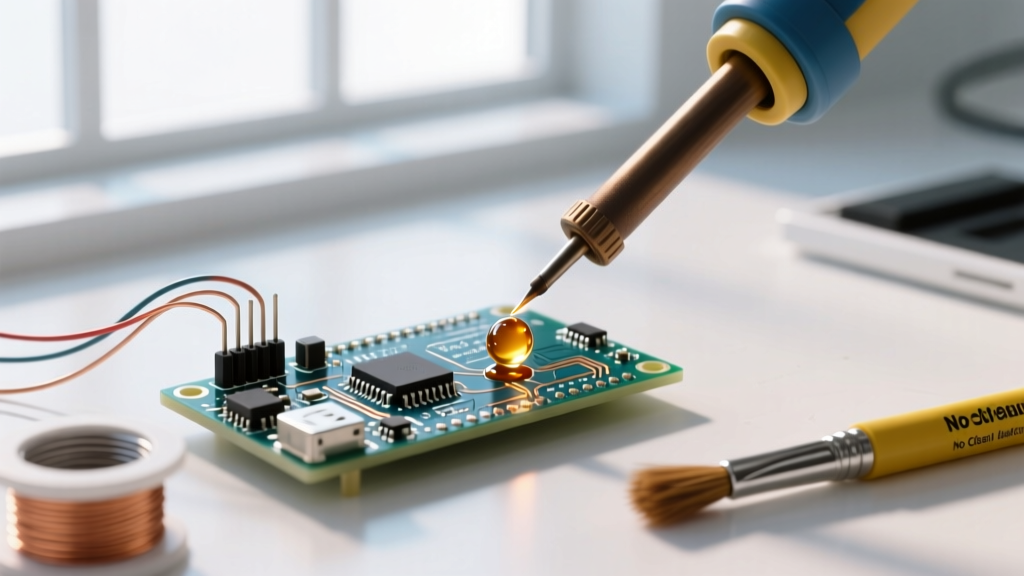
- Flux Pens (e.g., Kester 951): Ideal for quick drag-soldering of SOIC chips. The brush applicator lays down a uniform 2mm wide track. Drawback: The alcohol solvent evaporates rapidly; you must solder within 60 seconds of application.
- Syringe Gel (e.g., Amtech NC-559): Essential for BGA rework and 0402 components. Use a 22-gauge blunt tip needle for general application, and step down to a 30-gauge needle for micro-BGA pads. Apply a 0.5mm dot directly to the center of the pad array.
- Rosin Paste Jars: Best for heavy wire tinning and large mechanical lugs. The high viscosity prevents the flux from running off vertical surfaces before the iron heats the mass.
Frequently Asked Questions (FAQ)
Doesn't the flux core inside my solder wire provide enough flux?
Standard solder wire (like Kester 245 or Sn63/Pb37) contains a 2% to 3% flux core by weight. This is perfectly adequate for pristine, brand-new PCB pads and fresh component leads. However, it is entirely insufficient for rework, repair, or soldering to oxidized surfaces. The core flux is designed to activate as the wire melts, but in rework scenarios, the existing oxidation requires a separate, generous application of external flux to break down the barrier before the new solder can integrate with the old joint.
Why does my no-clean flux residue turn black and crusty?
If your no-clean flux is turning dark brown or black, your soldering iron temperature is too high, or your dwell time is too long. No-clean fluxes rely on synthetic resins that carbonize when exposed to temperatures exceeding 350°C for more than 4-5 seconds. Carbonized flux loses its dielectric properties and can become slightly conductive in high-humidity environments. Lower your iron temperature to 320°C-340°C for lead-free SAC305, and use a chisel tip to maximize thermal transfer speed.
Can I use isopropyl alcohol (IPA) to clean no-clean flux?
While IPA (99%) will dissolve the visible resin, it often just spreads the invisible, active halide salts across the PCB surface. For true cleaning of no-clean or RMA residues, use a dedicated PCB cleaner (like MG Chemicals Super Wash) or a saponified water bath, followed by a thorough rinse and bake-out. For more advanced cleaning protocols, refer to the Indium Corporation Technical Resources library on flux residue management.
Final Verdict
Skipping flux to save time or money is a false economy that guarantees compromised metallurgical integrity. Whether you are assembling a high-frequency RF board requiring ultra-low residue, or repairing a heavy-gauge automotive harness, treating flux as a primary chemical reagent rather than an afterthought is the hallmark of professional-grade electronics work. Invest in high-quality, application-specific fluxes, respect their thermal activation profiles, and your solder joints will consistently meet IPC Class 2 and Class 3 reliability standards.