
The Core Chemistry: What Is Flux For in Soldering?
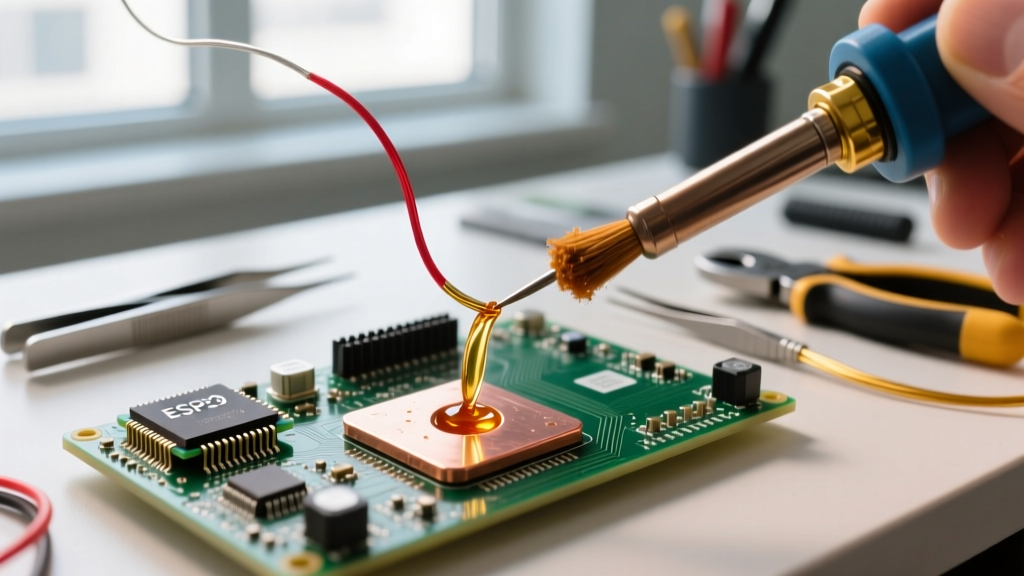
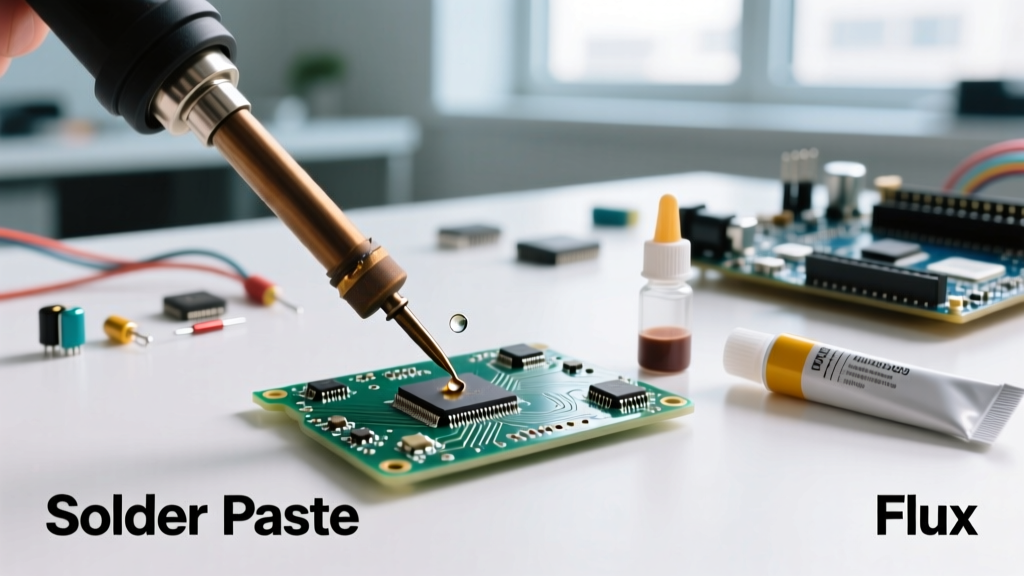
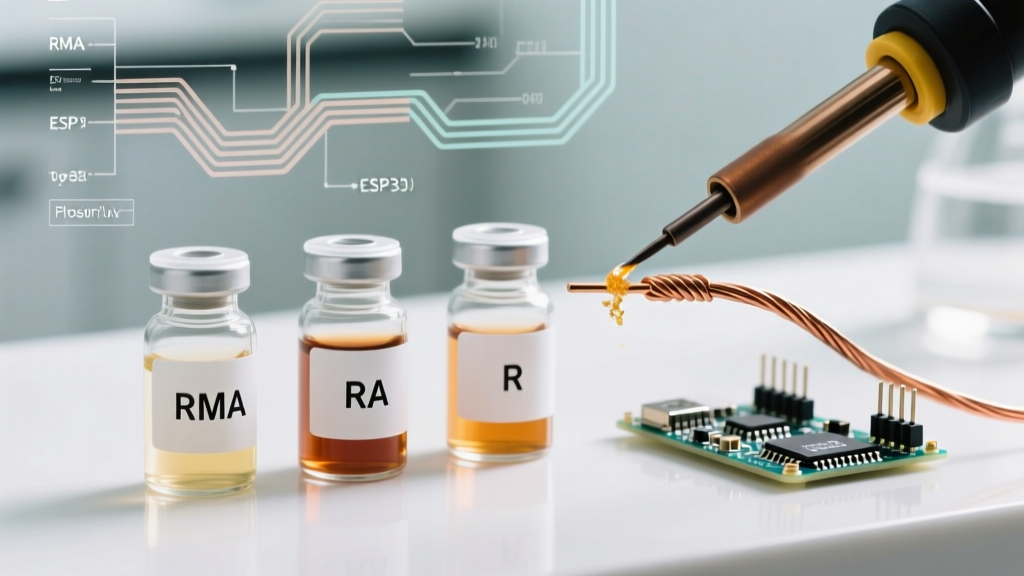
At its most fundamental level, flux is a chemical reducing agent. When you ask, "what is flux for in soldering?", the answer extends far beyond simply helping solder "stick." In reality, molten solder will not wet to oxidized copper. Flux serves three critical thermodynamic and chemical functions during the soldering process:
- Oxide Reduction: As temperatures approach 150°C, chemical activators (typically carboxylic acids like adipic or succinic acid) break down copper oxide (CuO) on the PCB pads and component leads, converting them into water vapor and metal salts.
- Oxygen Shielding: The base resin (rosin or synthetic) melts and forms a physical barrier over the joint, preventing atmospheric oxygen from reforming oxides while the solder reaches its liquidus phase.
- Surface Tension Reduction: Flux lowers the surface tension of the molten solder alloy, allowing capillary action to pull the solder into plated through-holes (PTH) and under tight-pitch surface mount pads.
Expert Insight: If your flux boils and spatters before the solder melts, your preheat ramp rate is too aggressive. Flux must activate before the alloy reaches its liquidus temperature (e.g., 217°C for SAC305) to ensure proper wetting.
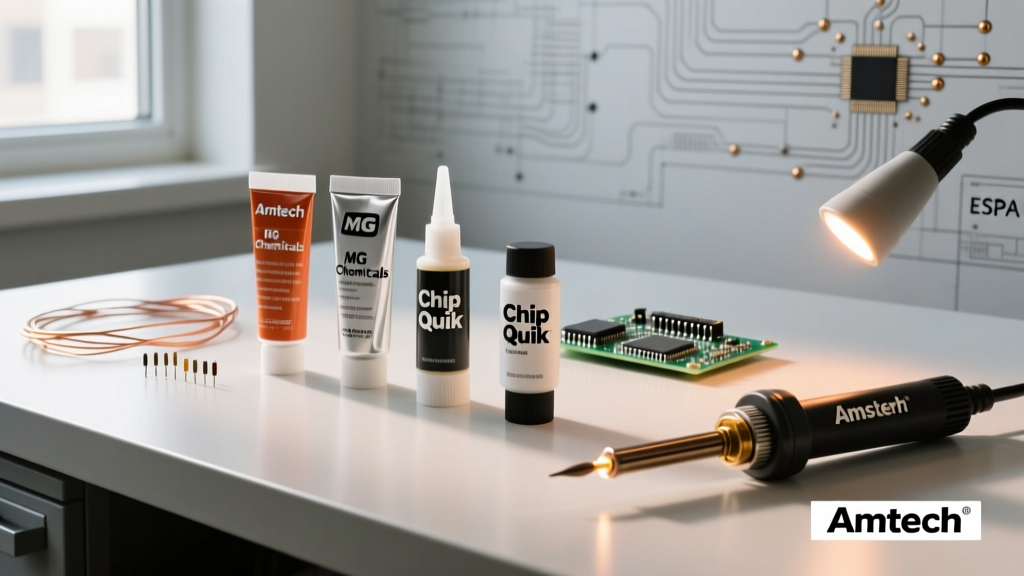
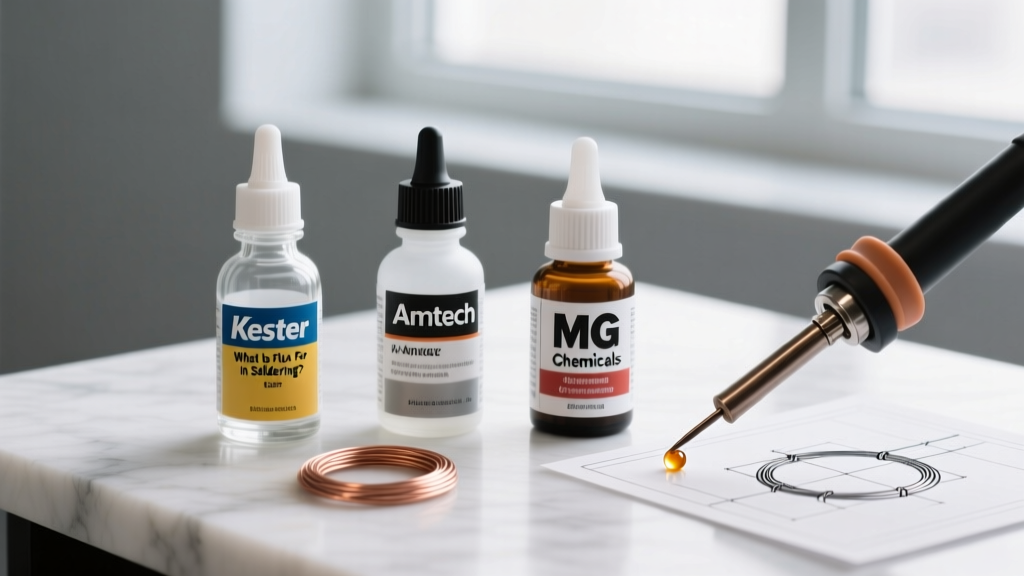
To understand how different manufacturers formulate these chemicals, we must look at the IPC J-STD-004B standards, which classify flux by base material (Rosin, Resin, Organic, Inorganic) and activity level. As of 2026, the market is dominated by three distinct brand philosophies: Kester (high-reliability industrial), Amtech (advanced SMD rework), and MG Chemicals (accessible prototyping).
Brand Deep-Dive: Kester, Amtech, and MG Chemicals
1. Kester: The High-Reliability Standard
Kester (an ITW company) is the benchmark for aerospace, automotive, and high-volume manufacturing. Their formulations prioritize long-term reliability, minimal ionic residue, and strict adherence to NASA and military workmanship standards.
- Flagship Model: Kester 245 (No-Clean, ROL0 classification).
- Chemistry: Halogen-free, rosin-based. The ROL0 designation means it has zero halide activators, making it exceptionally safe for high-impedance circuits where electrochemical migration (dendrites) is a risk.
- Real-World Pricing (2026): ~$18.00 for a 10g syringe; ~$48.00 for a 1lb (454g) jar.
- Best Application: Hand soldering of sensitive mixed-signal PCBs, medical devices, and aerospace through-hole components where cleaning is impossible.
- Edge Case / Failure Mode: Kester 245 leaves a hard, glass-like residue. If you attempt to probe the board with a multimeter immediately after soldering, the residue can cause false continuity readings or high contact resistance. It also makes visual inspection of cold joints difficult due to the opaque, amber-colored crust it forms over the fillet.
2. Amtech: The SMD and BGA Rework Specialist
Amtech (now part of Indium Corporation) dominates the repair, reballing, and micro-soldering sector. Their fluxes are engineered for high-tack applications where components must be physically held in place prior to reflow.
- Flagship Model: Amtech NC-559-V2-TF (Tacky No-Clean Flux).
- Chemistry: Synthetic resin base with moderate activators (ROL1). The "TF" stands for Tacky Flux, boasting a viscosity exceeding 350 kcps (kilocentipoise).
- Real-World Pricing (2026): ~$38.00 for a 10cc syringe with precision dispensing tips.
- Best Application: BGA (Ball Grid Array) reballing, bottom-terminated component (BTC/QFN) rework, and micro-soldering under a microscope.
- Edge Case / Failure Mode: Because of its high viscosity, NC-559-V2-TF can trap solvent vapors if heated too quickly. This leads to "solder balling"—where microscopic spheres of solder get trapped in the flux residue next to the pad, creating latent short-circuit risks on 0.4mm pitch BGAs. A strict preheat profile (ramping at 2°C/sec) is mandatory.
3. MG Chemicals: The Accessible Prototyper
MG Chemicals provides highly accessible, budget-friendly consumables for hobbyists, university labs, and rapid prototyping environments. Their focus is on ease of use and aggressive wetting rather than aerospace-grade reliability.
- Flagship Model: MG Chemicals 8341 (No-Clean Paste Flux).
- Chemistry: Rosin-based with mild organic activators. It is noticeably more fluid than Amtech's tacky fluxes, making it easier to dispense from standard syringes without specialized air pressure equipment.
- Real-World Pricing (2026): ~$11.50 for a 10g syringe; ~$24.00 for a 50g jar.
- Best Application: General-purpose SMD soldering, drag-soldering SOIC chips, and through-hole prototyping where cost-efficiency is paramount.
- Edge Case / Failure Mode: MG 8341 has a lower thermal mass tolerance. When used on large ground planes without adequate preheating, the flux exhausts its chemical activators before the copper reaches soldering temperature. This results in "grainy" or "dull" solder joints, indicating severe oxidation that the flux failed to penetrate.
2026 Flux Comparison Matrix
The following matrix breaks down the technical specifications and economic factors of the three flagship fluxes to help you select the right consumable for your specific workflow.
| Brand & Model | IPC Classification | Viscosity (kcps) | Halide Content | Price (10g/10cc) | Primary Use Case |
|---|---|---|---|---|---|
| Kester 245 | ROL0 (No-Clean) | ~150 | 0.0% | $18.00 | High-reliability, medical, aerospace |
| Amtech NC-559-V2-TF | ROL1 (No-Clean) | >350 | <0.5% | $38.00 | BGA reballing, micro-soldering, QFN |
| MG Chemicals 8341 | ROL0 (No-Clean) | ~120 | 0.0% | $11.50 | Rapid prototyping, drag soldering |
Real-World Failure Modes: When Flux Selection Goes Wrong
Understanding what flux is for in soldering also means understanding the catastrophic failures that occur when the wrong type or brand is applied to the wrong scenario. Here are three common edge cases encountered in modern PCB assembly:
1. Tombstoning on 0201 Components
The Scenario: You are hand-soldering or hot-air reworking 0201 resistors using a low-tack, highly fluid flux like MG 8341.
The Failure: The fluid flux boils unevenly under the component, creating a localized vapor pocket. The surface tension on one pad overcomes the other, pulling the component upright (tombstoning).
The Fix: Switch to a high-tack flux like Amtech NC-559-V2-TF. The high viscosity physically anchors the component to the pads while the flux activators do their work uniformly.
2. Electrochemical Migration (Dendrites)
The Scenario: Using a Water-Soluble (OA / ORH1) flux for a high-impedance sensor board, assuming "no-clean" is optional.
The Failure: Water-soluble fluxes contain highly aggressive ionic activators. If left on the board and exposed to ambient humidity, these ions create conductive pathways between traces. Over weeks or months, dendritic crystals grow, causing intermittent short circuits.
The Fix: Never use water-soluble fluxes unless you have access to an ultrasonic cleaner and deionized (DI) water rinse station. For high-impedance circuits, strictly use halogen-free ROL0 fluxes like Kester 245.
3. Pad Cratering During BGA Rework
The Scenario: Applying excessive amounts of standard rosin paste flux under a large BGA chip before reflow.
The Failure: As the flux reaches its boiling point, the volatile solvents vaporize. Because the BGA is heavy and the flux cannot escape the tight 0.8mm pitch maze quickly enough, the expanding gas creates immense localized pressure, literally lifting the copper pad off the fiberglass substrate (pad cratering).
The Fix: Use a minimal, evenly distributed layer of ultra-low-voiding tacky flux. Ensure your rework station has a bottom-side preheater to slowly drive off solvents before the top-side hot air hits the liquidus temperature.
Expert Decision Framework
Choosing the right flux is not about finding the "best" brand overall; it is about matching the chemical formulation to your thermal profile and reliability requirements.
- Choose Kester if you are building hardware that will be deployed in harsh environments, subjected to thermal cycling, or requires strict IPC Class 3 compliance without post-solder cleaning.
- Choose Amtech if your work involves a microscope, hot-air rework stations, BGA stencils, and micro-soldering where component placement stability is just as important as the chemical wetting.
- Choose MG Chemicals if you are a student, hobbyist, or prototyper running through dozens of test boards a week, where cost-efficiency and ease of dispensing outweigh the need for zero-ionic-residue guarantees.
By understanding the precise chemical role flux plays in oxide reduction and surface tension modification, you can eliminate cold joints, prevent latent shorts, and dramatically improve the structural integrity of your solder connections.