
The Invisible Catalyst: Why Solder Won't Stick Without Flux
When troubleshooting a cold solder joint or a bridged SMD pad, beginners often blame the soldering iron, the tip temperature, or the solder wire itself. But to truly master electronics assembly and rework, you must answer a fundamental question: what does flux do in soldering? Simply put, solder wire is just the metallic filler; flux is the chemical catalyst that makes the metallurgical bond possible.
Without flux, molten solder will ball up and roll off a copper pad like water on a freshly waxed car. As of 2026, with the industry's continued shift toward complex lead-free alloys like SAC305 (Sn96.5/Ag3.0/Cu0.5) and low-temperature SnBiAg pastes, understanding flux chemistry is no longer optional—it is the primary differentiator between a reliable IPC-A-610 Class 3 joint and a field-failure waiting to happen.
The Chemistry of Oxidation and the Flux Solution
To understand what flux does, you must first understand the enemy: oxidation. When copper (the base metal of your PCB pads and component leads) is exposed to ambient air, it immediately begins forming a microscopically thin layer of copper oxide (CuO and Cu2O). Molten tin and silver cannot wet to copper oxide. They will only wet to pure, bare copper.
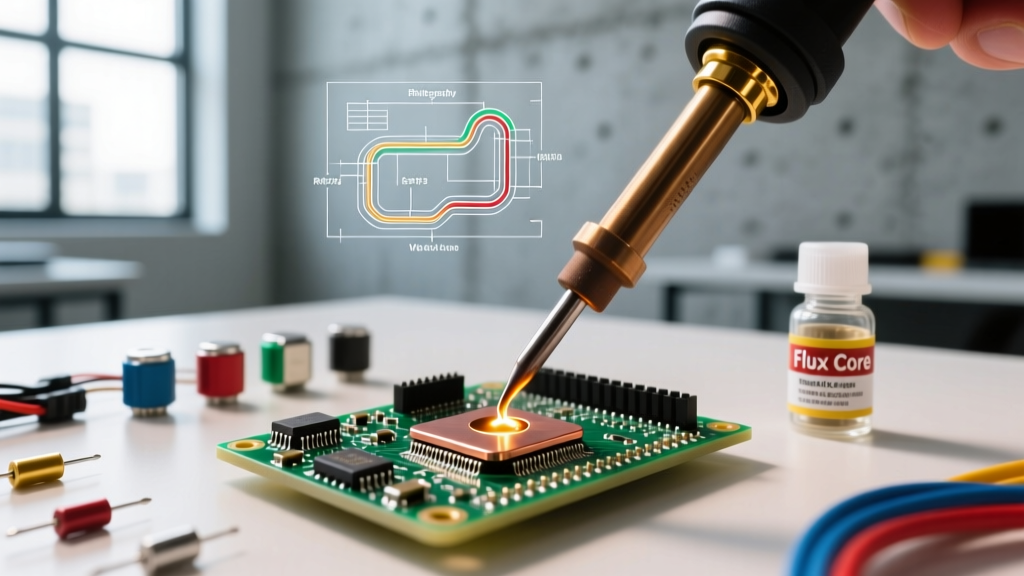
Flux is a mildly acidic chemical compound engineered to activate at specific temperatures. When heated, the flux dissolves the oxide layer, exposing the pristine copper underneath just milliseconds before the solder alloy reaches its liquidus temperature and flows into the gap.
The Three Pillars of Flux Action
- Deoxidization (Chemical Cleaning): In traditional rosin flux, abietic acid reacts with copper oxide at roughly 150°C to form copper abietate, a soluble salt that lifts the oxide away from the joint interface.
- Surface Tension Reduction (Wetting): Flux lowers the surface tension of the molten solder. This reduces the contact angle, allowing the solder to flow into microscopic vias and under tight-pitch QFN pads via capillary action.
- Thermal Transfer: Liquid flux acts as a temporary thermal bridge, transferring heat from the soldering iron tip to the component lead and pad much faster than air alone, reducing dwell time and preventing thermal damage to the PCB laminate.
Expert Comparison Matrix: Flux Types & 2026 Product Picks
Choosing the wrong flux type is the leading cause of post-soldering corrosion and electromigration. Below is an expert breakdown of the three primary flux categories used in modern electronics, complete with current market recommendations.
| Flux Category | Core Chemistry | Activation Temp | Cleaning Required? | Expert Product Pick & Pricing |
|---|---|---|---|---|
| Rosin (RA/RMA) | Abietic & Pimaric Acids (Pine Sap derived) | 150°C - 180°C | Optional (but recommended for high-reliability) | Kester 44 Cored Wire (~$38 / 1oz tube) |
| No-Clean | Synthetic Resins & Weak Organic Acids | 180°C - 200°C | No (Residue is benign and highly resistive) | Amtech NC-559-V2-TF (~$45 / 10g syringe) |
| Water-Soluble (OA) | Adipic, Glutaric, or Citric Acids | 150°C - 170°C | Mandatory (Must use heated DI water) | MG Chemicals 8341 (~$25 / 10ml liquid) |
Real-World Failure Modes: When Flux Goes Wrong
Even the best flux will cause catastrophic assembly defects if applied incorrectly or if the thermal profile is mismanaged. According to the NASA Workmanship Training Standards for Soldering, proper wetting and flux exhaustion are critical for aerospace and high-reliability assemblies. Here is what happens when flux fails:
1. Tombstoning (The Drawbridge Effect)
In SMD assembly, if flux on one pad activates and outgasses before the other, the surface tension on the wetted side will physically pull the component upright, standing it on its end like a tombstone. Expert Fix: Ensure uniform heating (use a pre-heater or hot air gun at 120°C) before applying the iron, ensuring both pads reach the flux activation temperature simultaneously.
2. Solder Balls and Splatter
Water-soluble and some aggressive RA fluxes contain solvents or moisture. If you plunge a 350°C iron tip directly into a puddle of liquid flux, the solvents boil instantaneously, causing micro-explosions that scatter tiny spheres of solder across your PCB. Expert Fix: Apply flux, wait 5 seconds for solvents to evaporate, and heat the pad, not the flux directly.
3. Dendrite Growth and Electrochemical Migration (ECM)
If you use a water-soluble flux and fail to clean it with deionized (DI) water, the leftover organic acids will absorb ambient humidity. Under DC voltage bias, this creates an electrolytic cell that grows microscopic metallic "dendrites" between traces, eventually causing a short circuit. Always follow IPC J-STD-004 guidelines regarding flux residue classification and cleaning mandates.
Expert Warning: Never, under any circumstances, use plumbing flux (Zinc Chloride or Petrolatum-based) on electronics. Plumbing flux is highly corrosive and will literally eat through copper traces and component leads within weeks, causing irreversible galvanic corrosion.
Application-Specific Expert Recommendations
To maximize your success rate, match the flux formulation to your specific soldering scenario. Here is how professional rework technicians approach consumable selection in 2026.
Scenario A: Fine-Pitch SMD Rework (QFN, BGA, 0402s)
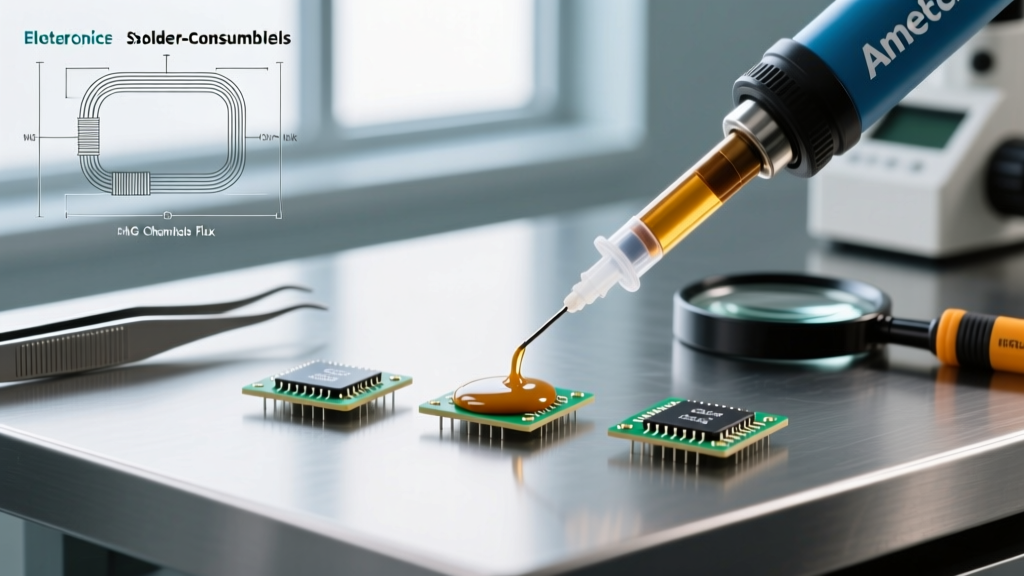
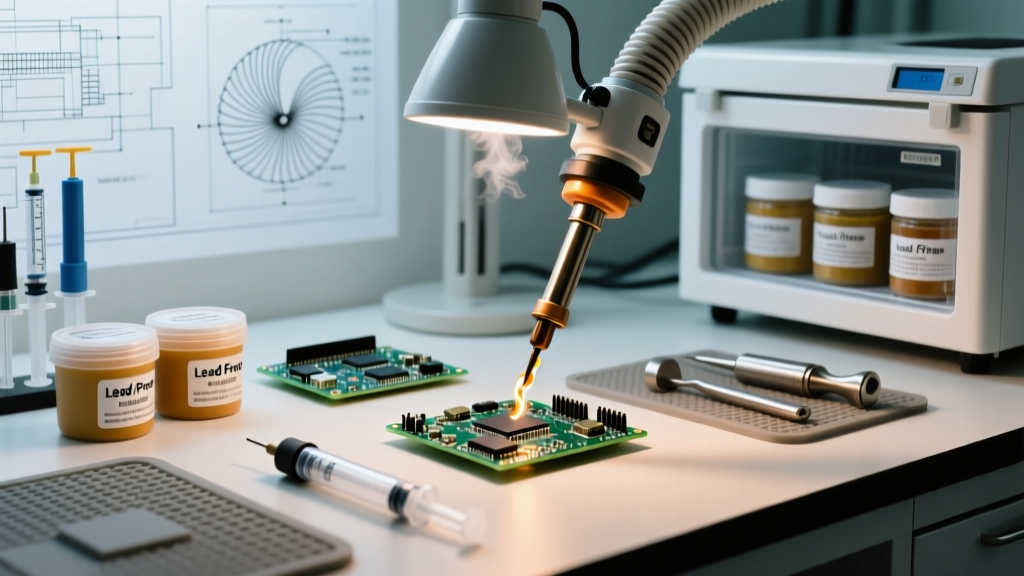
For surface mount rework, you need a No-Clean Tacky Flux. Tackiness holds the component in place while you apply heat, and the no-clean chemistry prevents you from having to scrub under a tight 0.5mm pitch QFN with isopropyl alcohol, which can actually push conductive residue under the component.
- Recommended Product: Amtech NC-559-V2-TF or Chip Quik NC191.
- Application Tip: Use a pneumatic syringe dispenser or a very fine needle tip. Apply a microscopic dot to the pads; excess flux will cause bridging when it boils.
Scenario B: General Through-Hole and Wire Tinning
For standard through-hole components, DIP ICs, and tinning stranded silicone wire, a Rosin-Core (RA) Solder Wire is the undisputed king. The internal flux core ensures that flux is delivered exactly where the heat is applied.
- Recommended Product: Kester 44 (63/37 or 60/40 Sn/Pb) or Kester 245 (for lead-free SAC305).
- Application Tip: Never melt solder on the iron tip and carry it to the joint. The flux will boil off in the 2 seconds it takes to move the iron, leaving you with a dry, oxidized blob. Always feed the solder wire directly into the heated joint.
Scenario C: Heavy Gauge Wire and Lugs (10 AWG and Thicker)
Thick copper wires act as massive heat sinks, drawing heat away from the iron and keeping the joint below the flux activation threshold for too long. For these high-thermal-mass joints, you need a highly active, high-temperature liquid flux applied externally before heating.
- Recommended Product: MG Chemicals 8341 Water-Soluble Liquid or a dedicated high-temp rosin paste.
- Application Tip: Paint the flux onto the stripped wire and the lug barrel. Use a high-wattage iron (100W+) or a micro-torch. Remember to clean the residue with distilled water and a stiff brush once the joint cools.
Summary: Mastering the Metallurgy
So, what does flux do in soldering? It is the chemical gatekeeper of the metallurgical bond. It strips away oxidation, lowers surface tension, and facilitates the intermetallic compound (IMC) layer that actually holds your circuit together. By understanding the activation temperatures of your specific flux and matching the chemistry to your cleaning capabilities, you will eliminate cold joints, prevent long-term corrosion, and achieve factory-grade reliability on your workbench.
For further reading on advanced wetting criteria and intermetallic layer thickness, consult the technical resources provided by the Indium Corporation, which offers deep-dive whitepapers on flux interactions with modern lead-free alloys.