
Beyond the Syringe: Matching Flux Chemistry to Your PCB
Choosing the correct flux is arguably the most critical variable in achieving reliable solder joints, yet it remains widely misunderstood. Flux is not merely a sticky medium to hold components in place; it is a complex chemical reducing agent designed to strip metallic oxides, lower surface tension, and facilitate intermetallic compound (IMC) formation. Using the wrong chemistry for your specific PCB surface finish or solder alloy will result in catastrophic failure modes, including electrochemical migration (ECM), dendritic growth, and cold joints.
In this comprehensive compatibility guide, we break down the primary types of soldering flux and map them to modern PCB finishes (ENIG, OSP, HASL) and solder alloys (SAC305, SN100C, Sn63/Pb37). Whether you are running a high-volume SMT line or performing precision BGA rework on a prototype, understanding these chemical interactions is mandatory for long-term reliability.
Decoding IPC J-STD-004B Classifications
Before matching flux to your board, you must understand how the industry categorizes them. The IPC Standards Portal outlines the J-STD-004B specification, which classifies fluxes by material composition, activity level, and halide content.
Expert Insight: Never rely solely on marketing terms like 'No-Clean' or 'Water-Soluble.' Always check the IPC designation on the technical data sheet (TDS). A flux designated as REL1 (Resin-based, Low-activity, with Halides) will behave vastly differently under thermal stress than an ORL0 (Organic, Low-activity, Zero Halides) formulation.
- RO (Rosin): Derived from pine tree extract (abietic acid). Excellent thermal stability but leaves a sticky, amber residue.
- RE (Resin): Synthetic or highly purified natural resins. Offers better consistency and higher activation temperatures than raw rosin.
- OR (Organic): Composed of organic acids (e.g., lactic, citric, stearic). Highly active at room temperature but extremely corrosive if left uncleaned.
- IN (Inorganic): Contains strong mineral acids (hydrochloric, zinc chloride). Used strictly for heavy industrial plumbing, never for electronics.
The Ultimate Flux Compatibility Matrix
The following matrix provides a rapid-reference framework for matching flux chemistry to your specific PCB surface finish and solder alloy. Mismatching these variables is the leading cause of non-wetting and pad cratering.
| Flux Type | Ideal PCB Finish | Compatible Alloys | Cleaning Requirement | Risk if Mismatched |
|---|---|---|---|---|
| Rosin (RMA/RA) | HASL (Leaded/Lead-Free) | Sn63/Pb37, Sn60/Pb40 | Isopropyl Alcohol (IPA) or Saponifier | Charred residue on ENIG; poor wetting on OSP. |
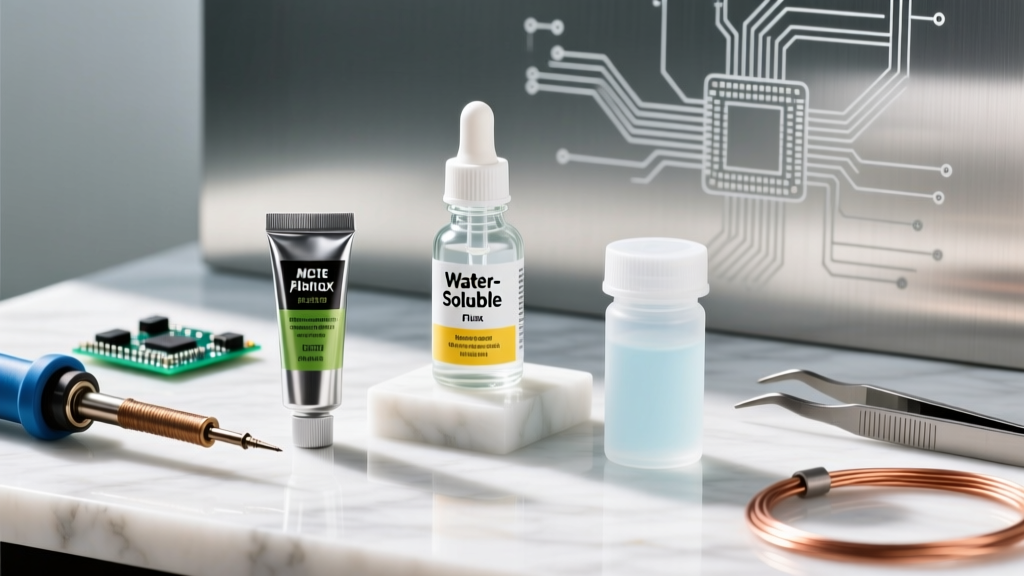
| Water-Soluble (OA) | Bare Copper, HASL, ImAg | Sn63/Pb37, SAC305 | Deionized (DI) Water (>1MΩ·cm) | Severe ECM and dendritic shorts on fine-pitch BGAs. |
| No-Clean (NC) | ENIG, OSP, Immersion Silver | SAC305, SN100C, Sn63/Pb37 | None (unless high-voltage/high-humidity) | White crusty residue if improperly heated; tombstoning. |
Deep Dive: Rosin-Based Flux (R, RMA, RA)
Chemistry and Application
Rosin fluxes rely on abietic acid, which only becomes active as a reducing agent when it reaches its melting point (around 170°C to 180°C). This makes it exceptionally safe for hand soldering, as the flux will not attack the copper pad until the soldering iron is actually applied.
- R (Rosin): Pure, unactivated. Very weak oxide removal. Best for pristine, freshly manufactured boards.
- RMA (Rosin Mildly Activated): The industry standard for hand soldering and legacy through-hole assemblies. Product Benchmark: Kester 186 RMA Flux (approx. $18–$22 per 2oz bottle) remains the gold standard for HASL boards.
- RA (Rosin Activated): Contains added halide activators for heavily oxidized pads. Requires mandatory cleaning post-soldering.
The ENIG Incompatibility
Applying aggressive RA flux to Electroless Nickel Immersion Gold (ENIG) finishes is a common error. The halide activators can penetrate the micro-porous gold layer and attack the underlying electroless nickel, leading to 'black pad syndrome' and brittle intermetallic joints that fail under mechanical shock.
Deep Dive: Water-Soluble (Organic Acid) Flux
Chemistry and Application
Water-soluble fluxes utilize glycols and organic acids (like lactic or citric acid). They are highly aggressive, capable of stripping heavy oxides from bare copper and heavily tarnished HASL finishes. Because they remain active at room temperature, they provide an incredibly wide process window for wave soldering and selective soldering machines.
Product Benchmark: Indium FLUX-WS-446H (approx. $45–$55 per pint) is widely used in high-reliability automotive and aerospace SMT lines where post-solder cleaning is guaranteed.
The Cleaning Mandate
According to the stringent workmanship requirements outlined in NASA-STD-8739.3, any visible or ionic residue from organic acid fluxes must be removed to prevent catastrophic field failures. Cleaning must be performed using heated Deionized (DI) water with a resistivity of >1 Megohm-cm. Furthermore, the board must be cleaned within 4 hours of reflow; once the organic acids crystallize and bond with ambient moisture, they become nearly impossible to remove without ultrasonic agitation and specialized saponifiers.
Deep Dive: No-Clean (NC) Flux
Chemistry and Application
No-clean fluxes are formulated with synthetic resins and extremely low-solid content (typically 2% to 5%, compared to 35% for traditional rosin). Upon reaching reflow temperatures, the activators are designed to volatilize or encapsulate themselves within the hardened resin matrix, rendering the residue electrically inert.
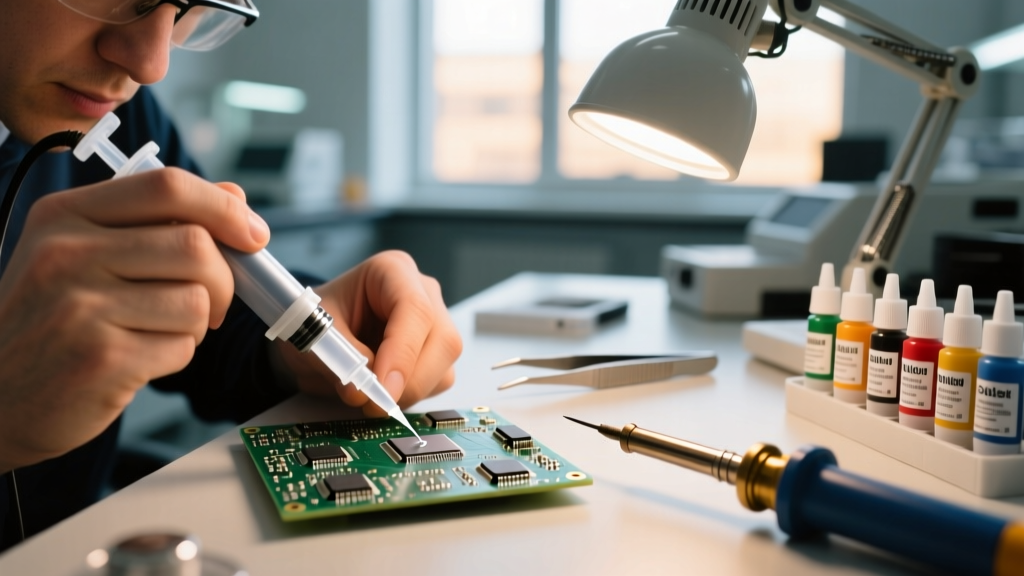
They are the undisputed champions for modern, high-density PCBs featuring ENIG, OSP (Organic Solderability Preservative), and fine-pitch (0.4mm) BGAs. Product Benchmark: For liquid applications, Kester 951 No-Clean Flux Pen ($25–$30) is ideal for quick touch-ups. For BGA rework and stenciling, Amtech NC-559-V2-TF Tack Flux ($35–$45 per 10g syringe) provides the necessary viscosity to hold components through the reflow profile.
The 'No-Clean' Myth and High-Bias Failures
The term 'no-clean' is a manufacturing convenience, not an absolute guarantee of safety. In high-humidity environments (85% RH) combined with high-voltage bias, the encapsulated residues can absorb moisture, lower the surface insulation resistance (SIR), and trigger electrochemical migration (ECM). If your assembly operates in harsh automotive or outdoor telecom environments, you must clean no-clean residue using a specialized solvent like Kyzen E5611, or apply a conformal coating only after verifying the flux is fully polymerized.
Thermal Profile Matching: Flux vs. Solder Alloy
A frequent cause of soldering failure is mismatching the flux's thermal burnout threshold with the solder alloy's liquidus temperature.
- Leaded Alloys (Sn63/Pb37 - 183°C): Standard rosin and no-clean fluxes activate perfectly in the 150°C to 190°C range. The flux remains active long enough to ensure wetting before the solder solidifies.
- Lead-Free Alloys (SAC305 - 217°C / SN100C - 227°C): These alloys require peak reflow temperatures of 240°C to 260°C. If you use a standard leaded rosin flux with SAC305, the flux activators will completely burn off (carbonize) at 220°C, leaving a charred, non-conductive barrier that prevents the molten solder from wetting the pad. You must use a high-thermal-stability synthetic resin flux designed specifically for lead-free profiles.
Troubleshooting Edge Cases and Failure Modes
1. The 'White Crusty Residue' Phenomenon
If you clean a Rosin Activated (RA) or RMA flux using pure water or low-grade IPA, you will often see a white, powdery crust form on the PCB. This is not corrosion; it is saponification. The water reacts with the unactivated abietic acid to create insoluble rosin soaps. Solution: Use a high-purity (99%) IPA mixed with a mild saponifier, or switch to a dedicated rosin-removal solvent.
2. Tombstoning on 0201 Components
Tombstoning occurs when one end of a small passive component solders while the other lifts. This is often caused by uneven flux activation or outgassing. If using a liquid no-clean flux on an OSP board, ensure the flux is completely dry (tacky, not wet) before placing components. Wet flux outgasses violently during reflow, physically pushing micro-components out of alignment.
3. Dendritic Growth on High-Impedance Circuits
Even trace amounts of halide activators left on a high-impedance analog circuit will cause signal leakage. For medical and aerospace sensor boards, always specify ORL0 or REL0 (Zero Halide) fluxes, and verify cleanliness using an Ionograph or ROSE (Resistivity of Solvent Extract) test, ensuring ionic contamination remains below 1.56 µg NaCl/cm².
Safety and Ventilation Protocols
Flux fumes contain volatile organic compounds (VOCs) and microscopic particulate matter that are known respiratory sensitizers. Prolonged exposure to abietic acid fumes can cause occupational asthma. Always utilize localized HEPA and activated carbon fume extractors at the soldering station. For comprehensive safety data and handling protocols regarding chemical hazards in the workplace, refer to the OSHA Hazard Communication Standard. Never rely on ambient room ventilation; capture the fume at the source.
Summary
Mastering the types of soldering flux requires moving beyond generic product labels and understanding the underlying chemistry. Match Rosin to legacy HASL and hand-soldering, utilize Water-Soluble for heavily oxidized bare copper (with strict DI water cleaning), and deploy synthetic No-Clean formulations for modern ENIG/OSP lead-free assemblies. By aligning your flux chemistry, PCB finish, and thermal profile, you eliminate the root causes of field failures and ensure robust, long-lasting electronic assemblies.