
The Hard Truth: Can You Solder Without Flux?
When you run out of flux mid-project or attempt to repair a delicate PCB on a budget, a common search query emerges: what to use instead of flux for soldering? The internet is flooded with DIY forums suggesting household items like petroleum jelly, pine sap, or even lemon juice. As a domain expert in electronics assembly, I must state this unequivocally: there is no safe, chemically viable household substitute for engineered soldering flux.
Attempting to use household items will inevitably lead to catastrophic failure modes, including electrochemical migration (dendrite growth), high-resistance cold joints, and severe copper trace corrosion. However, if your goal is to avoid the mess of external liquid or paste flux, there are highly effective, application-specific form-factor alternatives that eliminate the need for a separate flux bottle while maintaining IPC-compliant reliability.
The Metallurgy of Wetting: Why Substitutes Fail
To understand why household hacks fail, you must understand the physics of solder wetting. Bare copper exposed to ambient air instantly forms a layer of copper oxide (Cu2O). Molten solder alloys—whether traditional Sn63Pb37 (63/37) or modern lead-free SAC305 (Tin/Silver/Copper)—will physically ball up and refuse to bond to copper oxide.
Engineered rosin flux (specifically containing abietic acid) becomes chemically active at soldering temperatures (typically 180°C to 220°C). It strips the copper oxide, converting it into copper abietate, which dissolves into the molten solder and exposes pure copper for a metallurgical intermetallic compound (IMC) bond. Household items lack this precise thermal activation curve and chemical reduction capability.
Dangerous 'Hacks': What NEVER to Use Instead of Flux
Below is a matrix of commonly suggested online 'substitutes' and the exact failure modes they introduce to your circuit boards in 2026.
| Proposed 'Hack' | Chemical Composition | Failure Mode & Consequence |
|---|---|---|
| Vaseline (Petroleum Jelly) | Mixture of hydrocarbons | Melts at ~40°C and carbonizes at 350°C. Leaves a highly insulative carbon residue that prevents wetting and causes high-resistance joints. |
| Raw Pine Sap | Unrefined colophony, terpenes, moisture | Boils violently under an iron, causing microscopic solder splatter (short circuits). High acidity causes long-term copper corrosion. |
| Lemon Juice / Vinegar | Citric / Acetic Acid | Extremely corrosive. Triggers rapid electrochemical migration (dendrites) under voltage, shorting fine-pitch SMD components within weeks. |
| Plumbing Paste (e.g., Oatey) | Zinc Chloride / Ammonium Chloride | Water-soluble inorganic acid. Will aggressively eat through PCB vias, delaminate fiberglass substrates, and destroy copper traces. |
Expert Warning: Never cross-contaminate your electronics workspace with plumbing flux. Zinc chloride-based fluxes are designed for heavy copper pipes and will permanently destroy a printed circuit board.
Application-Specific Alternatives to External Flux
If your aversion to flux stems from the mess, the extra step, or the cleanup, the correct approach is not to find a chemical substitute, but to change your consumable form factor. Here is what to use instead of external flux, categorized by your specific assembly application.
Scenario 1: Through-Hole & General PCB Assembly
The Alternative: High-Flux Core Solder Wire
Instead of applying liquid rosin or no-clean gel to the joint before heating, use a premium solder wire with a high-percentage flux core. For standard electronics, Kester 44 remains the industry gold standard. While standard wires contain 1% to 2% flux core, you can purchase Kester 44 with a 3.3% flux core. This provides enough chemical reduction power to clean moderately oxidized through-hole pads without requiring any external flux application.
- Product Recommendation: Kester 44 (63/37 or SAC305) 3.3% Flux Core, 0.031" diameter.
- Cost: ~$28 - $35 per 1lb spool (2026 pricing).
- Cleanup: Requires 99% Isopropyl Alcohol (IPA) to remove the sticky rosin residue if aesthetics matter.
Scenario 2: SMD, QFN, and Reflow Soldering
The Alternative: No-Clean Solder Paste
When soldering Surface Mount Devices (SMDs), applying external liquid flux with a brush can cause component tombstoning due to uneven surface tension. The substitute here is solder paste, which consists of microscopic spheres of solder alloy suspended in a thick, no-clean flux vehicle. You apply the paste, place the component, and heat it. The flux activates, cleans the pad, and the solder melts simultaneously.
- Product Recommendation: Chip Quik SMD4300AX10 (SAC305 No-Clean Paste).
- Cost: ~$32 for a 10cc syringe with fine-gauge needles.
- Pro-Tip: Store solder paste in a dedicated refrigerator at 0°C to 10°C to prevent the flux vehicle from degrading or the solder spheres from oxidizing prematurely.
Scenario 3: Heavy Ground Planes & High Thermal Mass
The Alternative: High-Tack / Tacky Flux
When soldering thick ground planes, standard liquid flux boils away before the copper reaches the melting point of the solder, leaving you with a dry, oxidized joint. If you are trying to avoid standard liquid flux because it evaporates too fast, the alternative is a high-solids tacky flux. This viscous gel clings to the joint, survives prolonged heat application (350°C+), and maintains an oxygen barrier until the solder wets.
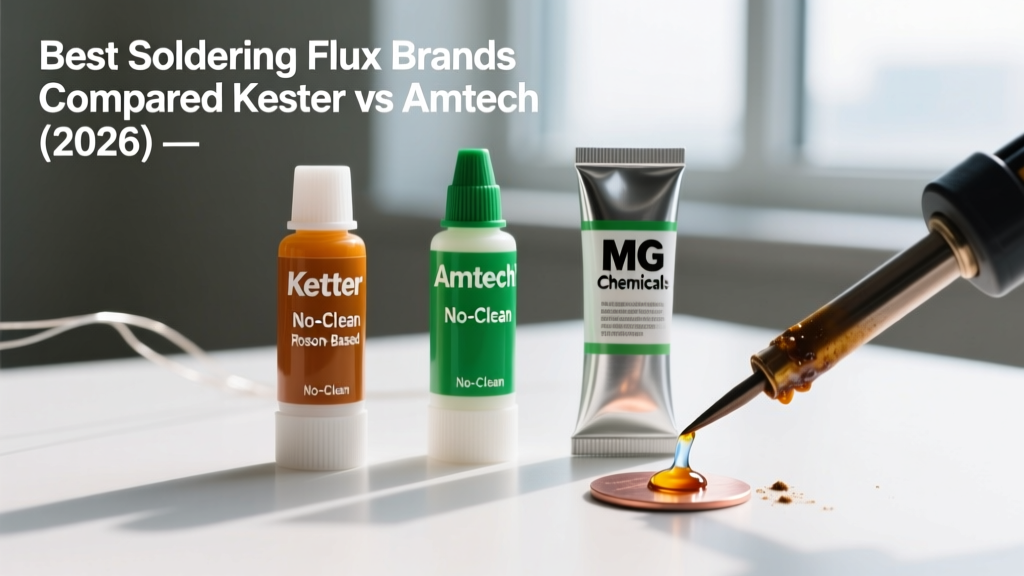
- Product Recommendation: Amtech NC-559-V2-TF Tacky No-Clean Flux.
- Cost: ~$18 for a 10cc syringe.
- Application: Use a precision needle tip to apply a microscopic dot to the pad before reworking large QFP chips or thick RF connectors.
Understanding IPC Standards for Flux Selection
When selecting your flux (or flux-cored alternative), always refer to the IPC J-STD-004B standard, which categorizes flux by chemical composition and activity level. Understanding these codes prevents you from accidentally choosing a substitute that will destroy your board.
- RO (Rosin): Derived from pine trees. Safe for most electronics. Categorized by activity (L, M, H) and halide content (0, 1, 2). RO0 or RO1 are standard for consumer electronics.
- OR (Organic): Water-soluble organic acids. Highly active, excellent for heavily oxidized boards, but must be washed off with deionized water post-soldering to prevent corrosion.
- IN (Inorganic): Acid and salt-based (plumbing flux). Never use on PCBs.
- RE (Resin): Synthetic resins, offering higher thermal stability than natural rosin.
For a deeper dive into proper technique and flux application, the Adafruit Guide to Excellent Soldering provides excellent visual references on how flux behaves under a heated iron tip.
The True Cost of 'Substitutes' vs. Proper Consumables
A common reason hobbyists seek flux substitutes is cost. A bottle of premium no-clean flux gel costs between $12 and $20. However, consider the cost of a failed joint. If a poorly wetted joint on a BGA chip or a microcontroller pin fails in the field, the cost of rework, diagnostic time, or replacing a $150+ PCB vastly outweighs the cost of proper consumables. Furthermore, using acidic substitutes like vinegar will destroy your soldering iron tips, which cost $10 to $40 each to replace, as the acid strips the iron-plating layer.
Frequently Asked Questions (FAQ)
Can I use rubbing alcohol as a flux?
No. Isopropyl alcohol (IPA) is a solvent used for cleaning flux residue after soldering. It does not possess the chemical properties to remove copper oxide and will evaporate instantly upon contact with a 350°C soldering iron, providing zero wetting assistance.
What if I am soldering bare copper wire (not a PCB)?
If you are splicing raw, unoxidized copper wire for low-voltage applications, you can sometimes achieve a mechanical bond using fresh, high-quality 60/40 rosin-core solder without external flux. However, if the wire is tarnished or oxidized, you still require rosin paste or a high-flux core wire to ensure a reliable electrical connection. For a comprehensive overview of wire soldering, SparkFun's soldering tutorial covers the basics of wire preparation.
Is 'No-Clean' flux truly safe to leave on the board?
Modern no-clean fluxes (like those in Chip Quik or Amtech pastes) are designed so that their post-soldering residue is non-conductive and non-corrosive at room temperature. However, if the board will be exposed to high humidity or high-voltage RF signals, the residue can absorb moisture and cause parasitic capacitance or leakage currents. In those edge cases, washing the 'no-clean' flux with an aerosol flux remover is still recommended.
Final Verdict
When asking what to use instead of flux for soldering, the only correct answer is to change the delivery method, not the chemistry. Abandon household hacks that guarantee corrosion and shorts. Instead, upgrade to high-core-percentage solder wires for through-hole work, utilize no-clean solder pastes for SMD assembly, and rely on high-tack gels for heavy thermal mass rework. By matching the IPC-rated chemistry to your specific application, you ensure professional-grade reliability without the mess of traditional liquid flux bottles.