
The Chemistry of Wetting: Why Flux is Non-Negotiable
When using flux soldering techniques for printed circuit board (PCB) assembly or microelectronics repair, the flux is arguably more critical than the solder alloy itself. Solder does not bond to copper; it bonds to a clean, oxide-free metallic surface. In 2026, as component pitch sizes shrink to 0.35mm and below for BGAs and micro-QFNs, the surface tension dynamics of molten solder require precise chemical intervention to prevent catastrophic wetting failures.
Flux serves three primary thermodynamic and chemical functions:
- Oxide Reduction: Activators (such as adipic or succinic acid) chemically strip copper oxide (CuO) layers at elevated temperatures.
- Surface Tension Reduction: Lowers the contact angle of the molten solder, promoting capillary action in plated through-holes (PTH) and under fine-pitch SMD pads.
- Oxidation Barrier: Forms a temporary liquid shield over the heated joint, preventing rapid re-oxidation from atmospheric oxygen before the alloy solidifies.
"According to the IPC (Association Connecting Electronics Industries), flux activity levels must be strictly matched to the solderability of the component leads and the board's surface finish to meet IPC-A-610 Class 2 and Class 3 reliability standards."
The Big Three: Flux Classifications Under IPC J-STD-004
Selecting the correct chemistry is the foundation of reliable assembly. The industry standard IPC J-STD-004 categorizes flux into three primary families based on composition and activity.
1. Rosin-Based Flux (R, RMA, RA)
Derived from pine tree sap, rosin flux is the legacy workhorse of electronics manufacturing. It is categorized by its activator concentration:
- R (Rosin): Pure, non-activated. Extremely safe but weak. Used almost exclusively for ultra-high-reliability aerospace applications where cleaning is impossible.
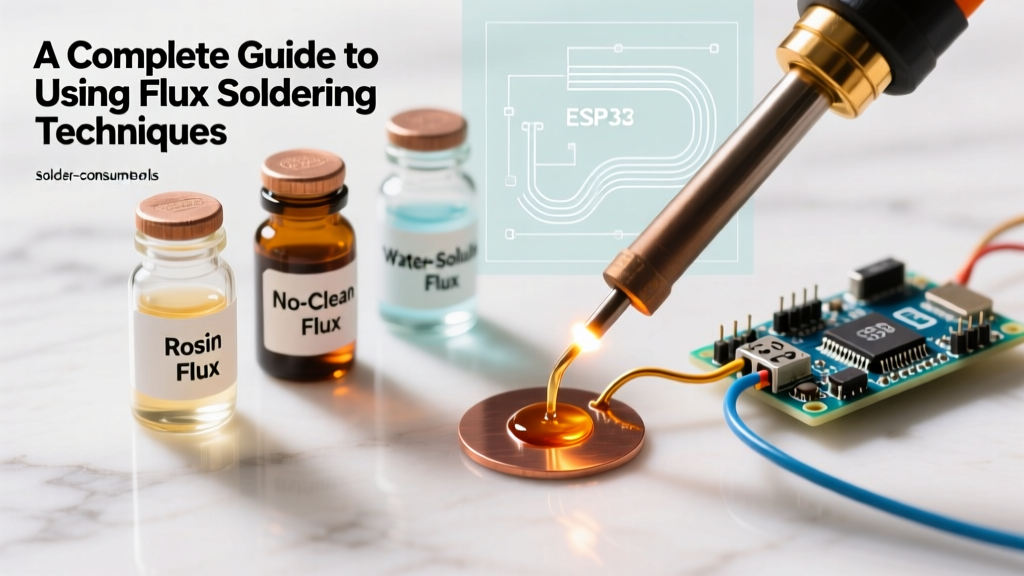
- RMA (Rosin Mildly Activated): Contains mild organic acids. The standard for general-purpose DIY and commercial repair.
- RA (Rosin Activated): Heavily activated with halides or strong organic acids. Excellent for tarnished boards but leaves highly corrosive residue that mandates immediate cleaning.
Product Spotlight: Kester 186 RMA Liquid Flux remains a benchmark in 2026, retailing at approximately $22.00 per pint. It provides an excellent balance of wetting speed and safe, non-conductive residue if left uncleaned on consumer-grade (Class 1) boards.
2. Water-Soluble Flux (Organic Acid / OA)
Water-soluble fluxes abandon rosin entirely, utilizing aggressive organic acids (like citric or lactic acid) and water as a solvent. They offer the highest wetting activity, making them ideal for heavily oxidized through-hole components or difficult surface finishes like ENIG (Electroless Nickel Immersion Gold).
The Catch: The residue is highly conductive and corrosive. It must be cleaned. Furthermore, you cannot use tap water. The NASA Electronic Parts and Packaging (NEPP) Program mandates that cleaning water-soluble flux requires Deionized (DI) water with a resistivity of >1 Megohm-cm, ideally heated to 140°F (60°C) to properly saponify and rinse the activators.
3. No-Clean Flux (NC)
Dominating modern SMT (Surface Mount Technology) assembly, no-clean fluxes use synthetic resins and highly volatile solvents. Upon reaching reflow temperatures (typically 217°C for SAC305 or 183°C for Sn63/Pb37), the activators completely volatilize, leaving behind a microscopic, non-conductive, non-corrosive resin shell.
Product Spotlight: For liquid dispensing, Kester 951 No-Clean ($8.50 to $11.00 per 2oz bottle) is ubiquitous. For SMD rework and BGA reballing, tacky no-clean paste like Amtech NC-559-V2-TF ($45.00 - $55.00 per 10cc syringe) provides the necessary viscosity to hold components in place prior to reflow.
Selection Matrix: Matching Flux to Your PCB Assembly
Use this decision matrix to select the appropriate flux chemistry for your specific 2026 manufacturing or repair workflow.
| Flux Type | Activity Level | Residue Conductivity | Cleaning Required? | Best Application Scenario |
|---|---|---|---|---|
| Rosin (RMA) | Medium | Very Low | Optional (Aesthetic) | General DIY, THT repair, consumer electronics |
| Rosin (RA) | High | Medium (if damp) | Mandatory | Heavily tarnished vintage boards, thick ground planes |
| Water-Soluble (OA) | Very High | High (Corrosive) | Mandatory (DI Water) | Automotive, difficult ENIG finishes, wave soldering |
| No-Clean (NC) | Low to Medium | Negligible | No (Avoid cleaning) | BGA rework, fine-pitch SMD (0.4mm+), automated SMT |
Application Methodologies: Precision is Key
When using flux soldering irons or hot air stations, how you apply the chemical dictates the thermal profile and the final joint morphology.
- Flux Pens: Ideal for broad strokes across SOIC or QFP footprints. Use a 1mm chisel tip to draw a continuous line across the pads. Warning: Cheap pens often flood the board; opt for valve-actuated pens like the MG Chemicals 8341 pen to control the flow rate.
- Liquid Dispenser Bottles: Use a 22-gauge or 27-gauge blunt-tip needle for targeted application. For 0603 or 0402 passives, a single 0.5mm drop is sufficient. Excess liquid flux will boil violently under hot air, potentially displacing micro-components (the "popcorn" effect).
- Tacky Flux Paste: Mandatory for BGA reballing. Use a precision plunger to apply a 0.1mm uniform film across the substrate. The high viscosity prevents solder spheres from migrating and bridging adjacent pads during the liquidus phase.
Troubleshooting Edge Cases and Failure Modes
Even experienced technicians encounter metallurgical anomalies. Here is how to diagnose flux-related failures:
1. Tombstoning (Drawbridging)
Symptom: A two-terminal SMD component (like a capacitor) stands vertically on one end.
Flux Cause: Uneven flux application or outgassing. If one pad has more liquid flux, the rapid boiling of the solvent creates a localized cooling effect and physical displacement force, pulling the component upright as the other pad solders first.
Fix: Switch to a lower-volatility no-clean paste or ensure perfectly symmetrical liquid flux dispensing.
2. Solder Bridging (Shorts)
Symptom: Molten solder flows between adjacent fine-pitch pins (e.g., 0.5mm pitch QFPs).
Flux Cause: Insufficient flux activity or flux exhaustion. If the flux volatilizes before the solder fully melts, surface tension fails to pull the solder back to the copper pads, leaving it suspended between pins.
Fix: Apply a secondary pass of high-activity RMA liquid flux (like Kester 186) using a 1/4" natural bristle brush, and reflow with a drag-soldering technique.
3. Electrochemical Migration (Dendrite Growth)
Symptom: Microscopic metallic trees grow between traces over weeks/months, causing latent short circuits.
Flux Cause: Leaving water-soluble flux residue on the board, or exposing no-clean flux residue to high-humidity environments without proper conformal coating. No-clean residue is safe only if it remains dry; if moisture penetrates, the un-volatilized activators can ionize.
Fix: Implement an ultrasonic or saponifier cleaning stage for water-soluble assemblies, and apply an acrylic or urethane conformal coating for high-humidity deployments.
Final Thoughts on 2026 Consumable Standards
Mastering the art of using flux soldering techniques requires moving beyond the generic "add more flux" mentality. By understanding the chemical activators, matching the flux volatility to your thermal profile, and adhering to IPC cleanliness standards, you transition from a hobbyist to a reliability-focused electronics engineer. Always verify your flux's shelf life—most liquid fluxes degrade and oxidize after 12 to 18 months, severely compromising their wetting capabilities.