
Why Seek a Soldering Flux Alternative?
For decades, mildly activated rosin (RMA) flux has been the undisputed king of the electronics workbench. However, as of 2026, the shift toward lead-free alloys (like SAC305), tighter fine-pitch component spacing, and stringent environmental regulations have forced engineers and hobbyists to seek a reliable soldering flux alternative. Whether you are battling rosin allergies, dealing with high-reliability IPC Class 3 aerospace requirements, or simply trying to avoid the tedious cleaning process of traditional rosin residues, selecting the right alternative chemistry is critical to preventing electrochemical migration (ECM) and dendritic growth.
⚠️ The Household Alternative Myth
Before diving into commercial brands, we must address a common search intent: using household items as a soldering flux alternative. Never use Vaseline, lemon juice, or raw pine sap on PCBs. Vaseline lacks the necessary chemical activators to reduce copper oxide at 240°C+. Lemon juice introduces corrosive citric acid that will eat through traces over time. Raw pine sap contains unpredictable halides and high carbon content, leading to severe charred residues that mask cold solder joints and promote rapid galvanic corrosion.
The Chemistry of Flux Alternatives
When transitioning away from standard rosin, you are primarily choosing between two chemical families: No-Clean (Synthetic/Resin) and Water-Soluble (Organic Acid). Understanding the IPC J-STD-004 classifications is mandatory before selecting a brand.
| Flux Type | IPC Classification | Cleaning Required? | Best Application |
|---|---|---|---|
| No-Clean (Halide-Free) | ROL0 / REL0 | No (Optional) | Fine-pitch SMD, BGA rework, consumer electronics |
| Water-Soluble (OA) | ORH0 / ORH1 | Yes (Mandatory) | Heavy oxidation, through-hole, high-reliability aerospace |
| Synthetic Resin | REH1 | Yes (Solvent) | High-temperature lead-free wave soldering |
Top Brand Comparisons: Finding Your Alternative
We tested and analyzed the top commercial alternatives to standard RMA rosin fluxes, focusing on wetting performance, residue clarity, and long-term reliability.
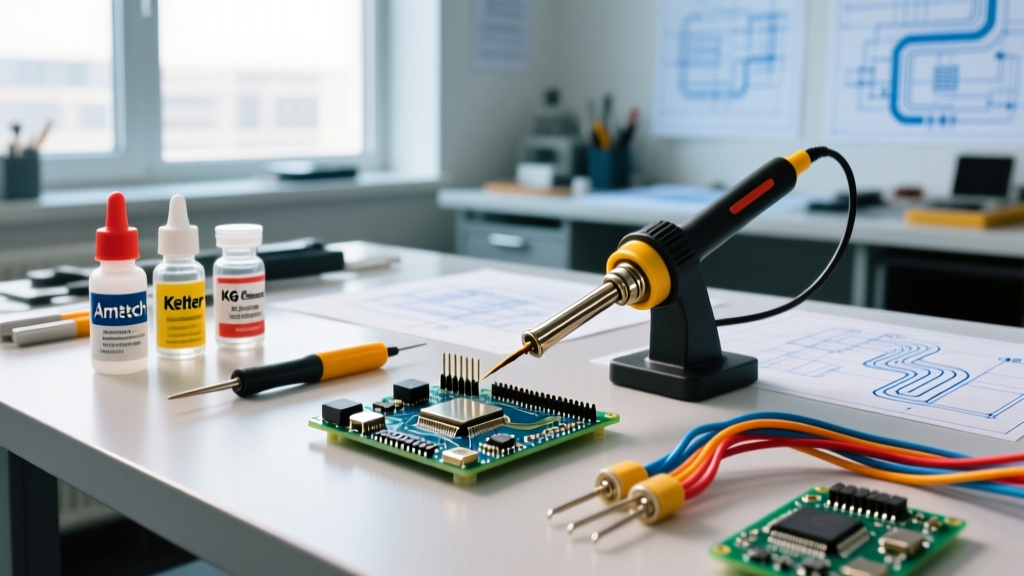
1. Amtech: The SMD & No-Clean Specialist
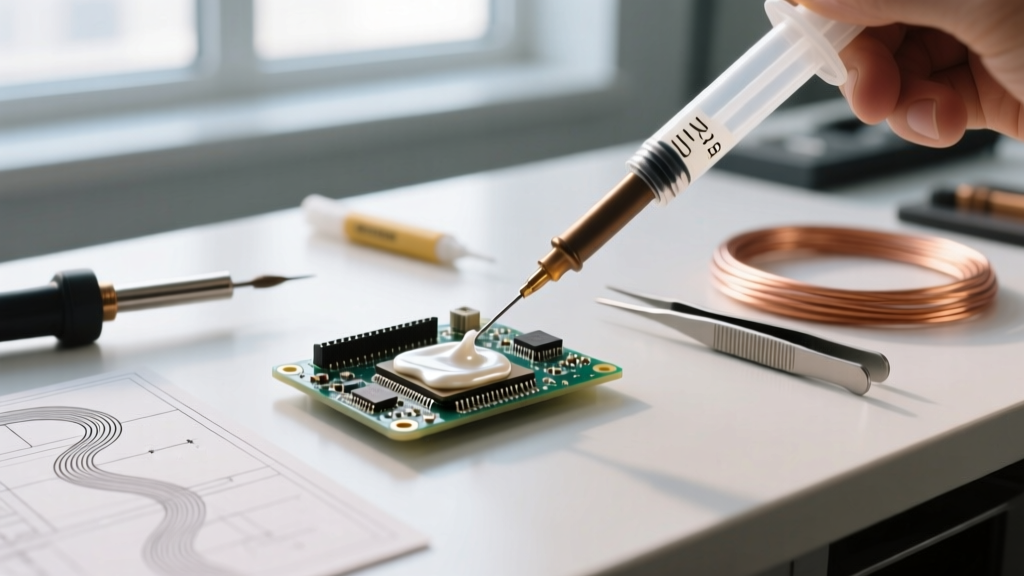
Amtech is widely considered the gold standard for SMD rework and no-clean alternatives. Their flagship NC-559-V2-TF is a Type ROL0 halide-free no-clean flux. Unlike traditional rosin that turns dark and crusty, NC-559 leaves a hard, optically clear residue that does not interfere with in-circuit testing (ICT) bed-of-nails probes.
- Wetting Performance: Excellent on 0402 and 0201 passives. The high-tack formulation holds components in place during hot-air reflow, virtually eliminating tombstoning.
- Failure Mode Edge Case: If subjected to multiple reflow cycles (e.g., double-sided SMT), the residue can carbonize if peak temperatures exceed 250°C for more than 45 seconds.
- 2026 Pricing: ~$28 for a 10cc syringe; ~$55 for a 30cc cartridge.
2. Kester: The Industrial & Water-Soluble Standard
If your alternative requirement is driven by heavy oxidation or strict NASA Electronic Parts and Packaging (NEPP) cleanliness standards, Kester’s water-soluble options are unmatched. Kester 245 is an organic acid (OA) flux designed for extreme wetting power.
- Wetting Performance: Unrivaled on heavily tarnished through-hole leads and large ground planes. It breaks down copper oxide almost instantly at 220°C.
- The Cleaning Mandate: Water-soluble flux residues are highly conductive and corrosive. You cannot just rinse this with tap water. Cleaning requires heated deionized (DI) water with a resistivity of >1 MΩ·cm, often augmented with a saponifier. Failure to clean Kester 245 will result in catastrophic dendritic shorting within weeks in humid environments.
- 2026 Pricing: ~$45 for a 1-pint bottle of liquid flux; ~$35 for a 50g tube of paste.
3. MG Chemicals: Accessible Prototyping & Repair
For field repair technicians and hobbyists who need a versatile rosin alternative without the premium price tag of Amtech, MG Chemicals offers highly accessible formulations. Their 8341 No-Clean Flux Pen and 8351 Water-Soluble Paste bridge the gap between amateur and professional grades.
- Formulation: The 8341 pen uses a synthetic resin base that flows beautifully under QFP leads via capillary action. It is classified as ROL0, making it safe to leave on the board.
- Shelf Life & Storage: Unlike Amtech syringes which require refrigeration to maintain viscosity over 12+ months, MG Chemicals pens and pastes are stable at room temperature (up to 25°C) for up to 24 months, making them ideal for mobile repair kits.
- 2026 Pricing: ~$12 per 10ml pen; ~$18 for a 10g paste jar.
Application-Specific Decision Matrix
Choosing the right soldering flux alternative depends entirely on your end-product environment and manufacturing capabilities. Refer to this decision framework based on current IPC standards for soldering fluxes:
- Scenario A: High-Density BGA Rework & Micro-Soldering
Winner: Amtech NC-559-V2-TF. The high surface tension and tackiness are mandatory to prevent component drift when using hot-air stations at 350°C. - Scenario B: Automotive or Aerospace (IPC Class 3)
Winner: Kester 245 (Water-Soluble). Class 3 mandates zero ionic contamination. Water-soluble flux, followed by rigorous DI water and Zestron-recommended saponifier cleaning, guarantees the highest insulation resistance (SIR) passing grades. - Scenario C: Quick Field Repair on Oxidized Connectors
Winner: MG Chemicals 8351. The aggressive organic acids cut through environmental corrosion on automotive connectors, and the paste form factor prevents the flux from running into adjacent sealed housings.
The Hidden Costs: Cleaning and Shelf Life
When calculating the true cost of a soldering flux alternative, the raw material price is only a fraction of the equation. No-clean fluxes (like Amtech and MG 8341) save money on the backend by eliminating the cleaning stage. However, if your design features ultra-high impedance analog circuits (e.g., precision medical sensors), even the microscopic leakage current caused by no-clean residue parasitic capacitance can introduce noise. In these edge cases, you must use a specialized solvent cleaner like Techspray Ecoline to dissolve the synthetic resins, adding roughly $0.15 to $0.30 per board in chemical costs.
Conversely, water-soluble alternatives require capital investment in ultrasonic or inline aqueous cleaning systems. If you are a low-volume shop, outsourcing aqueous cleaning can cost between $2.00 and $5.00 per board, making water-soluble fluxes economically unviable for consumer-grade prototyping.
Frequently Asked Questions
Can I mix no-clean and water-soluble fluxes?
No. Mixing chemistries can cause unpredictable exothermic reactions and create insoluble gummy residues that trap ionic contaminants beneath a no-clean shell, making subsequent cleaning impossible and guaranteeing long-term board failure.
Does 'No-Clean' mean I never have to clean the board?
'No-clean' means the residue is chemically inert and safe to leave on the board under normal operating conditions. However, if you plan to apply a conformal coating (like acrylic or urethane), you must clean the no-clean residue first. Conformal coatings will delaminate and peel off synthetic no-clean flux residues due to poor adhesion.
Conclusion
Transitioning away from traditional rosin requires a deliberate choice based on your thermal profile, cleaning capabilities, and reliability targets. For modern SMD and BGA work, Amtech NC-559-V2-TF remains the premier no-clean alternative, offering unmatched tack and clear residues. For heavy-duty, high-reliability through-hole applications where rigorous washing is possible, Kester 245 provides the aggressive wetting needed for flawless joints. Evaluate your workflow, respect the IPC cleaning mandates, and your alternative flux will yield superior, long-lasting solder joints.