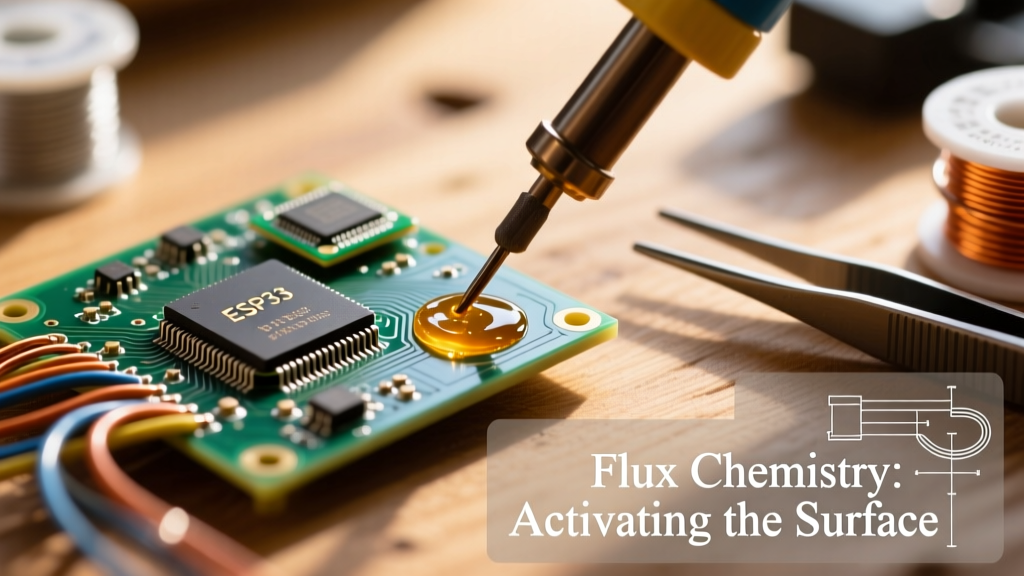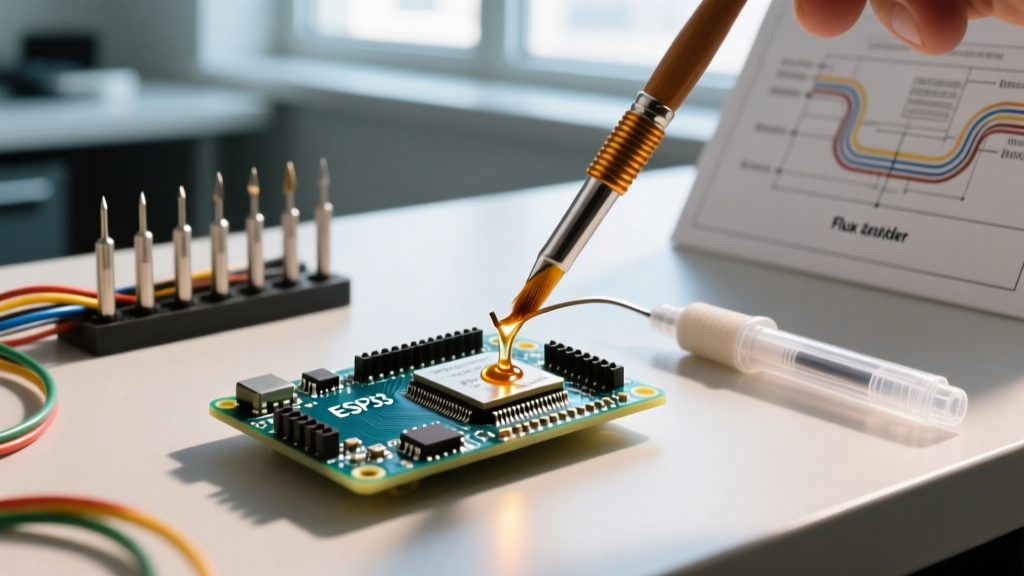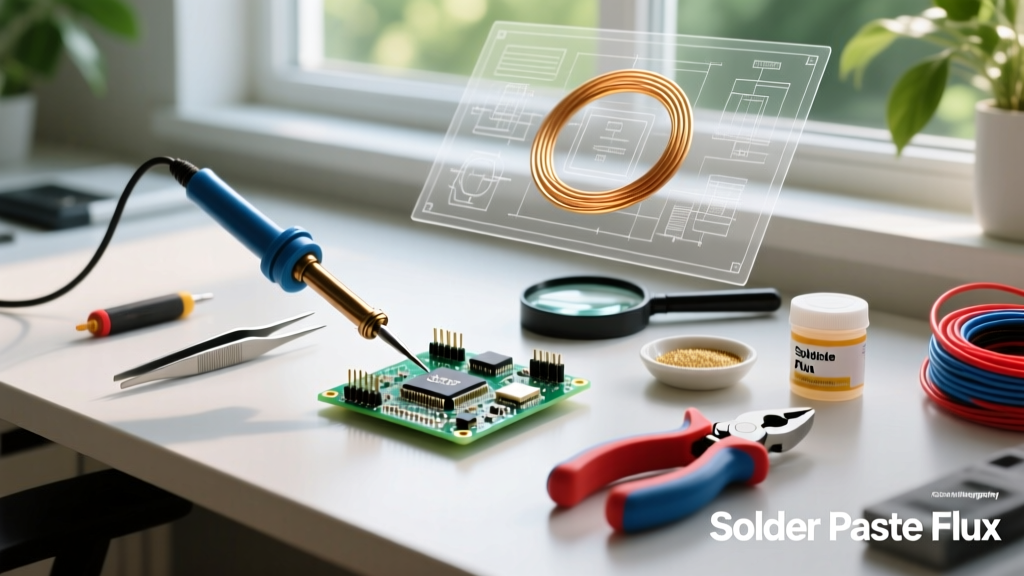

The Short Answer: Composition vs. Function
To answer the most common beginner question directly: No, soldering paste is not the same as flux. While both are essential for creating reliable metallurgical bonds, they serve fundamentally different roles in the soldering process. Flux is a chemical cleaning agent designed to remove metal oxides and prevent re-oxidation during heating. Solder paste, on the other hand, is a complex, multi-component mixture that contains flux, alongside microscopic spheres of solder alloy and rheological additives (tackifiers).
Understanding the distinction is critical for avoiding catastrophic assembly failures, especially as modern PCB designs push toward 01005 imperial components and micro-BGAs. In this 2026 selection guide, we break down the chemistry, IPC standards, and real-world application matrices to help you choose the exact consumable for your workbench.
Decoding the Chemistry: What Makes Them Different?
Flux: The Chemical Catalyst
Flux is primarily composed of a base resin (usually rosin or synthetic), solvents, and activators. When heated to its activation temperature (typically between 150°C and 220°C, depending on the formulation), the activators chemically reduce copper and tin oxides, leaving a pristine surface for the molten alloy to wet. According to the NASA Workmanship Standards, proper flux activation is the single most critical variable in preventing cold solder joints.
Solder Paste: The Delivery System
Solder paste is essentially a localized delivery system for both the alloy and the flux. By weight, a standard SAC305 (Tin/Silver/Copper) solder paste is roughly 88% to 90% metal powder and 10% to 12% flux vehicle. However, by volume, the ratio is closer to 50/50. The flux vehicle in paste contains specialized tackifiers that act like a temporary glue, holding surface-mount components in place on the pads before the assembly enters the reflow oven.
Flux Classifications and IPC J-STD-004B
When selecting standalone flux (for hand soldering or wave soldering), you must navigate the IPC J-STD-004B standard. This standard categorizes flux by its base material, activity level, and halide content (reliability).
| Flux Type | Base Material | Activity Level | Cleaning Required? | Best Application |
|---|---|---|---|---|
| RO (Rosin) | Natural pine rosin | L, M, H | Optional (L/M), Yes (H) | General THT hand soldering, aerospace |
| OR (Organic) | Water-soluble organic acids | L, M, H | Mandatory (Highly corrosive) | Heavily oxidized boards, automated wave |
| IN (Inorganic) | Acid/Halide salts | H | Mandatory | Industrial plumbing (Never use on PCBs) |
| RE (Resin) | Synthetic resins | L, M, H | Usually No | No-clean SMD rework, fine-pitch |
Under IPC J-STD-004B, the activity level is paired with a reliability rating (0 or 1). A rating of '0' indicates no halide content, meaning the flux is highly reliable and safe to leave on the board without cleaning. A rating of '1' indicates the presence of halides (which boost cleaning power on oxidized pads), mandating a post-solder cleaning process. For example, a flux classified as ROL0 is a Rosin-based, Low-activity, Zero-halide flux—the most common choice for modern no-clean consumer electronics.
Solder Paste Particle Sizes (IPC J-STD-005B)
Unlike liquid flux, solder paste is graded by the physical size of its metal powder, which dictates the minimum stencil aperture and component pitch you can reliably print. As component sizes shrink in 2026, Type 4 and Type 5 pastes have become the baseline for professional SMT assembly.
- Type 3 (25–45 µm): Standard for 0805, 0603, and SOIC packages. Stencil thickness: 0.12mm - 0.15mm.
- Type 4 (20–38 µm): Required for 0402, 0201, and fine-pitch QFPs (<0.5mm pitch). Stencil thickness: 0.10mm - 0.12mm.
- Type 5 (15–25 µm): Essential for 01005 components, micro-BGAs, and ultra-fine pitch (<0.3mm).
- Type 6 (5–15 µm): Used in advanced semiconductor packaging and flip-chip assemblies.
Application Decision Matrix: When to Use Which
Using the wrong consumable is the leading cause of rework. Refer to this matrix to match your assembly method with the correct chemical format.
| Assembly Method | Primary Consumable | Secondary / Rework Consumable |
|---|---|---|
| Reflow Oven (SMT) | Solder Paste (Type 3/4/5) | Tacky Flux (for BGA reballing) |
| Hand Soldering (THT) | Rosin-Core Solder Wire | Liquid Flux Pen (Kester 245) |
| Hot Air SMD Rework | Chip Quik Low-Temp Paste | No-Clean Tacky Flux Syringe |
| Drag Soldering (QFP) | Liquid No-Clean Flux | Rosin-Core Solder Wire (63/37) |
Expert Tip: Never use liquid flux for SMD reflow printing. Liquid flux lacks the rheological properties (tack and viscosity) required to hold a stencil print's shape. It will spread via capillary action, causing massive bridging and component tombstoning.
Real-World Failure Modes and Edge Cases
Failure Mode 1: Violent Splatter During Hand Soldering
A common beginner mistake is applying solder paste to a through-hole joint and touching it with a 380°C hand iron. The solvents in the paste's flux vehicle are designed to evaporate gradually across a 3-minute reflow profile. When hit with instantaneous, localized extreme heat, the solvents flash-boil, causing microscopic explosions that scatter solder balls across the PCB, risking short circuits in adjacent BGA arrays.
Failure Mode 2: Tombstoning from Expired Paste
Solder paste has a strict shelf life of 6 months when refrigerated (0°C to 10°C). If used past this date, or if left unrefrigerated, the metal powder oxidizes. The flux vehicle is no longer strong enough to reduce the heavy oxide layer during reflow. This results in uneven wetting forces on the component pads, pulling the component upright into a "tombstone" position. Always check the manufacturing date on syringes from suppliers like Indium Corporation or Amtech.
Edge Case: BGA Reballing
When reballing a BGA chip, you cannot use standard solder paste. You must use a highly viscous "tacky flux" (such as Amtech TAC-009). Tacky flux is essentially the flux vehicle without the solder powder, heavily loaded with tackifiers to act as an adhesive, holding the individual solder spheres in their precise BGA footprint until the hot air gun melts them into place.
Storage, Handling, and Cost Considerations
Proper handling is just as important as selection. Solder paste must be allowed to acclimate to room temperature for 2 to 4 hours before opening the jar or syringe. Opening a cold container introduces ambient moisture via condensation, which will cause severe solder spattering during reflow.
2026 Market Pricing Baseline:
- Premium Solder Paste (e.g., Amtech NC-559-V2-TF, 30cc syringe): $35 - $45. Ideal for fine-pitch SMD and lead-free rework.
- Budget DIY Paste (e.g., Chip Quik SMD291AX, 10cc): $16 - $20. Excellent for hobbyist SMD soldering and hot air work.
- No-Clean Flux Pen (e.g., Kester 245): $8 - $12. The gold standard for drag-soldering QFPs and THT rework.
For comprehensive tutorials on applying these materials, SparkFun's Soldering Guide remains an essential visual reference for both paste and flux application techniques.
Frequently Asked Questions
Can I use soldering flux instead of solder paste for SMDs?
No. Flux alone contains no metal alloy. If you apply liquid flux and heat it, you will simply clean the pads. You still need to introduce a solder wire or preform to create the physical and electrical joint.
Does "no-clean" mean I never have to clean the flux?
"No-clean" refers to the flux's chemical reliability, not its cosmetic appearance. The residue left behind is non-conductive and non-corrosive, meaning it will not cause dendritic growth or shorts. However, if the board requires conformal coating or automated optical inspection (AOI), you must clean the residue, as it can interfere with adhesion and light refraction.