
The Thermodynamic Barrier: Why Solder Rejects Bare Metal
When assembling printed circuit boards (PCBs) or terminating high-reliability wiring, the metallurgical bond between the solder alloy and the base metal is paramount. But before that bond can form, a fundamental chemical barrier must be overcome. This brings us to a critical question for electronics engineers and technicians: what does rosin do for soldering? From a material science perspective, rosin (colophony) is not merely a sticky additive; it is a thermally activated chemical solvent, a thermal transfer medium, and a surface tension modifier.
At room temperature, copper and tin surfaces naturally form a thin passivation layer of oxides (Cu₂O and SnO₂). When exposed to soldering temperatures—typically 250°C to 350°C at the iron tip—this oxidation accelerates exponentially. Molten solder simply will not wet metal oxides. Without intervention, the contact angle exceeds 90°, causing the solder to ball up and reject the pad, resulting in cold, non-wetting joints.
The Chemistry of Abietic Acid and Isomerization
Rosin is a solid form of resin obtained from pine trees, primarily composed of abietic acid (C₂₀H₃₀O₂). According to the PubChem Abietic Acid Compound Summary, this diterpene carboxylic acid is relatively inert at room temperature, which is why rosin-core solder wire can sit on a shelf for years without degrading.
However, when heated past its softening point (~100°C) and approaching its activation threshold (~150°C), abietic acid undergoes a structural isomerization into levopimaric acid. This isomer is highly reactive. It attacks the copper oxide layer, reducing it to bare, elemental copper while forming copper abietate—a metallic soap that safely dissolves into the molten rosin matrix, floating it away from the joint interface.
Material Science Principle: Rosin does not melt the solder; it engineers the microscopic environment, stripping oxides and manipulating surface tension to allow metallurgical intermetallic compounds (IMCs) like Cu₆Sn₅ to form.
Intermetallic Compound (IMC) Formation
Once the rosin clears the oxide, the bare copper and molten tin undergo a solid-state diffusion reaction, forming the Cu₆Sn₅ (eta phase) intermetallic compound. The liquid rosin matrix acts as a protective blanket during this critical 1-3 second window, preventing atmospheric oxygen from re-oxidizing the surface before the IMC layer reaches its optimal 1-2 micrometer thickness. If the rosin boils off prematurely, the IMC layer can grow excessively thick and brittle, or fail to form entirely.
Surface Tension and the Marangoni Effect
Once the oxide layer is chemically stripped, the rosin matrix dictates the fluid dynamics of the molten alloy. Soldering requires a low contact angle (ideally <30° for IPC-A-610 Class 3 compliance) to ensure capillary action draws the solder into plated through-holes (PTH). The rosin residue lowers the surface tension of the liquid solder. Furthermore, localized heating creates thermal gradients that induce the Marangoni effect, driving the molten solder toward the hottest areas of the joint and ensuring complete, uniform wetting across the pad.
IPC J-STD-004B Classification Matrix
Not all rosin is created equal. Pure rosin lacks the aggressive power needed for heavily oxidized boards or nickel-palladium-gold (NiPdAu) surface finishes. Thus, activators (like halides or organic acids) are added. The IPC J-STD-004 standard classifies rosin-based fluxes (designated as RO) by activity level and halide content. Understanding this matrix is crucial for selecting the right consumable.
| IPC Designation | Activity Level | Halide Content (by mass) | Typical Application & Edge Cases |
|---|---|---|---|
| RO-L0 | Low | 0% | High-reliability aerospace, bare copper, BGA rework |
| RO-L1 | Low | >0% to ≤0.5% | Standard consumer electronics, HASL finishes |
| RO-M0 | Moderate | 0% | Automotive, slightly oxidized pads, ENIG finishes |
| RO-M1 | Moderate | >0.5% to ≤2.0% | General purpose through-hole (e.g., Kester 44) |
| RO-H1 | High | >2.0% | Heavy industrial, severely oxidized terminals, RF shielding |
Real-World Formulations and Thermal Limits
Let us examine specific market formulations to see how this chemistry is applied in 2026 manufacturing environments:
- Kester 44 (Sn63/Pb37 with RA Rosin): The industry benchmark for RO-M1 flux, containing roughly 1.1% halide activators. It excels in through-hole wave soldering and manual soldering, providing rapid wetting on mildly oxidized copper.
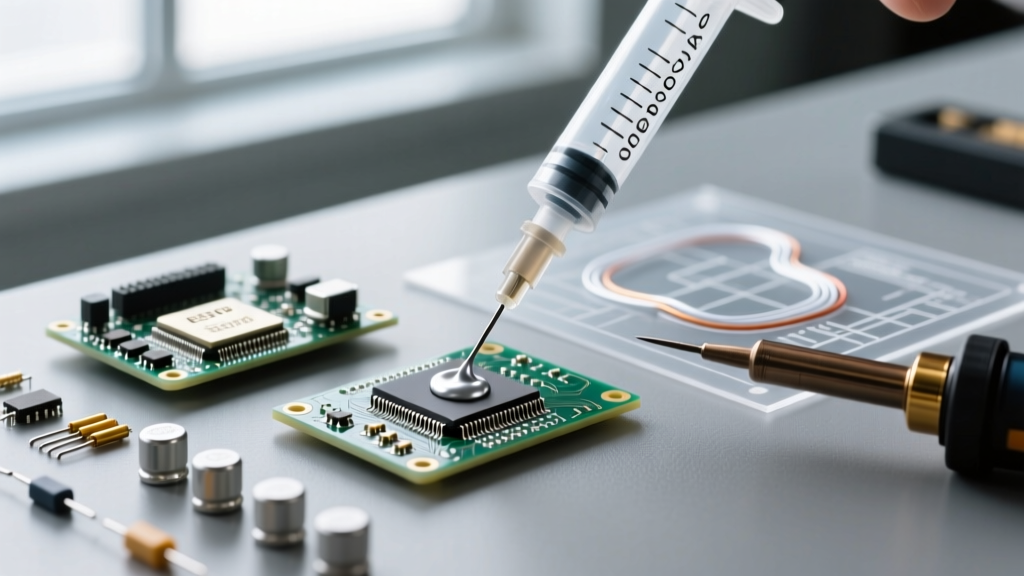
- Chip Quik SMD291AX (Tacky Flux): An RO-L0 formulation designed for modern lead-free SAC305 (Sn96.5/Ag3.0/Cu0.5) BGA rework. Its high viscosity holds components in place while providing just enough oxide reduction without risking electrochemical migration (ECM) post-reflow.
- MG Chemicals 835 (RMA Equivalent): A rosin mildly activated liquid flux used for selective soldering and dip-tinning component leads, balancing cleaning power with long-term residue stability.
Thermal Degradation and Carbonization Failure Modes
A common failure mode in manual soldering is 'burning' the flux. If the soldering iron tip exceeds 380°C and dwells on the rosin for more than 3-5 seconds, the abietic acid undergoes thermal degradation and carbonization. This leaves a hard, black, glass-like residue. Not only is this residue aesthetically poor, but it can also trap unreacted activators against the PCB substrate, leading to Surface Insulation Resistance (SIR) failures and dendritic growth under humid conditions.
The NASA Electronic Parts and Packaging (NEPP) Soldering Guidelines strictly mandate that carbonized flux residues be mechanically removed or avoided entirely via precise thermal profiling. Operators must match their iron tip geometry and thermal recovery rates to the specific activation temperature of the rosin core being used.
Laboratory Validation: Copper Mirror and SIR Testing
To quantify what rosin does for soldering in a lab setting, material scientists rely on standardized empirical tests:
- Copper Mirror Test (IPC-TM-650 2.3.32): A thin layer of copper is deposited on glass, and the flux is applied and heated. If the rosin's activators are too aggressive, the copper mirror is etched away, indicating potential long-term corrosivity.
- Surface Insulation Resistance (SIR) Testing (IPC-TM-650 2.6.3.7): This measures the electrical resistance between interdigitated copper combs after the rosin residue is left on the board in a high-humidity chamber (85°C/85% RH) for 7 days. High-quality RO-L0 fluxes will maintain an SIR >10⁸ ohms, proving the rosin matrix safely encapsulates any ionic activators, preventing short circuits.
Summary
Understanding the material science behind rosin transforms how technicians approach the soldering iron. By recognizing rosin as a thermally activated chemical solvent that manages oxidation and surface tension, engineers can select the precise IPC classification required for their specific alloy and surface finish, ensuring robust, long-lasting intermetallic bonds.