
The Chemistry of Flow: Why Brand Formulation Matters
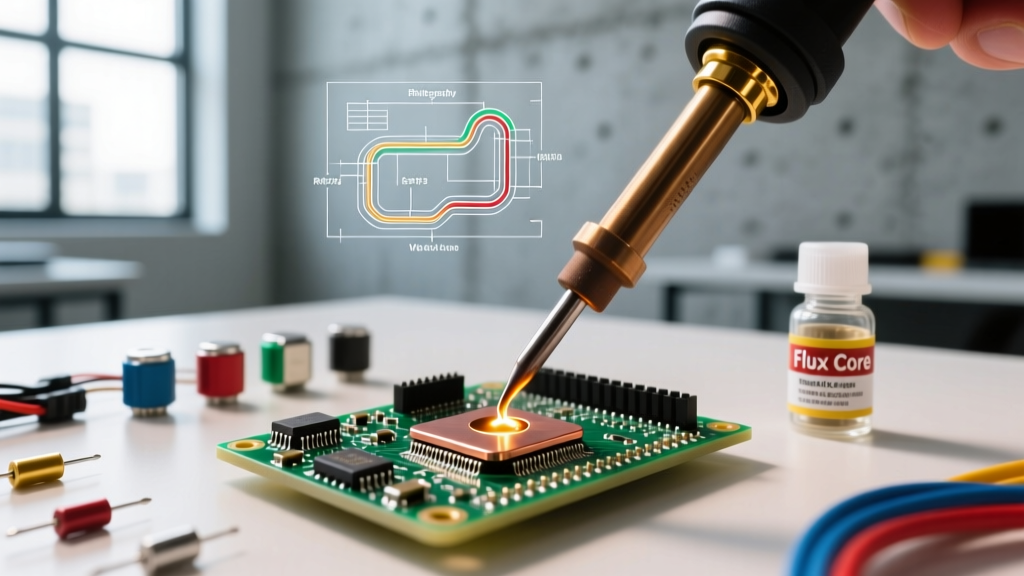
Understanding how to use flux for soldering is the dividing line between a reliable, glossy joint and a cold, fractured failure. Flux is not merely a sticky medium to hold components in place; it is a complex chemical reducing agent designed to strip metallic oxides, lower surface tension, and prevent re-oxidation during the thermal cycle. As of 2026, the market is dominated by formulations that adhere to the IPC J-STD-004 standard, classifying fluxes by composition (Rosin, Organic, Inorganic) and activity level (Low, Medium, High).
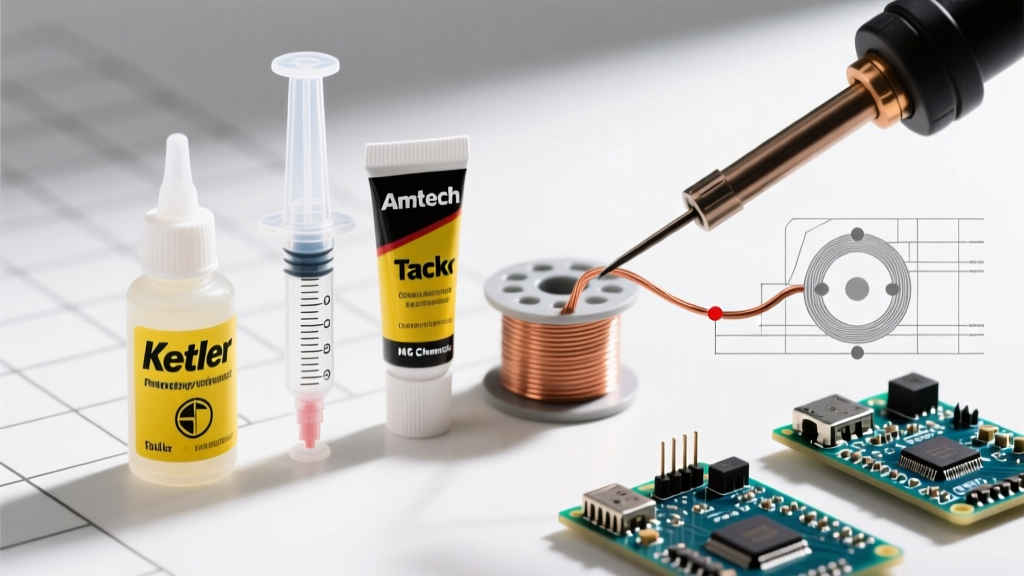
However, knowing the chemistry is only half the battle. The physical delivery method—liquid, gel, or tacky paste—dictates your application technique. In this guide, we compare three industry-standard brands: Kester, Amtech, and MG Chemicals, breaking down exactly how to apply their specific formulations for through-hole, fine-pitch SMD, and BGA rework.
Liquid Flux Techniques: Kester 186 vs. MG Chemicals 834B
Liquid fluxes are characterized by their high solvent content (typically isopropyl alcohol or specialized VOCs), which allows for rapid capillary action. They are the undisputed champions of drag soldering and through-hole pre-tinning.
Kester 186 (Mildly Activated Rosin - RMA)
Kester 186 is a legendary ROL1 (Rosin, Low-activity, Halide-containing) flux. It contains roughly 2% activators, providing excellent wetting on slightly oxidized pads.
- Application Technique: Never apply liquid flux directly to a hot iron tip; the solvents will instantly boil, causing violent spattering and leaving behind a charred, inactive rosin residue. Instead, use a stiff-bristled acid brush (trim the bristles to 10mm for better control) to paint a thin, even layer directly onto the PCB pads.
- Thermal Profile: Set your soldering station to 320°C for 63/37 Sn/Pb wire. The Kester 186 activators peak in effectiveness between 180°C and 220°C. If your iron is too hot (>380°C), you will burn the rosin base, creating a crusty, black carbon buildup that actually insulates the joint.
- Best Use Case: Tinning stranded wire, repairing through-hole connectors, and general DIY prototyping.
MG Chemicals 834B (Low-Solids Liquid Rosin)
MG Chemicals 834B is formulated for fast drying and minimal residue. According to the MG Chemicals technical documentation, this flux leaves less than 1% solid residue post-reflow, making it ideal for dense SMD boards where cleaning under tight-pitch ICs is difficult.
- Drag Soldering Strategy: When drag soldering a TQFP-64 microcontroller, apply a generous bead of 834B across all pins. Load your iron tip with a minimal amount of SAC305 (lead-free) solder. Drag the tip across the pins at a 45-degree angle at a speed of roughly 1cm per second. The low-solids formulation prevents the solder from bridging between 0.5mm pitch pins.
- Edge Case: Because it dries rapidly, you must reapply 834B if your drag-soldering pass takes longer than 15 seconds, otherwise the flux will exhaust and cause micro-bridges.
Tacky & Syringe Flux: Mastering Amtech NC-559-V2-TF
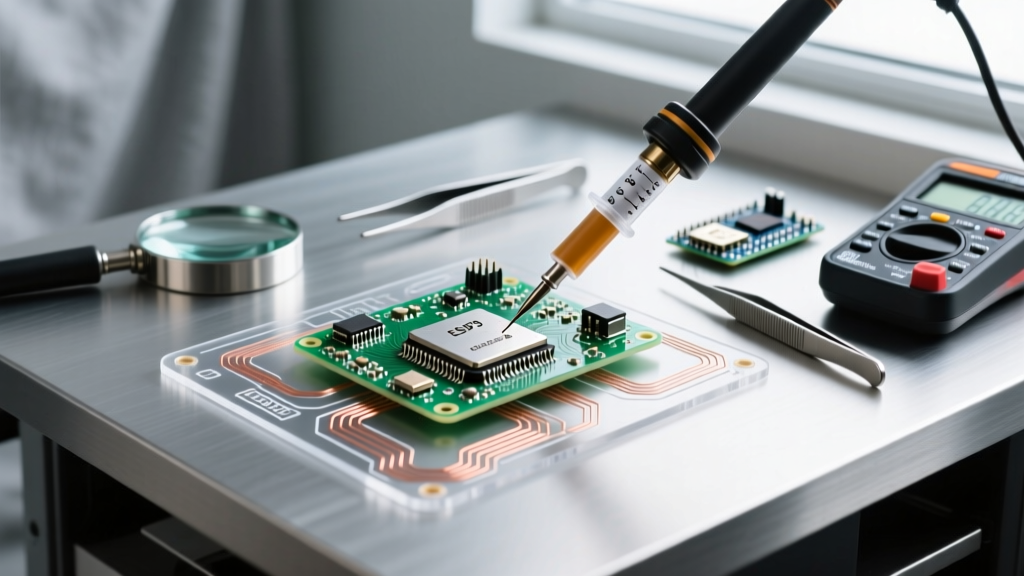
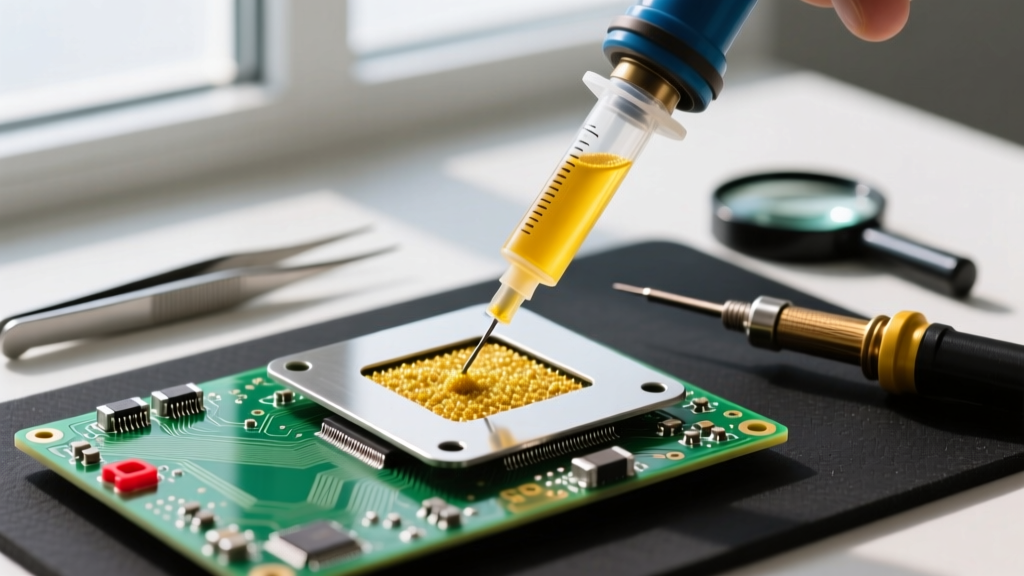
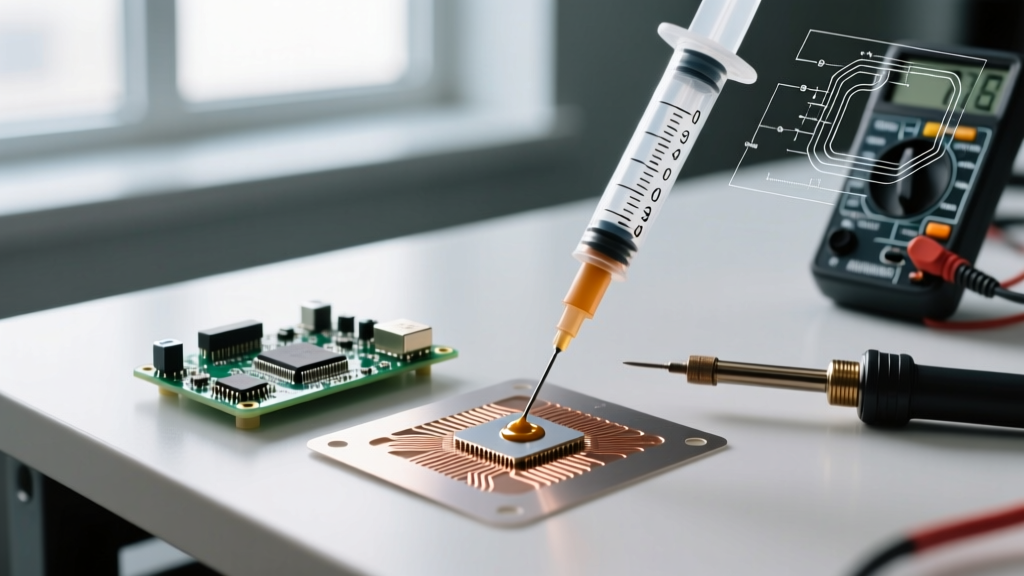
When dealing with 0402 passives, QFN ground pads, or BGA rework, liquid flux is useless—it wicks away and boils off before the component reaches reflow temperature. This is where Amtech NC-559-V2-TF (a no-clean, tacky ROL0 flux) becomes mandatory.
Needle Gauge Selection and Pneumatic Dispensing
Amtech NC-559 is highly viscous. How you dispense it dictates your success rate:
| Component Size | Needle Gauge | Inner Diameter (ID) | Dispensing Pressure |
|---|---|---|---|
| 0805 / 1206 / SOIC | 20G (Standard) | 0.90 mm | 10 - 15 PSI |
| 0402 / 0603 / TSSOP | 23G (Fine) | 0.40 mm | 18 - 25 PSI |
| 0201 / BGA Spheres | 25G (Ultra-Fine) | 0.25 mm | 30+ PSI |
Note: If dispensing manually via thumb plunger, use a 20G or 22G needle. 25G needles require too much manual force, leading to sudden 'blobs' of flux that can flood tiny pads.
BGA Rework and 'Head-in-Pillow' Prevention
For BGA reballing or reflowing QFNs with Amtech NC-559, apply a microscopic dot of flux to the pad, not the component. The tackiness holds the BGA in place during the initial heating phase. Because NC-559 is a no-clean formulation, it is designed to encapsulate itself in the rosin matrix upon cooling. However, if your reflow profile heats the board too slowly, the flux activators will exhaust before the solder melts, resulting in a 'Head-in-Pillow' defect (where the BGA sphere and paste ball melt but fail to coalesce).
Comparative Matrix: 2026 Brand Specifications
| Brand & Model | IPC Classification | Format | Primary Application | Cleaning Required? | Approx. Price (2026) |
|---|---|---|---|---|---|
| Kester 186 | ROL1 (Rosin) | Liquid (Bottle/Pen) | Through-hole, Wire Tinning | Yes (99% IPA) | $18.00 / 2oz |
| MG Chemicals 834B | ROL1 (Rosin) | Low-Solids Liquid | Fine-Pitch Drag Soldering | Optional (IPA) | $14.50 / 100mL |
| Amtech NC-559-V2-TF | ROL0 (No-Clean) | Tacky Syringe Paste | BGA Rework, 0402 SMD | No | $32.00 / 10cc |
| Kester 245 | ORH1 (Water-Soluble) | Liquid/Gel | Heavy Oxidation, Aerospace | Mandatory (DI Water) | $25.00 / 10oz |
Troubleshooting Flux-Induced Defects
Even with premium brands, improper technique leads to distinct failure modes. Here is how to diagnose and fix them:
Defect: Solder Balling / Spattering
Cause: Applying liquid flux to a cold joint and immediately hitting it with a 380°C iron. The solvents flash-boil, exploding microscopic solder spheres across the PCB.
Fix: Pre-heat the PCB on a hotplate to 80°C-100°C before applying liquid flux. This gently evaporates the solvents before the iron makes contact.
Defect: Tombstoning on 0402 Components
Cause: Uneven tacky flux application. If one pad has more Amtech NC-559 than the other, the surface tension during reflow will pull the component upright.
Fix: Use a 23G needle and apply an identically sized micro-dot to both pads. For manual rework, use tweezers to hold the component down until the paste reaches its liquidus state (approx 217°C for SAC305).
Defect: Dendrite Growth and Short Circuits
Cause: Using a water-soluble flux (like Kester 245) and failing to clean it. Water-soluble fluxes contain highly active organic acids that will absorb ambient humidity and grow conductive dendrites between traces within 48 hours.
Fix: Water-soluble fluxes must be cleaned within 2 hours of soldering using heated (60°C) deionized (DI) water, followed by a compressed air dry. Standard IPA will not neutralize these activators.
Post-Soldering Cleaning Protocols
The 'No-Clean' designation on Amtech NC-559 is highly misunderstood. It does not mean the residue is invisible or non-conductive under all conditions; it means the residue is chemically inert and encapsulated under normal operating environments. However, if you are applying a conformal coating (like MG Chemicals 419D acrylic) or operating in high-humidity environments, you must clean no-clean flux.
For ROL1 rosin fluxes (Kester 186, MG 834B), use 99.9% anhydrous Isopropyl Alcohol and a lint-free swab. Scrub in a circular motion while the board is tilted at a 45-degree angle to allow the dissolved rosin to run off the board, rather than drying back onto the traces. For a comprehensive guide on general soldering preparation and safety, refer to the SparkFun soldering tutorial archives.
Frequently Asked Questions
Can I use plumbing flux for electronics?
Absolutely not. Plumbing fluxes (like Oatey No-Corv) are highly acidic inorganic fluxes (zinc chloride or ammonium chloride). They will rapidly corrode copper traces and destroy PCB laminates within days. Always use IPC J-STD-004 compliant electronic fluxes.
Why is my Amtech syringe flux separating into liquid and solid?
Tacky fluxes can separate if stored improperly. Amtech NC-559 should be stored in a cool, dark place (ideally 10°C - 25°C). If separation occurs, do not microwave it. Instead, let the syringe reach room temperature and gently roll it between your palms for 5 minutes to re-homogenize the resin and solvent matrix.
Does flux expire?
Yes. Liquid rosin fluxes (Kester 186) typically have a shelf life of 12 to 18 months. As the solvents evaporate through the cap, the flux becomes a thick sludge that will not wick properly. Tacky syringe fluxes (Amtech) generally last 6 to 12 months. Always check the manufacturer's date code on the packaging.