
The Hidden Economics of Soldering Chemistry
Most hobbyists and junior technicians view flux as a simple liquid or paste that makes solder "stick." However, in professional electronics manufacturing and high-reliability DIY builds, misunderstanding the purpose of flux in soldering is one of the leading causes of hidden financial losses. When you evaluate flux purely by its upfront retail price, you ignore the massive downstream costs associated with rework, cleaning, and field failures.
In 2026, with component densities shrinking to 01005 passives and micro-BGAs becoming standard even in consumer hardware, the margin for error is zero. This cost analysis breaks down the chemical purpose of flux, compares the true financial impact of different flux chemistries, and provides a framework for calculating your Total Cost of Ownership (TCO).
The Core Purpose of Flux in Soldering (And Why It Matters Financially)
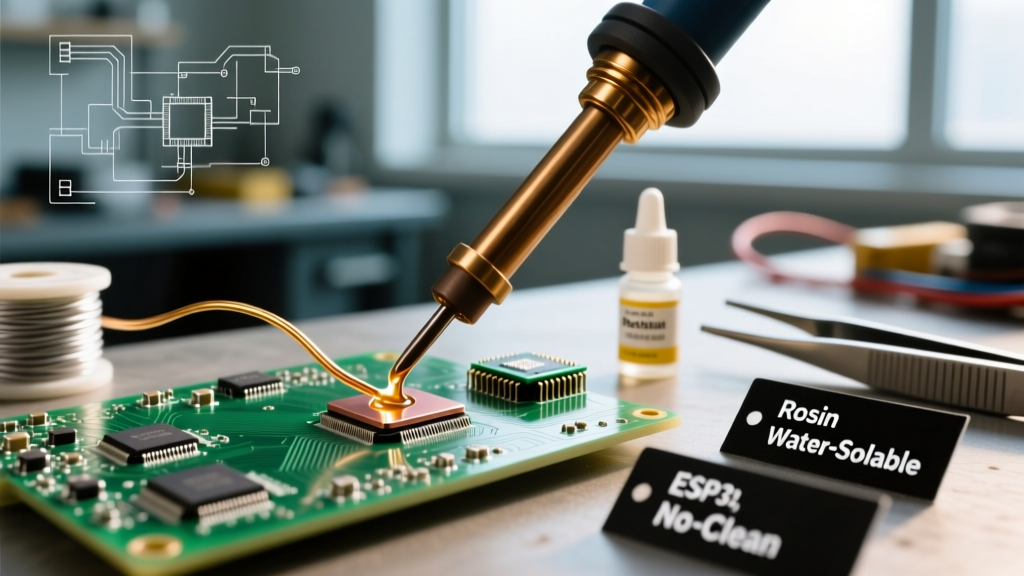
At a molecular level, the primary purpose of flux in soldering is the chemical reduction of metal oxides. When copper pads and component leads are heated to typical SAC305 (lead-free) reflow temperatures of 240°C–260°C, they oxidize almost instantly in the presence of atmospheric oxygen. Solder will not wet to copper oxide; it will ball up and reject the pad, leading to cold joints or non-wetting.
Expert Insight: Flux does not clean dirt, oils, or fingerprints. It specifically targets metallic oxides. If your PCBs have organic contamination from handling, no amount of high-end flux will save the joint. Pre-cleaning with isopropyl alcohol (IPA) or a dedicated saponifier is a mandatory, albeit often skipped, cost center.
According to the NASA Workmanship Standards for soldering, proper flux activation is critical for achieving the required wetting angles and intermetallic compound (IMC) formation. When flux is under-applied or the wrong type is chosen, the IMC layer becomes brittle or incomplete, leading to mechanical failure under thermal cycling.
The Financial Matrix: Flux Types Compared
To understand the cost-benefit ratio, we must look beyond the $20–$40 price tag of a 100ml bottle. Below is a cost matrix comparing the three primary flux chemistries used in modern electronics.
| Flux Type | Example Product (2026) | Upfront Cost (per 100ml) | Post-Solder Cleaning Cost | Rework / Scrap Risk | Best ROI Scenario |
|---|---|---|---|---|---|
| Rosin (RMA) | Kester 186 Mildly Activated | $22 - $28 | Medium (Requires IPA or solvent wash) | Low (Highly reliable, forgiving) | Hand soldering, aerospace, high-reliability DIY |
| Water-Soluble (OA) | MG Chemicals 8341 / Alpha WS-301 | $25 - $35 | High (Requires heated DI water & ultrasonic) | High (Catastrophic if uncleaned) | High-volume wave soldering, heavily oxidized boards |
| No-Clean | Kester 951 / Indium NC-256 | $30 - $45 | Zero (Designed to be left on the board) | Low (If profiled correctly) | SMT reflow, automated assembly, rapid prototyping |
Deep Dive: The "Water-Soluble" Cost Trap
Water-soluble (Organic Acid or OA) fluxes are highly aggressive. They strip oxides beautifully, making them ideal for heavily tarnished boards or high-speed wave soldering. However, the purpose of flux in soldering with OA chemistries comes with a strict caveat: the residue must be removed.
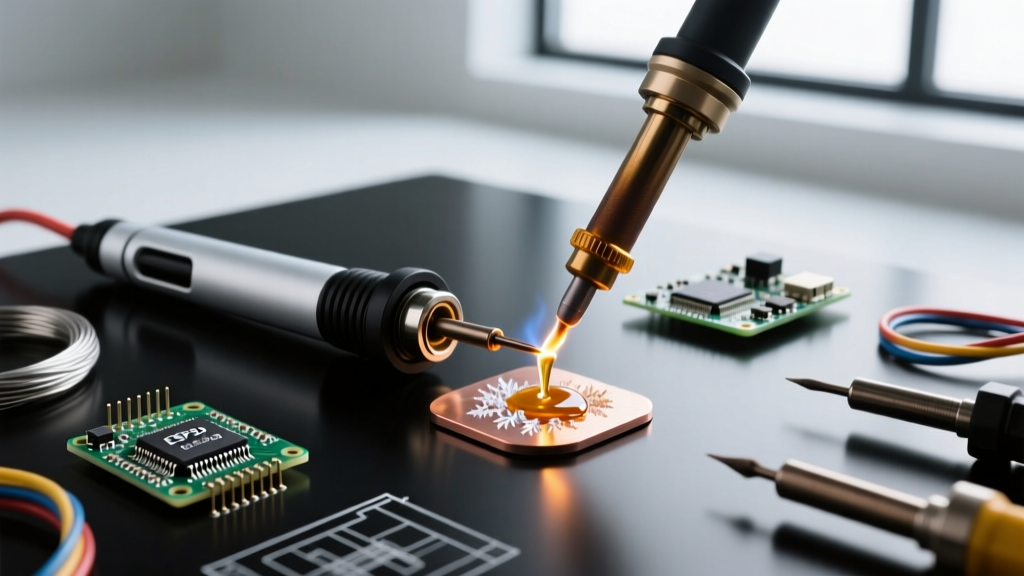
OA residues are highly hygroscopic (they absorb moisture from the air) and conductive. If a DIYer or small shop uses MG Chemicals 8341 to save $10 upfront but skips the mandatory deionized (DI) water cleaning step, they invite Electrochemical Migration (ECM). ECM causes dendritic growth—microscopic metal trees that grow between pads, eventually causing short circuits.
The Math: A single field return for a shorted $150 custom PCB costs roughly $45 in return shipping, $85 in diagnostic labor (at standard 2026 bench rates of $85/hr), and $150 in scrap/replacement. That is a $280 loss to save $10 on a bottle of flux and skip a cleaning step.
Hidden Costs of Flux-Related Failure Modes
When the purpose of flux is ignored or the wrong thermal profile is applied, specific failure modes emerge. Here is how those failures impact your bottom line:
- Tombstoning (Drawbridging): Occurs in SMT when flux activates unevenly on a passive component, causing one side to wet faster and pull the component upright. Cost Impact: Requires manual micro-tweezers rework under a microscope. At 30 seconds per joint, reworking 50 tombstoned 0402 capacitors adds $21 in pure labor cost to a single board run.
- Solder Balling / Splatter: Happens when water-based no-clean flux is heated too rapidly, causing the solvent to boil and explode microscopic solder spheres across the board. Cost Impact: Solder balls trapped under BGA chips cause latent shorts. X-ray inspection and BGA rework station time costs upwards of $125 per component.
- Corrosion of Test Points: Halide-activated fluxes left on test points will corrode the copper, ruining the board for future In-Circuit Testing (ICT). Cost Impact: Ruined test fixtures and scrapped prototype runs.
Calculating Your Total Cost of Ownership (TCO) for Flux
To make an informed purchasing decision, use this TCO formula tailored for small-batch manufacturing and serious DIY labs:
TCO = (Flux Material Cost) + (Cleaning Labor & Chemicals) + (Rework Labor) + (Scrap/Field Failures)
Scenario A: The No-Clean Route (10,000 Joints)
- Material: 50ml of Kester 951 No-Clean ($15 equivalent)
- Cleaning: $0 (Residue is benign and encapsulated)
- Rework: 1% failure rate (100 joints) @ $2/joint = $200
- Total TCO: $215
Scenario B: The Water-Soluble Route (10,000 Joints)
- Material: 50ml of Alpha WS-301 ($12 equivalent)
- Cleaning: DI Water system runtime, saponifier, and 2 hours labor = $180
- Rework: 0.2% failure rate (20 joints) due to excellent wetting @ $2/joint = $40
- Total TCO: $232
While Water-Soluble flux offers superior wetting and fewer initial cold joints, the mandatory cleaning infrastructure makes it more expensive for low-to-medium volume runs. As noted by the IPC (Association Connecting Electronics Industries) in their J-STD-004 guidelines, the transition to no-clean chemistries has been driven primarily by the elimination of CFCs and the reduction of aqueous cleaning costs in modern manufacturing.
Expert Sourcing: Avoiding the Counterfeit Tax
In 2026, the secondary market for electronics consumables is flooded with counterfeit flux pens and syringes, particularly on third-party marketplace storefronts. Counterfeit no-clean flux often contains cheap, unrefined rosin and high levels of chlorine-based activators.
Using counterfeit flux defeats the entire purpose of flux in soldering by introducing corrosive halides that eat through copper traces over a 6-to-12-month period. To protect your investment:
- Buy Direct or from Authorized Distributors: Source from verified suppliers like Digi-Key, Mouser, or directly from manufacturers like Kester (MacDermid Alpha).
- Check the Lot Code: Authentic flux syringes feature laser-etched lot codes and expiration dates. Smudged inkjet printing is a primary indicator of a repackaged counterfeit.
- Monitor Viscosity: If a flux pen dispenses watery liquid instead of a consistent, slightly viscous gel, the solvent has either evaporated due to poor sealing or it is a fake product. Discard it immediately; the cost of a ruined PCB far outweighs the $12 replacement cost of the pen.
Final Verdict: Aligning Purpose with Profit
Understanding the true purpose of flux in soldering is not just an academic exercise in chemistry; it is a critical business and engineering decision. For high-reliability, hand-soldered aerospace or audio projects, the mild activation and long tack-time of RMA rosin fluxes provide the best insurance against cold joints. For high-volume, automated SMT assembly, the zero-cleaning overhead of premium no-clean fluxes like Indium NC-256 maximizes profit margins.
Stop buying flux based solely on the sticker price. Evaluate your cleaning capabilities, your component density, and your tolerance for rework. By aligning the chemical purpose of the flux with your specific production environment, you will drastically reduce hidden costs and build electronics that survive the test of time.