
The Chemical Reality: Why Flux is Non-Negotiable
In the realm of electronics assembly and repair, solder is merely the structural bridge; flux is the chemical engine that makes the bridge possible. At temperatures exceeding 200°C, copper pads and component leads oxidize almost instantly, forming a barrier of copper oxide (CuO and Cu2O) that molten solder cannot penetrate. Flux acts as a reducing agent, stripping away these oxides and lowering the surface tension of the solder to promote proper wetting.
As of 2026, the widespread adoption of lead-free alloys like SAC305 and Sn99.3Cu0.7 in consumer electronics has pushed reflow and hand-soldering temperatures into the 230°C–260°C range. This thermal shift means that selecting the correct DIY soldering flux is more critical than ever, as older flux formulations simply burn off or char before modern lead-free solder reaches its liquidus state.
The "Homemade" Myth vs. Commercial DIY Flux
A common search intent behind "DIY soldering flux" involves hobbyists attempting to brew their own flux by dissolving crushed violin rosin or pine sap in 99% isopropyl alcohol (IPA). While this creates a basic Rosin (R) flux suitable for simple, large through-hole joints, it is fundamentally inadequate for modern surface-mount device (SMD) work. Homemade mixtures lack the precise chemical activators (like adipic or glutaric acid) required to break down stubborn oxides on nickel-gold or HASL finishes. Furthermore, uncontrolled viscosity leads to uneven application. For reliable results, DIYers should select commercially formulated fluxes designed for hobbyist and prototyping environments.
Decoding IPC J-STD-004B for DIYers
The IPC (Association Connecting Electronics Industries) classifies flux under the IPC J-STD-004B standard using a four-character code. Understanding this code prevents catastrophic project failures:
- Base Material: RO (Rosin), RE (Resin), OR (Organic), IN (Inorganic).
- Activator Level: L (Low), M (Moderate), H (High).
- Halide Content: 0 (Less than 0.05% halides), 1 (Greater than 0.05%).
For 90% of DIY electronics projects, a ROL0 (Rosin, Organic activator, Low activity, 0 halides) or REL0 flux is the safest and most effective choice, providing adequate oxide removal without risking long-term corrosion.
The Big Three: DIY Soldering Flux Types
1. Rosin-Based (R, RMA, RA)
Derived from pine sap (colophony), rosin flux is the historical backbone of electronics. Rosin Mildly Activated (RMA) remains the gold standard for general-purpose DIY soldering, drone repair, and automotive wiring.
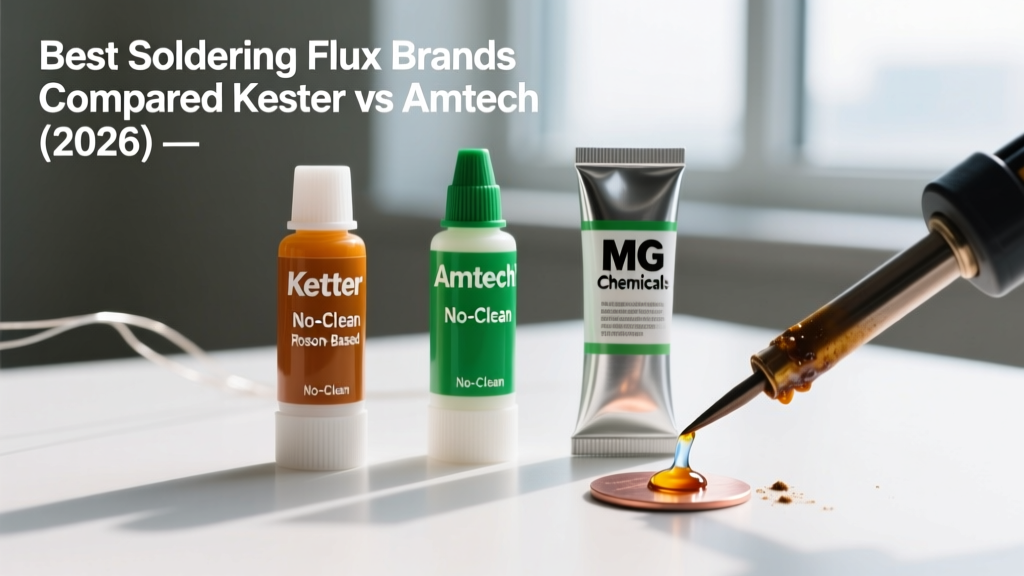
- Top Product: Kester 186 RMA Liquid Flux.
- 2026 Pricing: ~$22 for a 2oz (59ml) bottle.
- Best For: Through-hole components, tinning stranded wires, and stained glass (when mixed into a paste).
- Edge Case: Rosin chars if exposed to an iron tip directly for more than 3 seconds. This carbonized residue is slightly conductive and can cause high-resistance leakage in high-impedance analog audio circuits.
2. No-Clean (Synthetic Resin)
No-clean fluxes use synthetic resins that leave behind a clear, hard, and chemically inert residue. They are designed to be left on the board post-soldering.
- Top Product: MG Chemicals 8341 No-Clean Paste Flux.
- 2026 Pricing: ~$19 for a 10ml syringe.
- Best For: SMD rework, BGA reballing, and tight-pitch QFP chips where cleaning under the component is impossible.
- Edge Case: If you trap uncured no-clean flux under a BGA component and expose it to high humidity, it can cause parasitic capacitance. Always apply gentle heat (100°C for 5 minutes) to fully cure the residue after rework.
3. Water-Soluble (Organic Acid - OA)
Highly active and aggressive, water-soluble fluxes tackle heavily oxidized boards and difficult surfaces like bare copper or nickel. However, they are unforgiving if not cleaned properly.
- Top Product: Chip Quik WS4300.
- 2026 Pricing: ~$24 for a 10g syringe.
- Best For: Restoring vintage, heavily corroded PCBs, and plumbing/jewelry applications (using specific non-electronic OA variants).
- Edge Case: Failure to clean OA flux within 2 hours leads to Electrochemical Migration (ECM) and dendritic growth, which will eventually short-circuit your board.
Flux Selection Matrix: Form Factors and Use Cases
The physical delivery method of your DIY soldering flux dictates your workflow efficiency. Here is how to match the form factor to your project:
| Form Factor | Viscosity | Ideal Application | DIY Recommendation |
|---|---|---|---|
| Liquid (Brush/Drip) | Low (Water-like) | Tinning wires, large through-hole pads, stained glass | Kester 186 (2oz Bottle) |
| Gel / Tack Paste | High (Thixotropic) | SMD drag soldering, BGA reballing, component tack-down | Chip Quik SMD291AX10 (10cc Syringe) |
| Flux Pen | Medium (Alcohol-based) | Precision touch-ups on 0402/0603 components | Techni-Tool Clean Touch Pen |
Step-by-Step: Cleaning Water-Soluble Flux
If your project demands the aggressive oxide-removal of water-soluble flux, you must follow a strict cleaning protocol to meet the workmanship requirements outlined in NASA-STD-8739.3 for high-reliability soldering. Wiping with a standard IPA-soaked Q-tip is insufficient and merely spreads the acidic activators across the board.
- Prep: Allow the board to cool to room temperature to prevent thermal shock.
- Rinse: Spray the board with heated (50°C–60°C) Deionized (DI) water. Tap water contains minerals that will react with the flux to form conductive salts.
- Agitate: Use a soft-bristle ESD-safe brush to gently agitate under low-profile components (like SOIC chips) where flux hides.
- Final Rinse: Flood the board with fresh DI water to wash away the suspended activators.
- Dry: Immediately dry using compressed air or an isopropyl alcohol displacement bath (99.9% IPA) to prevent water spots and oxidation.
Critical Safety: Colophony and Fume Extraction
The vaporized activators in rosin-based fluxes contain colophony, a known respiratory sensitizer. Prolonged exposure without ventilation can lead to occupational asthma, a condition extensively documented by the UK Health and Safety Executive (HSE). Even for DIYers working in a home garage or basement, fume management is non-negotiable.
Expert Tip: A standard desk fan merely blows hazardous particulates around the room, increasing your inhalation risk. Invest in a dedicated carbon-activated fume extractor. The Hakko FA-400 or the Kemet Airclean series (priced between $55 and $180 in 2026) utilize HEPA and activated carbon filters to trap both the visible rosin smoke and the invisible volatile organic compounds (VOCs).
Final Verdict: Building Your DIY Flux Arsenal
There is no single "universal" flux. To build a robust DIY soldering consumables kit, stock Kester 186 RMA liquid for general wiring and through-hole work, a high-quality No-Clean gel syringe (like MG Chemicals or Chip Quik) for SMD rework and micro-soldering, and keep a bottle of 99.9% IPA and DI water on hand for post-solder cleaning. By matching the flux chemistry to your specific alloy and component density, you will eliminate cold joints, prevent bridging, and ensure the long-term reliability of your electronic builds.