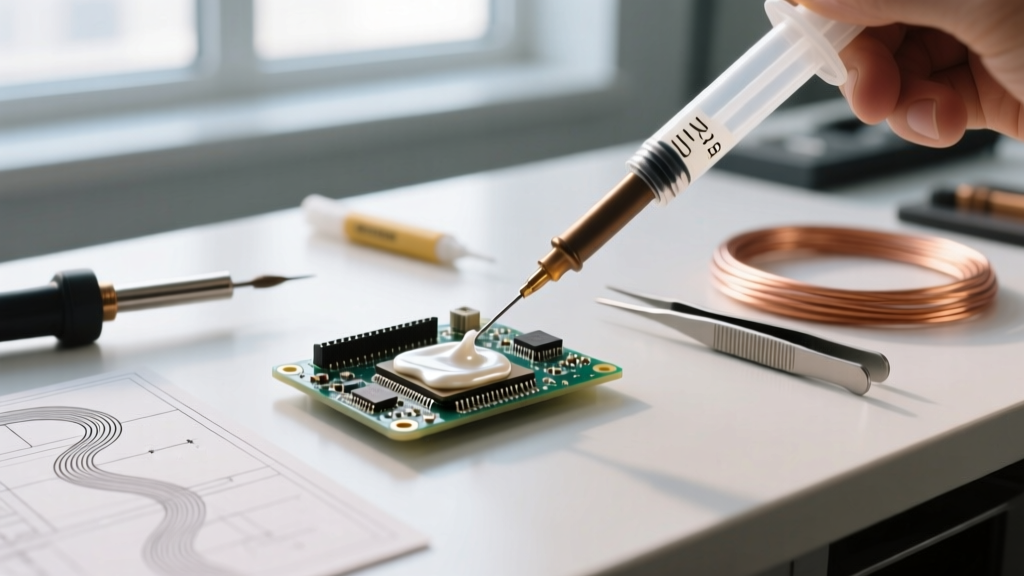

Understanding the Core Function: What Does Soldering Paste Do?
At its core, soldering paste (or solder paste) is a highly engineered, homogeneous mixture of microscopic metal alloy spheres suspended in a tacky, chemically active flux medium. If you have ever asked, "what does soldering paste do?", the simplest answer is that it acts as a temporary adhesive to hold surface mount components in place before reflow, while simultaneously providing the exact chemical environment required to strip oxidation and form reliable intermetallic bonds during heating.
Unlike liquid flux or solid solder wire, paste is designed specifically for high-volume stencil printing and precision reflow soldering. As of 2026, with the mass adoption of 01005 and 008004 micro-components, the rheology (flow characteristics) of the paste is just as critical as its thermal properties. The flux vehicle must prevent the solder powder from clumping, resist drying out during long stencil print times, and activate at precise temperature thresholds.
The Chemical Matrix: Flux Vehicle vs. Solder Powder
To understand the safety and handling requirements, we must break down the two primary constituents of the paste:
- The Alloy Powder (85% - 92% by weight): Typically SAC305 (96.5% Tin, 3.0% Silver, 0.5% Copper) for lead-free applications, or Sn63Pb37 for specialized aerospace/medical legacy boards. The powder is manufactured via gas atomization to ensure perfect sphericity.
- The Flux Vehicle (8% - 15% by weight): A complex blend of rosin (colophony) or synthetic resins, rheological modifiers (thixotropic agents to prevent slumping), and activators (like adipic or succinic acid) that dissolve metal oxides when heated.
Health Hazards: The Hidden Dangers in the Flux Vehicle
While the metal alloys in solder paste present minimal risk during the printing phase (provided you practice basic hygiene and avoid lead ingestion), the flux vehicle poses significant respiratory and dermatological hazards during the reflow and cleaning phases.
CRITICAL SAFETY WARNING: Colophony (rosin), the primary base for most traditional solder pastes, is a known respiratory sensitizer. Repeated inhalation of vaporized rosin flux during reflow can lead to occupational asthma, a condition that is often irreversible. Always consult the Health and Safety Executive (HSE) guidelines on colophony for workplace exposure limits.
Dermal and Ocular Exposure Risks
Solder paste is designed to be tacky. If it contacts the skin, the flux activators (which are mildly acidic) can cause contact dermatitis. Furthermore, the solvents used in the flux vehicle can strip natural oils from the skin. Never use bare hands to scoop paste from a jar; always use dedicated plastic or Teflon spatulas. If paste contacts the eyes, the resin and activators can cause severe chemical conjunctivitis requiring immediate 15-minute flushing and medical attention.
Storage, Handling, and Shelf-Life Best Practices
Improper handling of solder paste doesn't just ruin your PCB assembly; it creates safety hazards. Moisture ingress, for example, can cause the paste to "spatter" or "pop" violently inside the reflow oven, potentially ejecting molten solder onto heating elements or operators.
The 4-Step Safe Handling Protocol
- Refrigerated Storage: Unopened jars or cartridges must be stored in a dedicated refrigerator between 0°C and 10°C (32°F - 50°F). This halts the chemical degradation of the flux activators. A 500g jar of premium Indium SAC305 Type 4 paste costs roughly $95-$130 in 2026; improper storage will destroy this investment in weeks.
- Controlled Acclimation: Before opening the container, it must sit at room temperature (20°C - 25°C) for a minimum of 2 to 4 hours. Never use external heat sources to speed this up. Opening a cold jar causes atmospheric condensation to form inside, introducing water into the flux matrix.
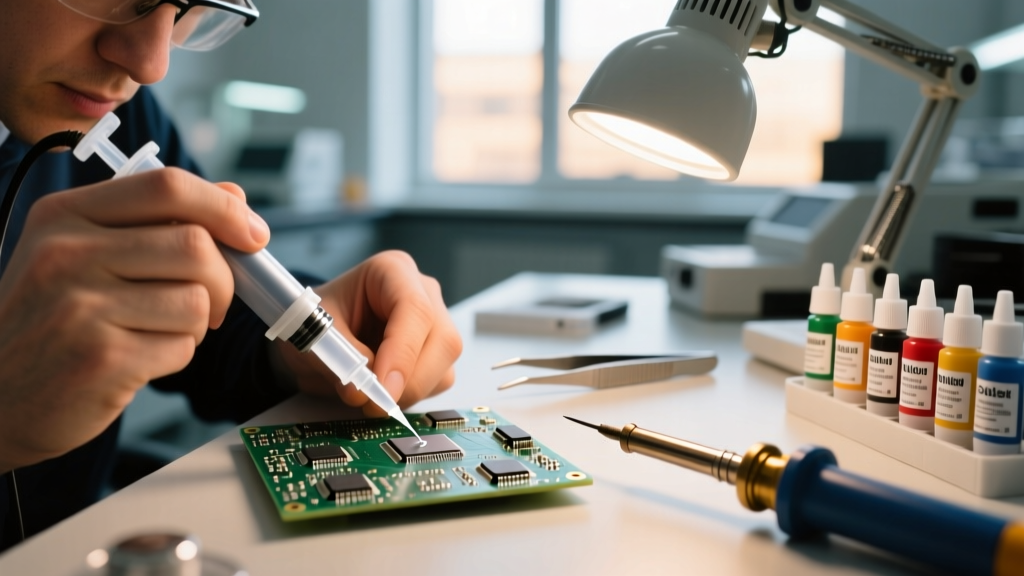
- Stirring and Rheology Check: Once acclimated, stir the paste gently with a dedicated spatula for 60-90 seconds to re-suspend any settled powder. Do not use high-speed mechanical mixers, as the friction can prematurely activate the flux or introduce air bubbles.
- Stencil Life Management: Once printed on the stencil, the paste has a "tack life" of 4 to 8 hours. Beyond this, the flux solvents evaporate, reducing tackiness and risking component tombstoning during reflow.
Paste Classification and Selection Matrix
Selecting the right paste type dictates not only your print quality but also your cleanup safety protocols. The IPC J-STD-005 standard governs these classifications based on powder mesh size and flux type.
| Paste Type | Powder Mesh Size | Best Application | Safety & Handling Note |
|---|---|---|---|
| Type 3 | 25 - 45 µm | Standard SMDs (0805, SOIC) | Standard fume extraction required during reflow. |
| Type 4 | 20 - 38 µm | Fine-pitch QFNs, 0402 components | Higher surface area increases oxidation risk; requires tighter nitrogen reflow environments. |
| Type 5 | 15 - 25 µm | Micro-BGAs, 01005 passives | Extremely prone to moisture absorption. Strict humidity control (<40% RH) in the print room is mandatory. |
| Water-Soluble | Varies (Usually T4) | High-reliability, bare copper | Highly acidic. Requires immediate post-reflow cleaning with heated DI water to prevent severe board corrosion. |
Reflow Safety: Managing Fumes and Thermal Breakdown
When the PCB enters the reflow zone (typically peaking at 235°C - 245°C for SAC305), the flux vehicle undergoes violent thermal decomposition. This releases Volatile Organic Compounds (VOCs), aerosolized rosin, and trace heavy metals into the air.
Fume Extraction Requirements
Overhead ventilation is entirely insufficient for capturing solder paste fumes. You must use source-capture fume extraction systems. According to occupational safety guidelines, the capture velocity at the point of fume generation must be at least 100 feet per minute (fpm). Systems equipped with HEPA and activated carbon filters (such as those from BOFA or Hakko) are required to trap both the particulate matter and the VOC gases. If you are running a benchtop reflow oven, it must be ducted to an external exhaust or fitted with a heavy-duty inline filtration unit.
Post-Reflow Cleanup and Solvent Safety
The safety protocols extend to the cleaning phase, which depends entirely on the flux chemistry you selected:
- No-Clean Pastes: The residue is designed to be left on the board. It encapsulates the activators in a hardened resin shell. However, if you must clean it for conformal coating adhesion, you will need aggressive saponifiers or specialized solvents (e.g., MicroCare MCC-SPW), which require chemical-resistant gloves (Nitrile or Viton) and localized exhaust ventilation.
- Water-Soluble (OA) Pastes: These leave highly active, corrosive residues. They must be cleaned within 2 to 4 hours of reflow using heated (60°C) Deionized (DI) water. The safety hazard here is the contaminated wastewater, which contains heavy metals and acidic flux. This effluent cannot be poured down the drain; it must be collected and disposed of as hazardous industrial waste in compliance with local environmental regulations.
Frequently Asked Questions (FAQ)
Can I use expired soldering paste if I bake it first?
No. Baking solder paste will destroy the chemical balance of the flux activators and evaporate the essential solvents, leading to catastrophic solder balling and non-wetting. Expired paste (typically past 6 months from manufacture) should be disposed of through a certified e-waste or hazardous materials recycler.
Is lead-free solder paste safer than leaded paste?
From an environmental and ingestion standpoint, yes. However, lead-free pastes (like SAC305) require higher reflow temperatures (up to 250°C). These higher temperatures cause the flux to decompose more aggressively, often producing more toxic and irritating fumes than lower-temperature leaded pastes. Fume extraction remains mandatory for both.
What should I do if I accidentally ingest solder paste?
Solder paste contains heavy metals and toxic chemical activators. Do not induce vomiting. Rinse the mouth with water, drink a small amount of milk or water to dilute, and immediately contact Poison Control or seek emergency medical attention, bringing the paste's Safety Data Sheet (SDS) with you.