
The Thermodynamic Reality of Soldering
To understand how flux works, we must first discard the common misconception that soldering is merely 'gluing with metal.' In material science, soldering is a complex thermodynamic and metallurgical process wherein a filler metal (the alloy) forms an intermetallic compound (IMC) with a base metal (the substrate). However, this metallurgical bond is impossible in ambient atmospheric conditions. The primary adversary of the soldering process is oxidation.
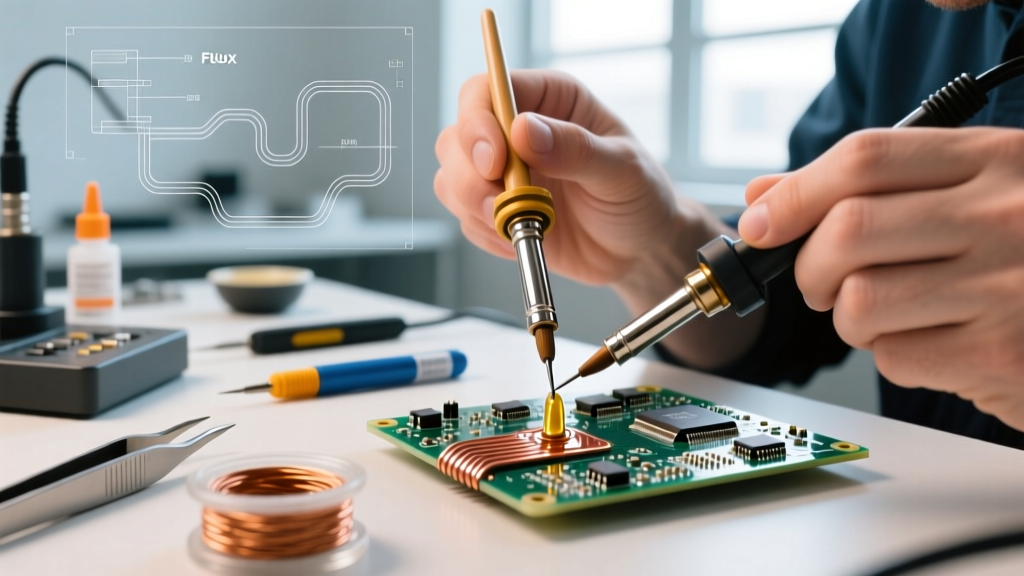
At standard reflow or hand-soldering temperatures (240°C to 350°C), copper pads and component leads react with atmospheric oxygen in milliseconds, forming cuprous oxide (Cu2O) and cupric oxide (CuO). Similarly, tin-based solder alloys instantly form a tin oxide (SnO2) skin. Liquid solder cannot wet or bond to these oxide layers; instead, surface tension causes the molten alloy to ball up and roll off the joint. This is where flux intervenes, acting as a chemical reducing agent and a physical barrier against further oxidation.
The Chemistry of Oxide Reduction
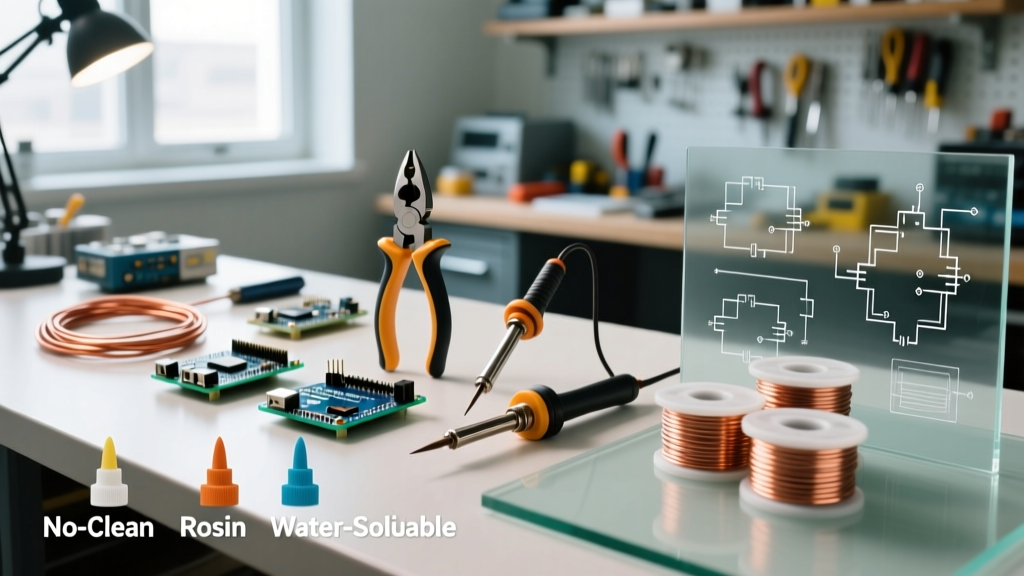
Flux does not simply 'clean' a surface; it actively reduces metal oxides back to their base metallic state through specific chemical reactions. The mechanism depends entirely on the flux classification, which is governed by standards such as those outlined by the IPC Association Connecting Electronics Industries (specifically IPC-J-STD-004).
Rosin Fluxes and Abietic Acid
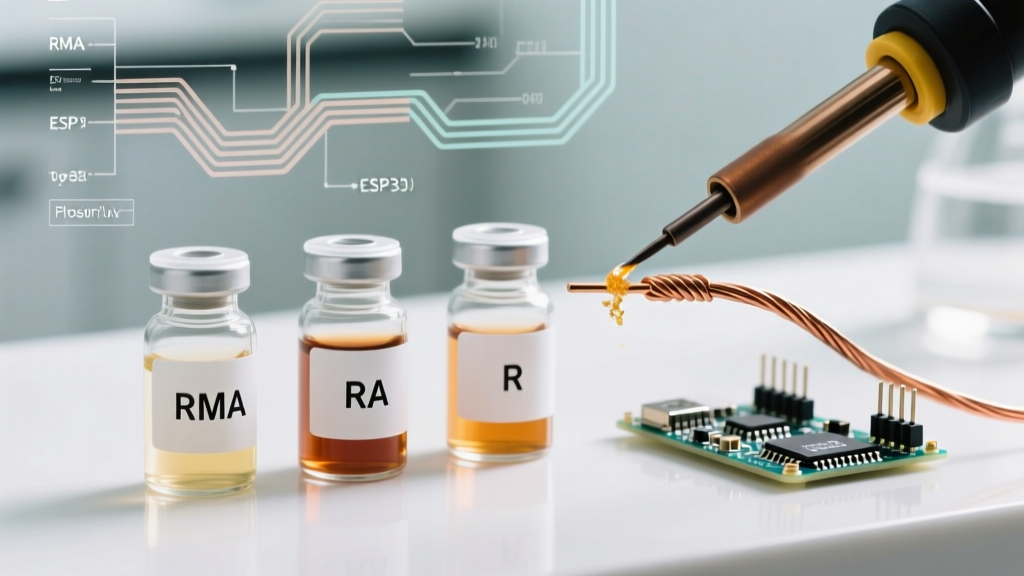
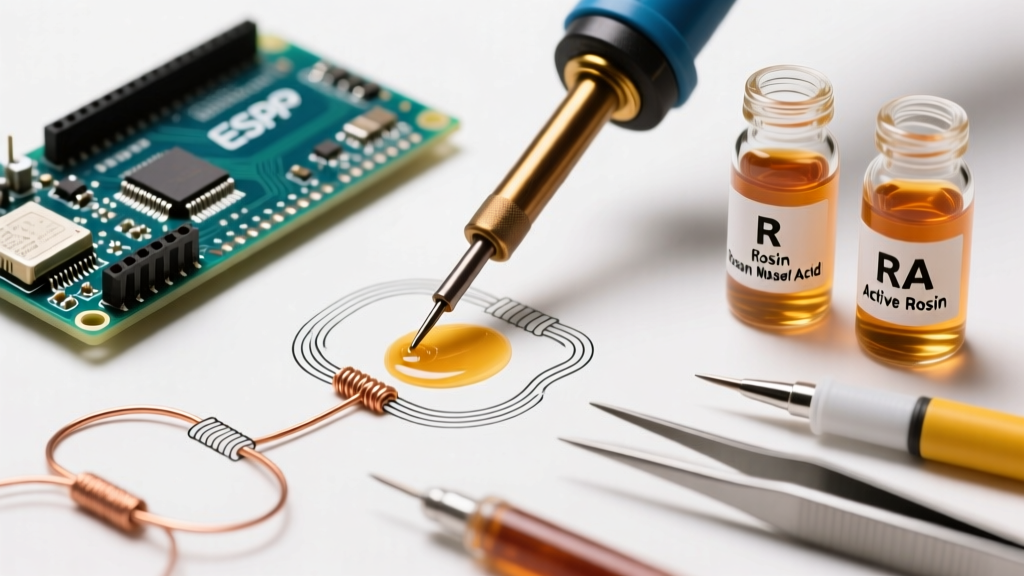
Traditional rosin fluxes are derived from pine tree sap, consisting primarily of abietic acid (C20H30O2). In its solid state, rosin is non-corrosive and electrically insulating. However, when heated above its activation temperature (typically around 150°C), abietic acid becomes highly reactive. It attacks copper oxide to form copper abietate, a soluble metallic salt that lifts the oxide layer away from the copper pad, exposing pristine metal for the liquid solder to wet. Once the joint cools, unreacted rosin re-solidifies into a benign, glassy matrix that encapsulates any residual ionic contaminants.
Water-Soluble (Organic Acid) Fluxes
For heavily oxidized boards or demanding industrial applications, water-soluble fluxes utilize stronger organic acids (OAs) such as adipic acid, glutaric acid, or stearic acid. These acids possess higher activation energies and more aggressive reduction capabilities. While they yield pristine, highly reliable metallurgical bonds, their residues are highly hygroscopic and conductive. Post-soldering aqueous cleaning is mandatory to prevent catastrophic failure modes, a standard heavily emphasized in NASA Workmanship Standards for mission-critical aerospace electronics.
No-Clean and Synthetic Resins
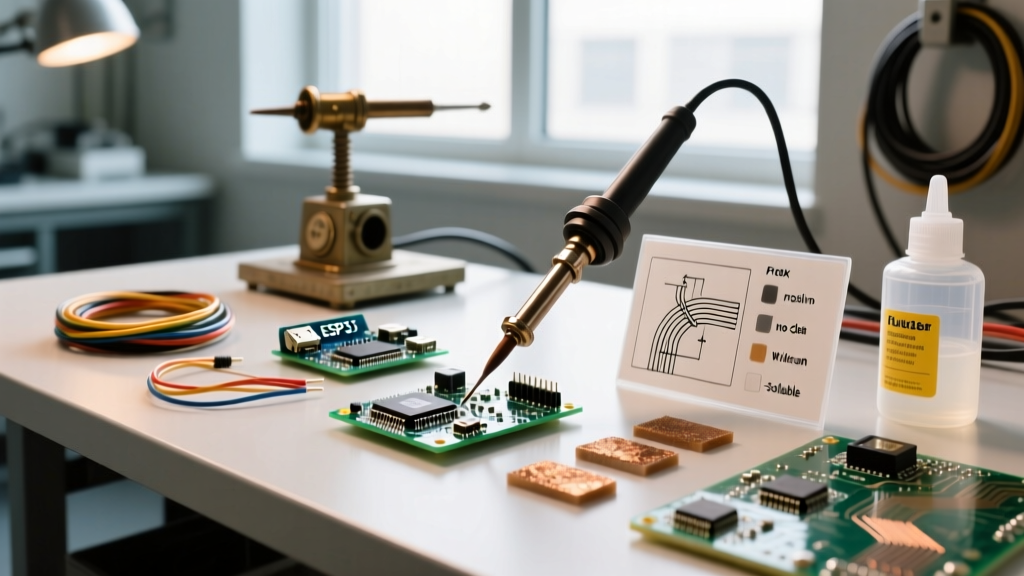
Modern no-clean fluxes rely on synthetic resins and weak halide-free activators (like dicarboxylic acids). They are engineered with a precise thermal decomposition profile. During the reflow cycle, the activators reduce the oxides, and upon reaching peak temperatures (245°C+), the active chemical species either volatilize completely or undergo a structural polymerization that renders the remaining residue electrically inert and non-hygroscopic.
The Physics of Wetting: Young’s Equation
Beyond chemical reduction, flux fundamentally alters the physics of the soldering environment by manipulating surface tension. The success of a solder joint is measured by its 'wetting angle' or 'contact angle' ($\theta$), defined by Young’s Equation:
$\gamma_{sg} = \gamma_{sl} + \gamma_{lg} \cos(\theta)$
Where $\gamma_{sg}$ is solid-gas interfacial energy, $\gamma_{sl}$ is solid-liquid interfacial energy, and $\gamma_{lg}$ is liquid-gas interfacial energy.
For a reliable solder joint, the contact angle must be less than 30°. Without flux, the high surface tension of the molten solder (liquid-gas) and the oxidized pad (solid-gas) results in a contact angle greater than 90° (non-wetting). Flux dramatically lowers the $\gamma_{lg}$ and $\gamma_{sl}$ variables by displacing air and oxides, allowing capillary action to draw the molten alloy into plated through-holes (PTH) and under fine-pitch surface mount components.
Flux Activation Profiles and Thermal Windows
Selecting the correct flux requires matching its chemical activation window to the thermal profile of your specific solder alloy. Using a high-temperature lead-free flux with a low-temperature bismuth-tin alloy will result in cold joints, as the flux will never activate. Conversely, using a low-temperature rosin flux with a SAC305 (Sn96.5/Ag3.0/Cu0.5) alloy will cause the flux to burn off before the solder reaches its 217°C liquidus point, leading to severe oxidation and solder balling.
| Flux Classification | Primary Activator Chemistry | Activation Temp Range | Peak Temp Tolerance | Residue Characteristic |
|---|---|---|---|---|
| Rosin (R / RMA) | Abietic Acid, Pine Rosin | 150°C - 170°C | 230°C | Hard, Glassy, Insulating |
| Water-Soluble (OA) | Adipic, Glutaric, Lactic Acids | 180°C - 210°C | 260°C+ | Sticky, Hygroscopic, Ionic |
| No-Clean (NC) | Synthetic Resins, Dicarboxylic Acids | 160°C - 190°C | 250°C | Soft, Tacky, Inert (Post-Reflow) |
| Inorganic Acid (IA) | Hydrochloric, Phosphoric Acids | 100°C - 150°C | 300°C+ | Highly Corrosive (Electronics Banned) |
The Role of Rheology in Solder Paste Flux
In surface mount technology (SMT), flux is not just a liquid; it is a complex rheological medium known as 'tack flux' or solder paste. This paste consists of 50% flux chemistry and 50% microscopic spheres of solder alloy. The flux in this context must also act as a thixotropic agent. It must maintain high viscosity at room temperature to hold heavy components (like BGAs and QFNs) in place via 'tack force,' yet undergo a rapid viscosity drop when subjected to the shear stress of a squeegee during stencil printing. Advanced 2026 solder pastes utilize specialized hydrogenated castor oil waxes to achieve this precise rheological shear-thinning behavior without compromising the chemical reduction capabilities of the activators.
Modern Failure Modes: ECM and BGA Voiding
Understanding metallurgical flux principles is critical for preventing modern assembly failures. Two prominent issues in high-density PCB design include:
- Electrochemical Migration (ECM): If no-clean flux residues are exposed to high humidity and a DC bias, unreacted weak acids can facilitate the growth of metallic dendrites between fine-pitch leads (0.4mm or less). This causes catastrophic short circuits. IPC-9252 testing is the industry benchmark for validating flux residues against ECM.
- BGA Voiding via Outgassing: In Ball Grid Array (BGA) components, if the solvents within the flux have a boiling point lower than the solder alloy's liquidus temperature, the flux will vaporize while the solder is already molten. The gas becomes trapped under the heavy component, creating voids that exceed the 25% IPC limit, severely degrading the thermal and mechanical reliability of the joint. Formulators solve this by utilizing high-boiling-point glycol ethers in modern no-clean pastes.
Summary for the Practicing Engineer
Flux is not an accessory to the soldering process; it is the fundamental enabler of metallurgical bonding. By chemically reducing oxides and physically manipulating interfacial surface tensions, flux bridges the gap between a molten alloy and a solid substrate. Whether you are hand-soldering a 0603 resistor with Sn63Pb37 and RMA rosin, or running a vapor-phase reflow profile for a 17x17mm BGA using SAC305 and a Type 4 no-clean paste, success relies entirely on matching the flux's chemical activation energy to your specific thermal and metallurgical parameters.