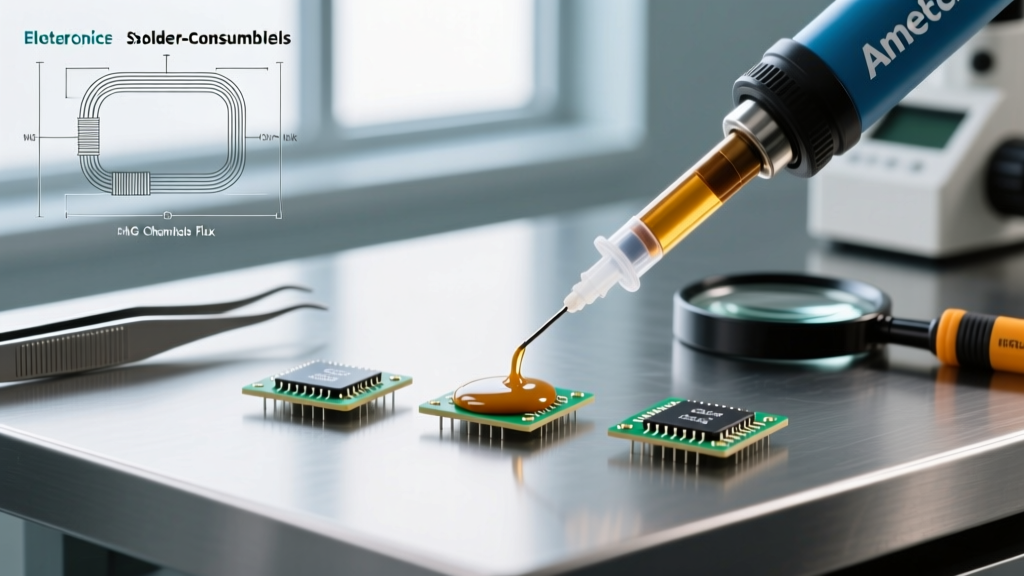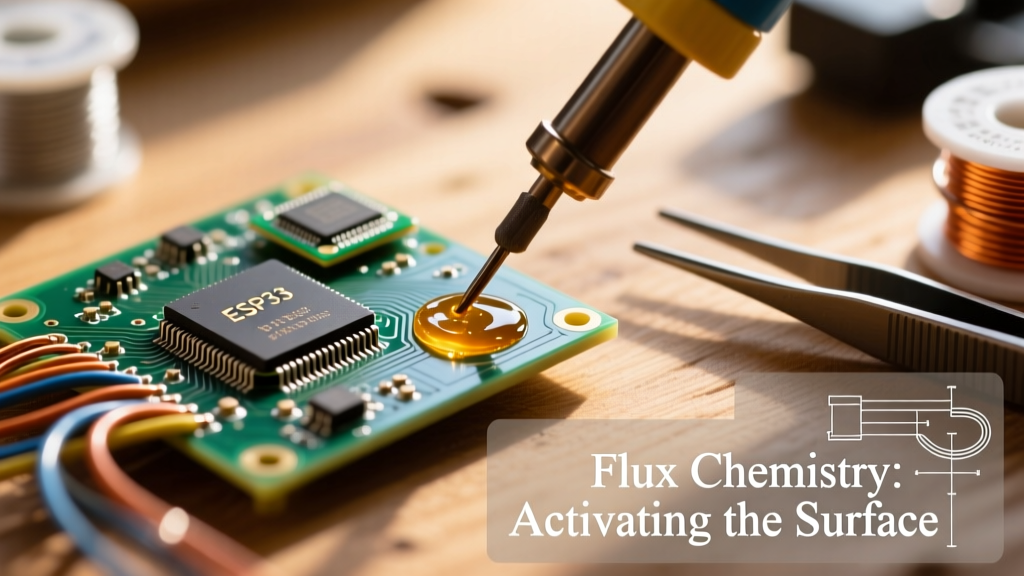

Most electronics hobbyists and junior technicians view flux as a mere sticky paste that magically makes solder flow. However, from a metallurgical and chemical engineering perspective, understanding the true purpose of flux for soldering requires examining the thermodynamics of metal oxidation, surface tension, and intermetallic compound (IMC) formation. Without flux, modern surface-mount technology (SMT) and through-hole assembly would be physically impossible. This material science explainer breaks down the exact chemical mechanics of how flux enables reliable electrical connections.
The Thermodynamic Barrier: Why Bare Metal Rejects Solder
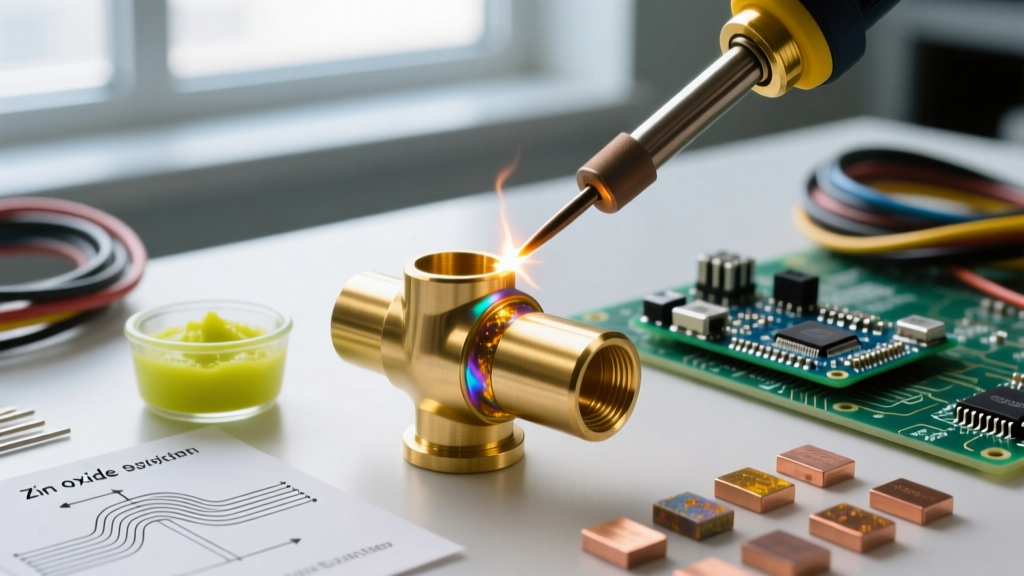
To understand the purpose of flux for soldering, we must first understand the enemy: metal oxides. When copper (Cu) or tin (Sn) is exposed to ambient oxygen, an oxidation layer forms immediately. At room temperature, a copper trace develops a cuprous oxide (Cu2O) and cupric oxide (CuO) layer roughly 10 to 50 angstroms thick. When heated to typical reflow temperatures (240°C to 260°C), this oxide layer grows exponentially, exceeding 1,000 angstroms in seconds.
Solder alloys—whether leaded Sn63Pb37 or lead-free SAC305 (Tin-Silver-Copper)—rely on the formation of intermetallic compounds (specifically Cu6Sn5 and Cu3Sn) to create a structural and electrical bond. Solder cannot wet or diffuse through copper oxide. If you apply molten SAC305 directly to an oxidized copper pad, the surface tension of the liquid solder will cause it to bead up and roll off, a phenomenon known as dewetting. The primary chemical purpose of flux is to act as a reducing agent, stripping away these oxides to expose bare, reactive metal before the solder reaches its liquidus temperature.
The Chemical Mechanics of Deoxidization
Fluxes are not universal cleaners; they are highly engineered chemical solvents designed to activate at specific thermal thresholds. The industry primarily relies on two chemical families, each serving a distinct material science function.
Rosin (Colophony) and Thermal Activation
Derived from pine tree sap, natural rosin consists primarily of abietic acid (C20H30O2). In its solid state at room temperature, abietic acid is completely inert and non-conductive. However, as the soldering iron or reflow oven raises the temperature past 150°C, the rosin undergoes a phase change and becomes chemically active. The activated abietic acid reacts with the copper oxide layer to form copper abietate, a soluble salt that floats to the surface of the molten solder joint. Once the joint cools, the unreacted rosin hardens into a glassy, electrically insulating shell, trapping any remaining contaminants. This makes rosin-based 'no-clean' fluxes ideal for consumer electronics where post-assembly washing is cost-prohibitive.
Water-Soluble (OA) Fluxes and Aggressive Ion Exchange
For high-reliability applications like aerospace or medical devices, organic acid (OA) water-soluble fluxes are utilized. These formulations replace abietic acid with shorter-chain dicarboxylic acids, such as adipic acid, glutaric acid, or succinic acid. These acids have lower activation temperatures and higher chemical aggressiveness, capable of reducing heavily oxidized nickel and gold surfaces that rosin cannot penetrate. The trade-off is that OA flux residues are highly ionic and hygroscopic. If left on the PCB, they will absorb atmospheric moisture and cause catastrophic short circuits, mandating a rigorous deionized (DI) water wash post-soldering.
IPC J-STD-004B Flux Classification Matrix
The IPC standard J-STD-004B categorizes fluxes based on their chemical composition, activity level, and halide content. Understanding this matrix is critical for matching the flux to your specific metallurgical requirements.
| IPC Code | Composition | Activity Level | Halide Content | Primary Use Case |
|---|---|---|---|---|
| ROL0 | Rosin (Low Activity) | Low | 0% (Halide-free) | Standard SMT, highly oxidized-free boards, no-clean processes. |
| ROM1 | Rosin (Medium Activity) | Medium | < 2% | Mildly oxidized boards, standard through-hole, requires cleaning if exposed to high humidity. |
| REL0 | Resin (Low Activity) | Low | 0% | Automotive electronics, high-reliability no-clean where synthetic resins outperform natural rosin. |
| ORH1 | Organic (High Activity) | High | > 2% | Heavily oxidized RF shields, thick copper planes. Mandatory DI water cleaning. |
Surface Tension and the Wetting Angle
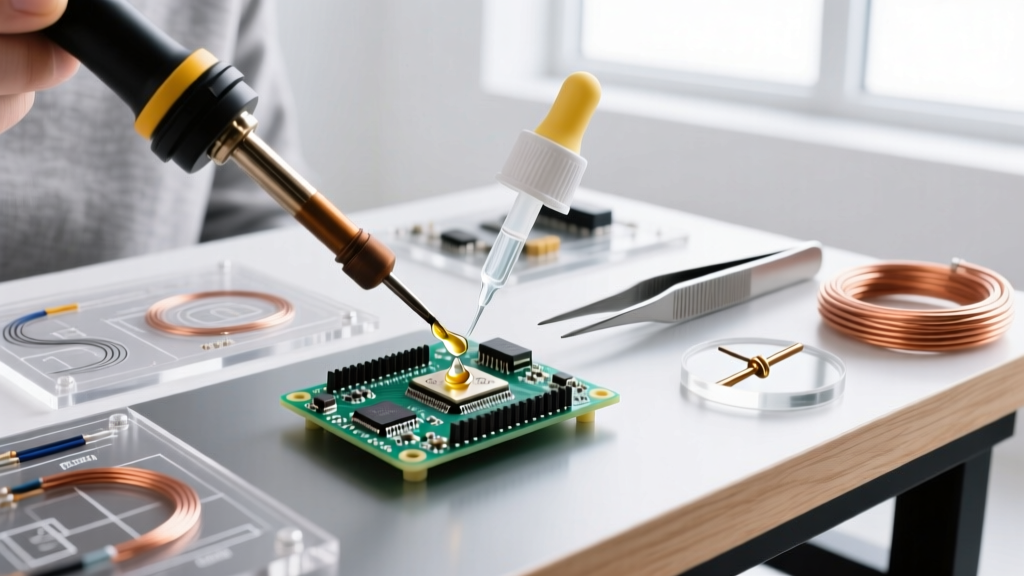
From a physics standpoint, the purpose of flux for soldering is to manipulate the wetting angle (contact angle) of the liquid solder, governed by Young's Equation. A wetting angle of less than 30° indicates excellent metallurgical bonding, where the solder spreads thinly and evenly across the pad. An angle greater than 90° indicates dewetting. Flux lowers the surface tension of the molten solder while simultaneously increasing the surface energy of the copper pad. By reducing the interfacial tension between the liquid alloy and the solid metal, flux allows capillary action to pull the solder into plated through-holes (PTH) and under tight-pitch QFN (Quad Flat No-leads) thermal pads.
Real-World Failure Modes Driven by Flux Chemistry
When the chemical properties of the flux are mismatched to the thermal profile or the component density, distinct physical failure modes occur on the assembly line:
- Tombstoning (Drawbridging): Common in 0201 and 01005 passive components. If the flux on one pad activates and outgasses slightly faster than the other, the unequal surface tension pulls the component upright, standing it on its end like a tombstone. This is often caused by uneven heating rather than the flux itself, but using a flux with a wider activation window (like Kester 245) mitigates the risk.
- Solder Balling and Splattering: Water-soluble and heavily solvent-based liquid fluxes can trap microscopic moisture pockets. When the reflow oven hits 215°C, the moisture flashes into steam, expanding 1,600 times in volume and explosively ejecting micro-spheres of solder across the PCB. Pre-baking boards or utilizing low-VOC, high-solids gel fluxes prevents this.
- Electrochemical Migration (ECM): If ROL1 or ORH1 flux residues are left uncleaned in high-humidity environments, the halide ions combine with moisture and DC bias to grow metallic dendrites between fine-pitch IC pins, eventually causing a hard short circuit.
2026 Expert Selection Guide for Micro-Components
As we navigate the manufacturing landscape of 2026, the miniaturization of PCBs has pushed component pitches below 0.3mm, and the adoption of ultra-low-temperature alloys (like Sn-Bi-Ag) has altered traditional thermal profiles. Selecting the correct flux is no longer a generic choice.
Expert Insight: 'When hand-soldering 0.4mm pitch BGA rework or 01005 passives, the physical viscosity of the flux is just as critical as its chemical activity. A high-tack, no-clean gel flux like Kester 245 or Indium TAC-4 provides the mechanical surface tension required to hold micro-components in place before the solder melts, while its ROL0 chemistry ensures long-term reliability without washing.'
For automated selective soldering or wave soldering of mixed-technology boards featuring heavy copper ground planes, engineers must utilize VOC-free, water-based fluxes (like Kester 952S). These formulations utilize synthetic organic acids that do not flash off prematurely when exposed to the prolonged preheat zones required to saturate thick multilayer boards. According to reliability data presented by the Surface Mount Technology Association (SMTA), matching the flux's boiling point and thermal degradation curve to the specific mass of the PCB assembly is the single highest predictor of long-term joint fatigue resistance.
Summary: The Indispensable Chemical Catalyst
The purpose of flux for soldering extends far beyond simple cleaning. It is a precisely engineered thermodynamic catalyst that reduces metal oxides, alters surface tension to promote capillary wetting, and shields the molten intermetallic boundary from atmospheric re-oxidation. Whether you are utilizing a mildly activated rosin for a quick drone repair or a highly active organic acid for aerospace RF shielding, respecting the material science of flux is the defining line between a catastrophic field failure and a lifelong, reliable solder joint.