
The Hidden Economics of Soldering Flux
When evaluating the types of flux in soldering, most engineers and procurement managers focus exclusively on the upfront cost per ounce or gram. However, in modern electronics manufacturing and advanced DIY prototyping, the material cost of the flux is merely the tip of the iceberg. The true financial impact of your flux selection is determined by its Total Cost of Ownership (TCO), which includes cleaning solvents, capital equipment depreciation, rework labor, and the catastrophic liability of field failures.
As supply chains stabilize in 2026, the pricing landscape for soldering consumables has shifted. Premium no-clean formulations have seen slight price reductions due to scaled production, while the cost of specialized cleaning solvents and heated deionized (DI) water systems continues to rise. This comprehensive cost analysis breaks down the three primary flux categories—Rosin, Water-Soluble, and No-Clean—to help you make financially sound, reliability-driven decisions.
The TCO Formula:
Total Cost = (Flux Material Cost) + (Cleaning Solvent/Water Cost) + (Equipment Depreciation) + (Rework/Scrap Rate) + (Field Failure Liability).
Upfront vs. Lifecycle Costs: The Core Dilemma
According to foundational metallurgical flux literature, the primary chemical purpose of flux is to reduce metal oxides and prevent re-oxidation during the thermal profile of soldering. While all fluxes achieve this, their post-soldering residue profiles dictate the lifecycle costs. Choosing a cheap water-soluble flux might save $0.10 per board in material costs, but if it requires a $25,000 batch cleaning system and $0.15 per board in saponifiers, the net financial loss is immediate.
Cost Breakdown by Flux Category
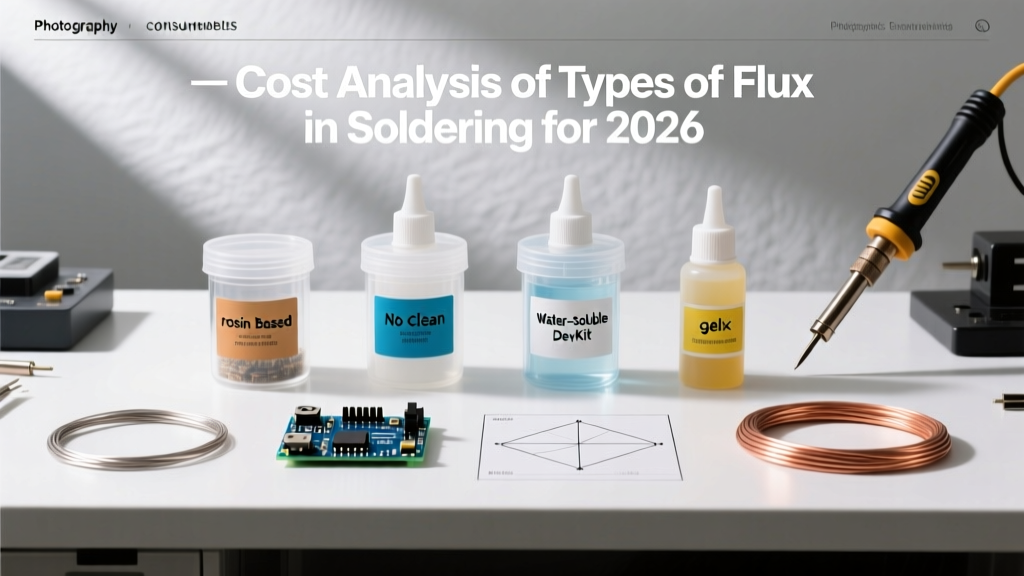
1. Rosin-Based Fluxes (R, RMA, RA)
Rosin fluxes, derived from pine sap, are the traditional workhorses of electronics assembly. They are categorized by activity level: Rosin (R), Rosin Mildly Activated (RMA), and Rosin Activated (RA).
- Example Products: Kester 1544 (RA liquid), MG Chemicals 8341 (RMA paste).
- 2026 Upfront Cost: $0.20 to $0.45 per gram. A standard 2oz jar of MG 8341 retails for approximately $14.00.
- Cleaning Requirements: RMA and RA fluxes leave sticky, active residues that must be removed to prevent long-term corrosion and to allow for accurate in-circuit testing (ICT).
- Cleaning Cost: Requires high-purity Isopropyl Alcohol (IPA) or specialized aerosol cleaners like Techspray Ecoline (~$22.00 per can). Manual brushing adds $0.30 to $0.80 per board in labor.
2. Water-Soluble (Organic Acid) Fluxes
Water-soluble fluxes contain aggressive organic acids (OA) designed for maximum wetting and fast soldering speeds, making them popular in high-volume wave soldering and heavy-duty through-hole assembly.
- Example Products: Kester 245 (liquid), Indium 5.8 (paste).
- 2026 Upfront Cost: $0.15 to $0.35 per gram. Kester 245 is roughly $32.00 per pint.
- Cleaning Requirements: Mandatory. OA residues are highly corrosive and hygroscopic. If left on the board, they will rapidly cause electrochemical migration (ECM).
- Cleaning Cost: Requires a heated DI water washing system (capital cost: $15,000–$40,000) and chemical saponifiers (e.g., Kyzen Aquanox). The operational cost averages $0.12 to $0.25 per board, factoring in water treatment and chemical replenishment.
3. No-Clean Fluxes
No-clean fluxes are engineered with synthetic resins that leave a minimal, electrically inert residue after reflow. They dominate modern Surface Mount Technology (SMT) assembly.
- Example Products: Amtech NC-559-V2-TF (tacky paste), Kester 951 (liquid).
- 2026 Upfront Cost: $0.50 to $1.20 per gram. A 10cc syringe of Amtech NC-559 costs around $48.00, reflecting its premium halogen-free formulation.
- Cleaning Requirements: None for standard commercial applications. The residue is designed to be safely left on the PCB.
- Cleaning Cost: $0.00 per board in standard scenarios. However, if cleaning is required for conformal coating adhesion or aerospace compliance, no-clean residues are notoriously difficult to remove, often requiring expensive specialty solvents like Zestron Vigon (~$85.00 per gallon).
2026 Cost Comparison Matrix
| Flux Type | Example Product | Upfront Cost (per 100g) | Cleaning Cost per Board | Hidden Costs & Risks | Best ROI Scenario |
|---|---|---|---|---|---|
| Rosin (RMA) | MG 8341 Paste | $18.00 - $22.00 | $0.35 (Manual IPA) | Solvent disposal fees; manual labor variability. | Low-volume DIY, repair shops, and manual rework. |
| Water-Soluble | Kester 245 Liquid | $12.00 - $16.00 | $0.18 (Batch DI Wash) | High capital equipment cost; catastrophic ECM if wash fails. | High-volume through-hole, wave soldering with existing wash infrastructure. |
| No-Clean | Amtech NC-559 | $45.00 - $55.00 | $0.00 (Standard) | Residue may interfere with ICT probes; conformal coating delamination if not managed. | High-volume SMT, BGA reballing, consumer electronics. |
Hidden Costs: Electrochemical Migration and SIR Failures
The most expensive cost associated with the types of flux in soldering is the cost of a field failure. When water-soluble or highly activated rosin fluxes are inadequately cleaned, the residual organic acids combine with ambient moisture to form conductive pathways. This phenomenon, known as dendritic growth or Electrochemical Migration (ECM), can short-circuit fine-pitch components.
Reliability data tracked by the NASA Electronic Parts and Packaging (NEPP) Program consistently highlights the dangers of ionic contamination in harsh environments. To quantify this risk, manufacturers use Surface Insulation Resistance (SIR) testing per IPC-TM-650 2.6.3.7. If a flux causes the SIR to drop below 100 MΩ, the board is deemed unreliable. The cost of a single recalled batch of medical or automotive PCBs due to ECM can easily exceed $500,000, instantly wiping out any upfront savings from using cheaper, aggressive flux chemistries.
Furthermore, compliance with IPC standards for soldering fluxes (specifically IPC J-STD-004B) requires rigorous testing of flux residues. No-clean fluxes must pass stringent copper mirror and corrosion tests to be certified, which is why premium brands like Amtech and Kester command higher upfront prices. You are paying for the chemical engineering that guarantees the residue will remain inert over a 10-year operational lifespan.
Strategic Selection Framework
For Low-Volume Prototyping and Rework
If you are running a repair lab or prototyping under 500 boards a month, Rosin-based pastes (RMA) or No-Clean tacky fluxes offer the best TCO. The lack of capital equipment required for cleaning keeps overhead low. For manual rework, the $48.00 investment in a 10cc syringe of Amtech NC-559 is justified by its superior wetting and zero-cleanup requirement, saving technicians 3-5 minutes per board in IPA scrubbing.
For High-Volume SMT Assembly
For SMT lines producing over 10,000 boards monthly, No-Clean liquid fluxes (like Kester 951) applied via jet-spraying or foaming are the undisputed financial winners. Eliminating the post-reflow cleaning stage removes a massive bottleneck, reduces factory floor space requirements, and eliminates the environmental compliance costs associated with disposing of VOC-heavy solvent waste.
For Heavy-Duty Through-Hole and Aerospace
When soldering large thermal mass components or building aerospace-grade hardware where absolute cleanliness is mandated by NASA-STD-8739.3, Water-Soluble fluxes are necessary. While the upfront equipment cost for an inline DI water washer is high, the amortized cost per board drops to pennies at high volumes, and the guarantee of zero ionic residue justifies the expense for mission-critical applications.
Expert FAQ
Can I use IPA to clean No-Clean flux residues?
Technically yes, but it is financially inefficient. Standard 99% IPA often just smears no-clean synthetic resins across the board rather than dissolving them. If you must clean no-clean flux (e.g., for conformal coating), you must use specialized saponified solvents, which increases the cleaning cost per board by up to 400% compared to washing water-soluble fluxes.
Why is Amtech NC-559 so much more expensive than generic no-clean fluxes?
Amtech NC-559-V2-TF is a halogen-free, zero-halide formulation engineered specifically for lead-free BGA reballing and fine-pitch SMT. Generic no-clean fluxes often contain hidden halide activators that leave corrosive residues. The premium price covers the rigorous SIR and ECM testing required to ensure the flux will not degrade high-impedance circuits over time.
Does flux expire, and how does that affect cost?
Yes. Liquid fluxes typically have a 12-to-24-month shelf life, while tacky pastes last 6 to 12 months. Using expired flux results in poor wetting, oxidized solder joints, and increased rework labor. To minimize waste costs, procure flux in smaller, application-specific volumes rather than bulk gallons that will oxidize and separate before use.