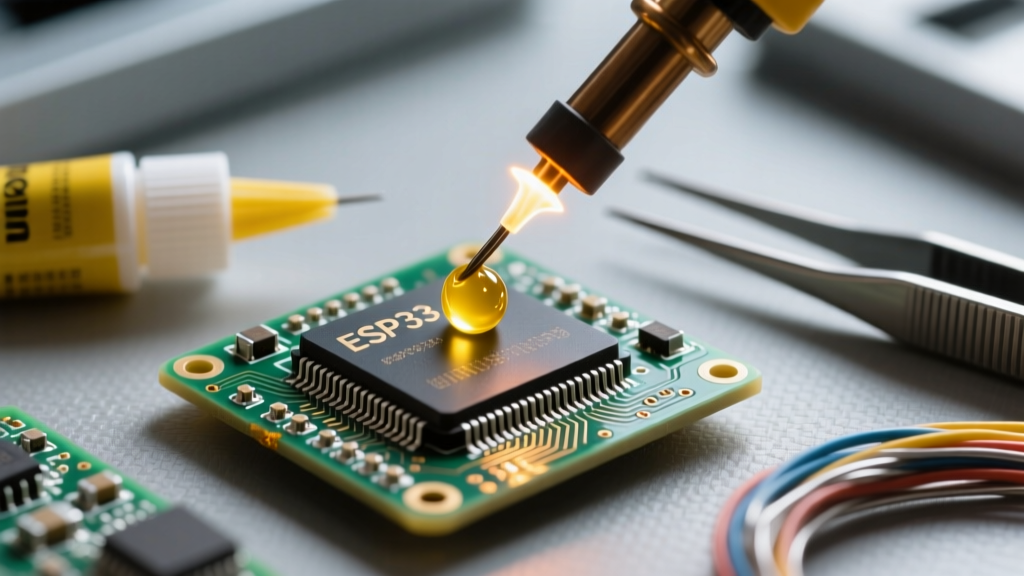

Beyond the 'Sticky Helper': The Material Science of Flux
In the electronics assembly and DIY repair communities, flux paste is often casually dismissed as a mere 'sticky helper' that holds components in place before reflow. From a material science perspective, however, flux paste is a highly engineered, thixotropic, chemically active suspension. It is designed to manage interfacial surface energies, dictate thermal mass transfer, and execute precise metallurgical oxide reduction. Understanding the chemistry behind flux paste soldering is critical for optimizing joint reliability, especially as the industry pushes toward ultra-fine pitch micro-BGAs and 01005 passive components in 2026.
Rheology and Thixotropy: Why It Is a Paste
The physical behavior of flux paste is governed by rheology—the study of flow and deformation of matter. Unlike liquid fluxes, solder paste and standalone flux pastes exhibit thixotropy. This means the material's viscosity decreases under shear stress and recovers when the stress is removed.
- Shear-Thinning During Application: When pushed through a syringe needle or swept by a stencil squeegee, the shear rate spikes. The paste's viscosity drops from a resting state of ~250 kcps (kilocentipoise) to under 100 kcps, allowing it to flow cleanly into micro-vias and stencil apertures.
- Viscosity Recovery at Rest: Once the shear stress ceases, hydrogenated castor oil and polyamide waxes (common rheological modifiers) rapidly rebuild a 3D hydrogen-bonded network. This prevents 'slumping' and maintains the structural integrity of the deposit before the solder melts.
For optimal stencil printing, formulators target a Brookfield viscosity of 160–220 kcps at 10 rpm and 25°C. Deviations in ambient temperature or humidity can disrupt this delicate rheological balance, leading to aperture clogging or bridging.
Metallurgical Interfacial Reactions: Breaking the Oxide Layer
The primary chemical mandate of any flux is to reduce metallic oxides. Copper, the most common PCB pad finish, naturally forms a passivation layer of Copper(I) oxide (Cu2O) and Copper(II) oxide (CuO) when exposed to ambient air. Molten solder will not wet an oxidized surface; the surface tension of the oxide prevents the intermetallic compound (IMC) formation necessary for a mechanical and electrical bond.
The Role of Abietic Acid in Rosin Pastes
In traditional rosin-based flux pastes, the active reducing agent is abietic acid, a diterpene carboxylic acid derived from pine resin. According to the National Center for Biotechnology Information (PubChem), abietic acid (C20H30O2) remains largely inert at room temperature. However, when the thermal profile crosses its activation threshold (typically around 150°C to 170°C), the carboxyl group (-COOH) reacts with CuO to form copper abietate, a metallic soap that dissolves into the molten solder alloy, exposing pristine copper.
Material Science Insight: Once the oxide is removed and molten tin (Sn) contacts bare copper (Cu), they react to form the η-phase Cu6Sn5 intermetallic compound. A highly active flux ensures a uniform IMC layer of 1–3 microns. If the flux is weak or exhausted, the IMC layer is discontinuous, resulting in brittle, high-resistance joints.
Thermal Decomposition and Activation Thresholds
Flux chemistries are categorized by their activation energies and residue profiles, as defined by the IPC J-STD-004 Standard for Soldering Fluxes. Selecting the correct paste requires matching the flux's thermal decomposition curve to your specific reflow or hand-soldering profile.
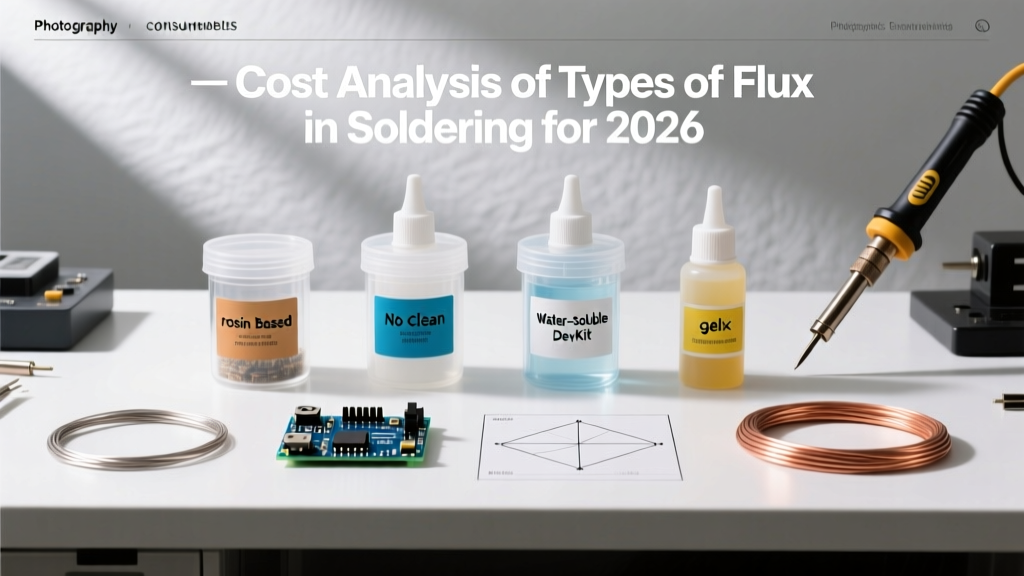
| Flux Category | Primary Activators | Activation Temp Range | Residue Characteristics & Post-Solder Action |
|---|---|---|---|
| RO (Rosin) | Abietic acid, plicatic acid | 150°C – 180°C | Non-conductive, benign. Encapsulates joint. Rarely requires cleaning. |
| OR (Organic Acid / Water-Soluble) | Adipic acid, glutaric acid, lactic acid | 130°C – 160°C | Highly corrosive, hygroscopic. Mandatory aqueous cleaning required post-reflow. |
| IN (Inorganic Acid) | Hydrochloric acid, zinc chloride | 200°C+ | Extremely corrosive. Used for heavy industrial plumbing, never for PCB electronics. |
| No-Clean (Synthetic) | Succinic acid, adipic acid (trace) | 160°C – 190°C | Low-solids (2-5%). Residue is glass-like and dielectric. Designed to be left on the board. |
Solvents and Outgassing Dynamics: The Hidden Failure Point
Flux pastes rely on high-boiling-point solvents (like diethylene glycol or specialized glycol ethers) to carry the activators and maintain paste consistency. During the preheat zone of a reflow profile, these solvents must evaporate gradually.
If the ramp rate exceeds 2°C to 3°C per second, the solvents flash-boil. This rapid outgassing causes microscopic explosions within the paste deposit, ejecting tiny spheres of molten solder away from the main joint—a defect known as solder balling. In ultra-small components like 0201 or 01005 passives, uneven solvent evaporation can create asymmetric surface tension forces, literally pulling the component upright, resulting in tombstoning.
2026 Market Formulations: Selecting the Right Paste
As component pitches shrink to 0.3mm and below, the demand for halogen-free, ultra-low-residue no-clean pastes has surged. Here is a breakdown of current industry-standard formulations and their 2026 pricing benchmarks for a standard 500g jar:
- Alpha Metals WS-609 (Water-Soluble): Priced around $48–$55. Formulated with high-activity organic acids (adipic and glutaric). Ideal for heavily oxidized RF shields or thick ground planes where maximum wetting power is required. Warning: Requires thorough DI water cleaning to prevent electrochemical migration (dendrite growth).
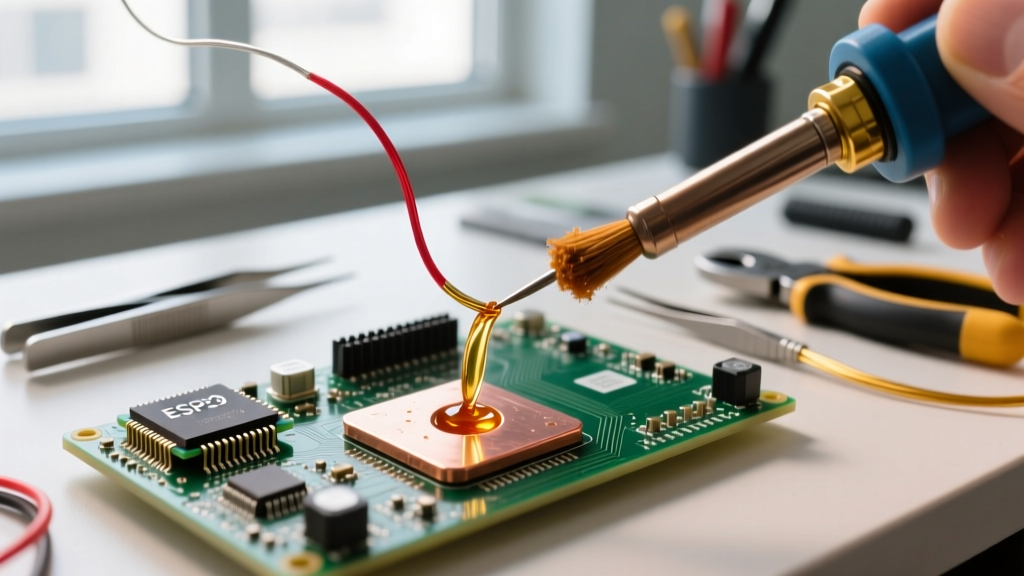
- Kester 951 / NC191 Equivalents (No-Clean): Priced around $65–$75. These utilize synthetic resins and trace dicarboxylic acids. Designed specifically for ultra-fine pitch micro-BGAs and QFNs. The low-solids formulation prevents the 'head-in-pillow' (HiP) defect by maintaining just enough surface tension to pull the BGA sphere into the paste deposit during liquidus.
- Indium SAC305 T5 No-Clean Paste: Priced at $85–$95. Type 5 powder (15-25 micron particle size) is mandatory for 0.3mm pitch stencils. The flux vehicle is engineered to resist 'graping' (premature oxidation of individual solder particles before they coalesce).
For comprehensive technical data sheets and rheological testing methodologies, resources like the Kester Technical Resources library provide invaluable empirical data on paste slump and tack life.
Real-World Failure Modes in Flux Paste Soldering
Even with premium materials, improper thermal management leads to distinct metallurgical failures:
1. Graping (Coalescence Failure)
Graping occurs when the flux's reducing agents are exhausted before the solder reaches its liquidus temperature (e.g., 217°C for SAC305). The individual solder powder particles oxidize and fail to merge into a single mass, leaving a rough, gray, grape-like cluster. Solution: Switch to a paste with higher solid content (12-14%) or use a nitrogen-inert reflow atmosphere to reduce the oxidative burden on the flux.
2. Head-in-Pillow (HiP) Defects
Common in BGA rework, HiP happens when the solder ball on the component and the paste deposit on the PCB both melt, but fail to wet each other due to an oxide barrier on the BGA sphere. Solution: Use a dedicated 'tack flux' (like Amtech NC-559-V2-TF) applied via dipping the BGA before placement. Tack fluxes possess higher viscosity and higher activator concentrations specifically engineered to penetrate thick component oxides.
Conclusion: Engineering the Joint
Mastering flux paste soldering requires shifting your perspective from simple assembly to applied chemical engineering. By respecting the rheological limits of the paste, matching the thermal activation profile to your heating method, and understanding the metallurgical necessity of oxide reduction, you transition from merely 'sticking parts together' to engineering highly reliable, fatigue-resistant intermetallic bonds.