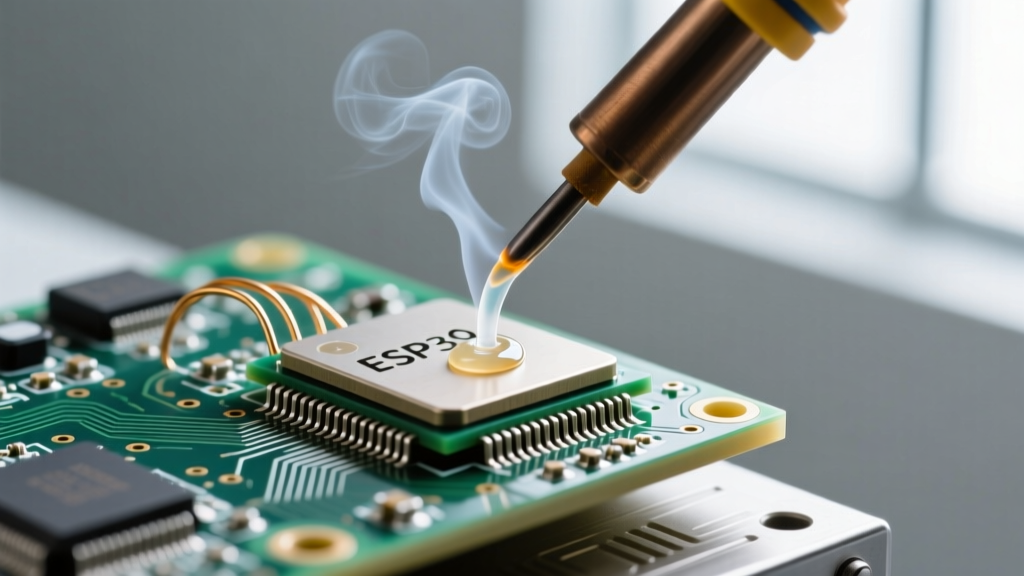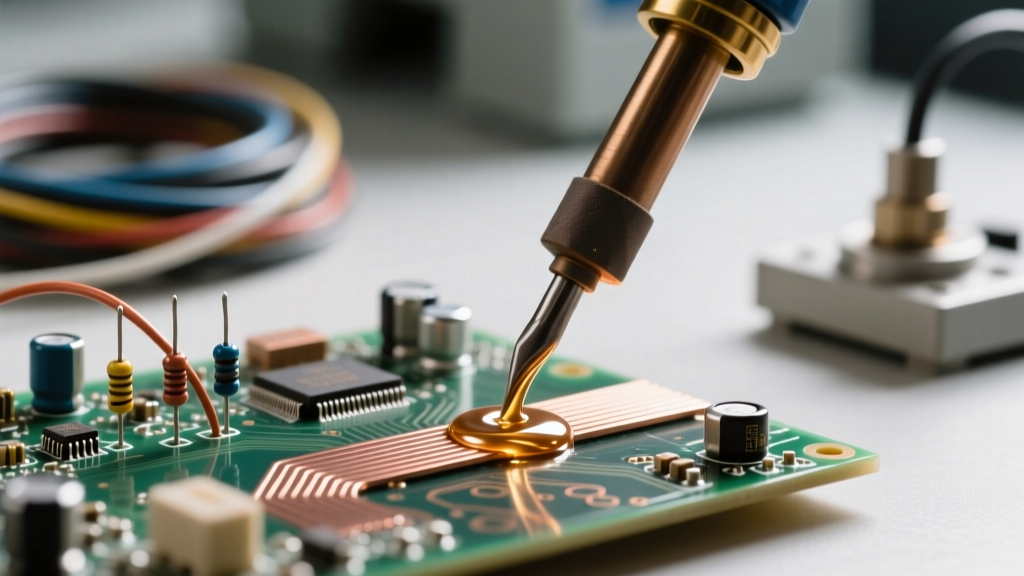

The moment a DIYer or junior technician asks, can you solder without flux?, they are usually staring at a spool of cheap solid-core solder wire, a stubbornly dry copper pad, and a soldering iron that refuses to bridge the gap. In the world of electronics assembly and PCB repair, flux is often treated as an optional accessory by beginners, but as a fundamental chemical necessity by professionals.
To answer the question directly: Yes, you can physically melt solder without flux, but no, you cannot form a reliable, electrically conductive metallurgical bond on raw metals without it. Understanding why requires a deep dive into the metallurgy of oxidation, surface tension, and the specific chemistry of solder alloys.
The Chemistry of Copper Oxidation and Wetting
Before addressing the exceptions, we must understand the barrier that flux is designed to eliminate. When copper is exposed to ambient air, it immediately begins to oxidize, forming a microscopically thin layer of cuprous oxide (Cu2O) and cupric oxide (CuO). While this layer is invisible to the naked eye, to molten solder, it is an impenetrable brick wall.
Soldering is not merely 'gluing' metals together; it is the creation of an intermetallic compound (IMC). For a tin-lead (Sn63/Pb37) or lead-free (SAC305) alloy to bond with a copper pad, the tin atoms must physically diffuse into the copper lattice, forming a Cu6Sn5 layer. This diffusion—known as wetting—can only occur if the molten solder makes direct, atom-to-atom contact with the base metal.
The Temperature Multiplier and Wetting Angles
Oxidation is an exothermic reaction that accelerates exponentially with heat. When you apply a 350°C soldering iron to a bare copper pad without flux, you are not just melting solder; you are flash-oxidizing the copper pad in real-time.
Expert Metric: In metallurgy, wetting is measured by the contact angle. A perfect fluxed solder joint will exhibit a wetting angle of less than 40 degrees, creating a smooth, concave fillet. A fluxless joint on oxidized copper will exhibit a contact angle greater than 90 degrees, resulting in a convex, spherical 'ball' that simply rests on the surface without bonding.
Chemical fluxes, particularly those based on rosin (abietic acid), are engineered to activate at temperatures just below the solder's liquidus point. For Sn63/Pb37 (melting point 183°C), a standard ROL0 (Rosin, Lightly Activated) flux becomes active around 120°C-150°C. It dissolves the copper oxide layer, exposing raw copper just milliseconds before the solder melts and flows into the gap, protected from further oxidation by the flux's liquid barrier.
The Three Exceptions: When Fluxless Soldering Actually Works
While 99% of standard electronics assembly requires flux, there are highly specific metallurgical and mechanical scenarios where the answer to 'can you solder without flux' is genuinely yes.
1. Reflowing Pre-Tinned Surfaces
If both the component lead and the PCB pad have been previously tinned with a high-quality flux-cored wire, the surfaces are already coated in a layer of tin and a microscopic residue of deactivated rosin. When reflowing these joints (such as during hot-air rework or drag soldering), the existing tin layers will alloy together without the need for additional chemical flux, provided the original oxidation layer has not been compromised by prolonged environmental exposure.
2. Ultrasonic Soldering (Acoustic Cavitation)
In advanced industrial applications, particularly when soldering to ceramics, glass, or heavily oxidized aluminum, engineers use ultrasonic soldering irons. These tools vibrate at frequencies between 20 kHz and 60 kHz. The acoustic energy creates microscopic cavitation bubbles in the molten solder. When these bubbles collapse against the metal surface, they generate localized shockwaves that physically shatter and dislodge the oxide layer, allowing the solder to wet the bare metal without any chemical flux whatsoever.
3. Indium-Based Specialty Alloys
Indium is a unique metal with an exceptionally low oxide formation energy. Specialty alloys, such as Indium-Tin (In51/Bi32/Sn16) or pure Indium wire, possess an inherent ability to wet precious metals like gold, silver, and certain metallized ceramics without the use of chemical flux. This makes Indium solders invaluable in cryogenic applications and photonics assembly, though the material cost is exponentially higher than standard SAC305.
Selection Matrix: Solid Core vs. Flux-Cored Wire
Choosing the right consumable dictates whether external flux is a requirement or a redundancy. Below is a selection guide for matching your solder wire type to your application.
| Wire Type | Flux Content | External Flux Required? | Primary Use Case |
|---|---|---|---|
| Solid Core Wire | 0% | Yes (Mandatory) | Plumbing, heavy-gauge wire lugging, stained glass. |
| Rosin Core (Sn63/Pb37) | 1.1% - 2.2% | No (for standard joints) | General purpose PCB through-hole, DIY prototyping. |
| Water-Soluble Core (SAC305) | 2.0% - 3.0% | No (but requires post-wash) | High-reliability lead-free assembly, automated soldering. |
| No-Clean Core (ROL0) | 1.5% - 2.5% | No (for standard joints) | SMT rework, BGA sphere attachment, consumer electronics. |
Note: Even when using flux-cored wire, complex multi-layer boards or large thermal mass ground planes will dissipate heat so rapidly that the flux may burn off before the joint reaches liquidus. In these cases, supplementing with a high-quality tacky flux (like Amtech or Kester) is required to prevent dry joints.
IPC Standards and the Myth of 'Clean' Solid Wire
Many hobbyists avoid flux because they believe it causes corrosion or messy residue, opting instead to melt solid-core wire directly onto their pads. According to the IPC J-STD-004 standard for soldering fluxes, the reality is quite the opposite. Solid-core wire used without flux results in 'cold' or 'disturbed' joints that fail IPC-A-610 visual inspection criteria due to poor wetting and exposed intermetallic vulnerabilities.
Furthermore, attempting to clean a raw, oxidized joint with isopropyl alcohol after the fact does nothing to fix the internal crystalline structure of the joint. The lack of flux means the intermetallic layer (Cu6Sn5) is either non-existent or severely fractured, leading to high electrical resistance and eventual thermal fatigue failure.
Troubleshooting: How to Recover a Fluxless Soldering Disaster
If you have already attempted to solder a PCB using solid wire and no flux, you likely have a board covered in dull, gray, spherical blobs of solder that move when you touch them with a multimeter probe. Here is the professional recovery protocol:
- Do Not Add More Heat Yet: Continually heating an oxidized joint will only drive the oxidation deeper into the copper trace, potentially lifting the pad from the FR4 fiberglass substrate.
- Apply Liquid or Gel Flux: Flood the defective joint with a reputable ROL0 (No-Clean) or ORH1 (Water-Soluble) liquid flux. The flux must completely encapsulate the joint.
- Reflow with a Clean Tip: Wipe your soldering iron tip on a damp brass sponge. Apply the tip to the joint at an appropriate temperature (320°C for leaded, 360°C for lead-free). The flux will immediately boil, dissolve the oxides, and the solder will instantly 'snap' into a shiny, concave fillet.
- Wick Excess Solder: If the joint has accumulated too much oxidized solder, use a high-quality desoldering braid (like Chemtronics or Goot Wick) pre-soaked in flux to pull the contaminated alloy away, leaving a pristine, freshly tinned pad ready for a new component.
For more rigorous guidelines on thermal profiles and wetting requirements, technicians should refer to the NASA Workmanship Standards, which explicitly detail the catastrophic failure modes of inadequate fluxing in high-reliability aerospace environments.
The Final Verdict
So, can you solder without flux? Only if you are reflowing pre-tinned metals, utilizing multi-thousand-dollar ultrasonic cavitation equipment, or working with exotic Indium alloys. For everyone else working with standard copper, brass, or nickel substrates, flux is not an optional accessory—it is the chemical catalyst that makes the metallurgy of soldering possible. Invest in a high-quality flux-cored wire and a syringe of supplemental tacky flux; your joints, your multimeter readings, and your project's lifespan will thank you.