
The Chemistry of Reliability: Why Brand Matters in 2026
As surface-mount technology (SMT) continues to shrink toward 01005 passives and ultra-fine-pitch micro-BGAs in 2026, the role of flux has evolved from a simple oxide-cleaning agent to a highly engineered rheological fluid. Selecting the right soldering flux for electronics is no longer about just grabbing a generic syringe; it is about matching the flux's viscosity, activation temperature, and Surface Insulation Resistance (SIR) to your specific PCB layout and thermal profile.
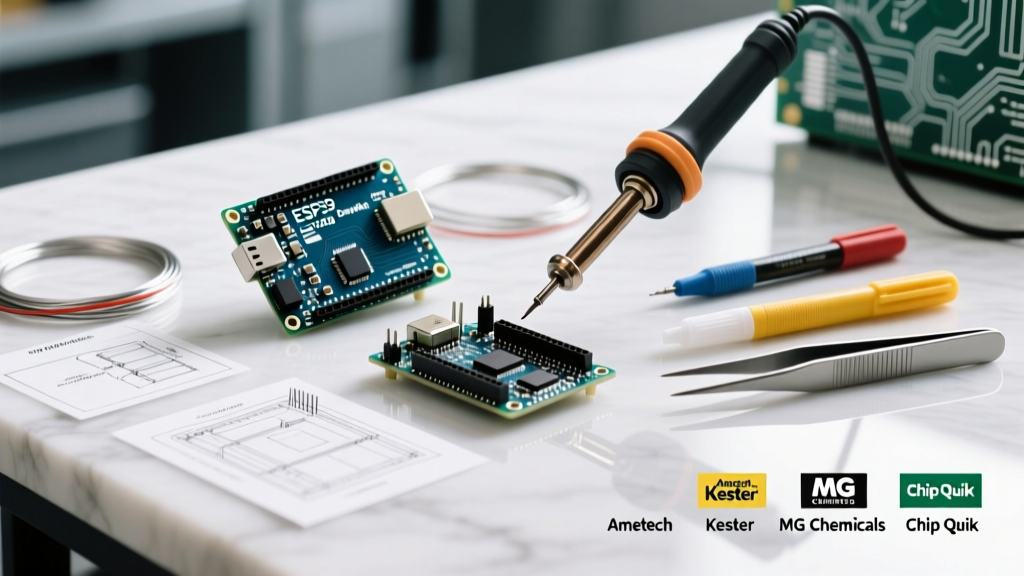
According to the IPC Standards Portfolio, modern no-clean fluxes must pass rigorous IPC-TM-650 testing methods for electrochemical migration (ECM) and corrosion. Using substandard or expired flux can lead to catastrophic field failures, including dendritic shorting under high humidity. In this comprehensive brand comparison, we evaluate the top four flux manufacturers dominating the electronics workbench in 2026: Amtech, Kester, MG Chemicals, and Chip Quik.
2026 Flux Contender Matrix
Before diving into the deep-dive evaluations, here is a structured comparison of the specific models we tested. Pricing reflects average authorized distributor street prices in early 2026.
| Brand & Model | Form Factor | Chemistry Base | Solids Content | 2026 Street Price | Ideal Application |
|---|---|---|---|---|---|
| Amtech NC-559-V2-TF | Tacky Paste | Halogen-Free Rosin | ~45% | $42 / 30g syringe | BGA rework, 0402 SMD |
| Kester 951 | Liquid | VOC-Free Synthetic | 2.5% | $18 / 100ml bottle | Through-hole, wire tinning |
| MG Chemicals 8341 | Paste | No-Clean Rosin | ~35% | $14 / 30g syringe | General hobbyist SMD |
| Chip Quik NC191 | Gel | Halogen-Free | ~40% | $22 / 30g syringe | QFP drag soldering |
Deep-Dive Brand Evaluations
1. Amtech NC-559-V2-TF: The SMD Tacky Standard
Amtech remains the undisputed king of professional SMD rework. The NC-559-V2-TF is a halogen-free, no-clean tacky flux designed specifically to hold fine-pitch components in place before and during reflow. Its thixotropic properties mean it stays exactly where you dispense it, preventing the 'bleeding' that causes tombstoning on 0402 and 0201 components.
Expert Warning: The Counterfeit Crisis
In 2026, counterfeit Amtech syringes remain rampant on third-party marketplaces. These fakes often contain highly acidic plumbing flux that will eat through your PCB traces within weeks. Always purchase from authorized electronics distributors like Mouser, Digi-Key, or direct from Indium Corporation (Amtech's parent company).
Failure Mode Edge Case: If the syringe is subjected to temperature cycling during shipping (e.g., sitting in a hot delivery truck), the flux can separate or prematurely activate. Always store Amtech tacky flux in a dedicated refrigerator at 10°C and allow it to reach room temperature for 2 hours before dispensing to prevent moisture condensation.
2. Kester 951: The Through-Hole & Wire Workhorse
For through-hole components, DIP ICs, and tinning stranded wires, liquid flux is superior to paste. Kester 951 is a VOC-free, no-clean liquid flux with an exceptionally low solids content of just 2.5%. This means it leaves virtually invisible residue, eliminating the need for post-solder cleaning on most consumer electronics.
Application Technique: The best way to apply Kester 951 is via a flux pen or a natural bristle brush. Do not flood the board. Because the solvent is water-based, applying too much liquid near a 380°C iron tip will cause violent spattering, potentially throwing hot flux droplets onto your skin or into adjacent micro-connectors.
3. MG Chemicals 8341: The Budget No-Clean Paste
MG Chemicals offers the 8341 No-Clean Paste as a highly accessible, budget-friendly option for hobbyists and educational labs. Priced around $14 per 30g syringe, it provides decent wetting action for larger SMD components (0805 and above) and SOIC chips. However, its rheology is noticeably stiffer than Amtech. Attempting to use it for 0.4mm pitch QFN pads without thinning it first will result in bridging due to the flux's high surface tension.
4. Chip Quik NC191: The Gel Dispenser King
Chip Quik's NC191 bridges the gap between liquid and heavy tacky paste. It is formulated as a gel and comes with an excellent array of dispensing needles (including 20G and 23G blunt tips). This makes it the premier choice for drag-soldering QFP (Quad Flat Package) microcontrollers. The gel activates smoothly at 180°C, breaking down oxides rapidly while providing just enough tack to keep the IC aligned on the pads.
Failure Modes: What Happens When Flux Goes Wrong?
According to the NASA-STD-8739.3 Workmanship Manual, improper flux selection or failure to clean activated residues can lead to severe reliability issues. Here are the three most common failure modes we see in the field:
- Electrochemical Migration (Dendrites): If a halide-activated flux is left under a high-impedance analog circuit and exposed to 85% relative humidity, metal ions will migrate between traces, forming microscopic conductive 'trees' (dendrites) that cause intermittent short circuits.
- BGA Voids: Using a high-solids paste flux under a BGA without a proper thermal soak profile traps outgassing solvents, creating voids in the solder balls. This reduces the mechanical shear strength of the BGA by up to 40%.
- Corrosion of Test Points: Acidic residues left on bare copper test points will oxidize rapidly, rendering the board untestable via bed-of-nails fixtures during QA.
For mission-critical or high-humidity environments, experts at Zestron Electronics Cleaning recommend utilizing a saponifier and ultrasonic cleaning process to remove all no-clean residues, followed by a conformal coating application.
Decision Framework: Matching Flux to Your PCB
Do not rely on a single flux for every project. Build a consumable library based on this decision matrix:
- For BGA Rework & Micro-SMD: Use Amtech NC-559-V2-TF. The high tack is mandatory for holding micro-components during hot-air reflow.
- For QFP Drag Soldering: Use Chip Quik NC191 Gel. The needle dispenser allows precise line application along the IC pins.
- For Wire Tinning & Through-Hole: Use Kester 951 Liquid. It wicks into stranded wire via capillary action without leaving a sticky residue.
- For Prototyping & Large Passives: Use MG Chemicals 8341. It is cost-effective and perfectly adequate for 0805 resistors and capacitors.
Fume Extraction and Safety Protocols
While modern no-clean fluxes are free from heavy metals and CFCs, the rosin (colophony) and synthetic resin bases produce sub-micron particulate fumes when vaporized by a 350°C+ soldering iron. Prolonged inhalation of these fumes is a known respiratory sensitizer that can trigger occupational asthma.
Safety Rule: Never solder without active fume extraction. A standard desk fan merely blows the hazardous particulates around the room. You must use a localized extraction system equipped with both a HEPA filter (for particulates) and an Activated Carbon filter (for volatile organic compounds), positioned no more than 15cm from the solder joint.
Final Verdict
The 'best' soldering flux for electronics in 2026 is entirely dependent on your assembly method. For professional SMT rework and micro-soldering, Amtech NC-559-V2-TF justifies its premium price through unmatched rheology and reliability. For general bench work, wire prep, and through-hole assembly, Kester 951 remains an essential, low-residue staple. By aligning your flux chemistry with your component geometry, you will drastically reduce bridging, improve wetting, and ensure the long-term SIR integrity of your electronic assemblies.