
Defining the Core: What's Soldering in an Industrial Context?
When engineering students or procurement specialists first search for whats soldering, they are often met with DIY tutorials focused on basic through-hole kits. However, in the industrial and high-reliability sectors, soldering is a highly controlled metallurgical process. It involves joining two or more metal items by melting and flowing a filler metal (solder) into the joint, where the filler metal has a strictly lower melting point than the adjoining workpieces.
Unlike welding, the base metals do not melt. In industrial electronics manufacturing, this process is governed by stringent frameworks like the IPC Standards (specifically IPC J-STD-001 and IPC-A-610). For Class 3 high-reliability products—such as aerospace avionics, automotive EV battery management systems (BMS), and medical life-support devices—the solder joint must withstand extreme thermal cycling, mechanical shock, and vibrational stress without fracturing.
The Big Three: Industrial Soldering Methods Compared
High-volume contract manufacturers (CMs) and original equipment manufacturers (OEMs) rarely rely on manual hand soldering for primary production. Instead, they utilize automated thermal profiles. Below is a comparative matrix of the dominant industrial methods utilized in 2026.
| Method | Best Application | CapEx Range (2026) | Throughput | Primary Defect Risks |
|---|---|---|---|---|
| Wave Soldering | High-volume Through-Hole (THT) & mixed tech | $120,000 - $350,000 | Very High | Bridging, icicles, shadowing |
| Selective Soldering | Complex mixed-tech PCBs, heavy copper planes | $45,000 - $150,000 | Medium | Barrel fill insufficiency, flux residue |
| Robotic Hand Soldering | Aerospace, medical, low-volume/high-mix | $15,000 - $60,000 | Low to Medium | Cold joints, thermal damage to pads |
Wave Soldering for High-Volume Through-Hole
Wave soldering remains the backbone for power electronics and legacy through-hole components. The PCB passes over a pump-driven wave of molten solder (typically SAC305 or SnPb). Modern machines, such as the ERSA POWERFLOW N2, utilize nitrogen blanketing to reduce oxidation. By maintaining an oxygen level below 100 ppm in the solder bath, manufacturers reduce dross generation by up to 80%, saving upwards of $20,000 annually in raw solder bar costs per production line.
Selective Soldering for Mixed-Technology PCBs
As surface mount technology (SMT) dominates, traditional wave soldering struggles with densely packed boards where SMT components would be shadowed or washed away. Selective soldering uses drop-jet fluxing and programmable mini-wave nozzles to solder only specific THT pins. The Pillarhouse Orion Synchrodex is a staple here, offering multi-axis gantry systems that can achieve cycle times of under 2 seconds per joint, bridging the gap between wave speed and hand-solder precision.
Robotic Hand Soldering for Aerospace & Medical
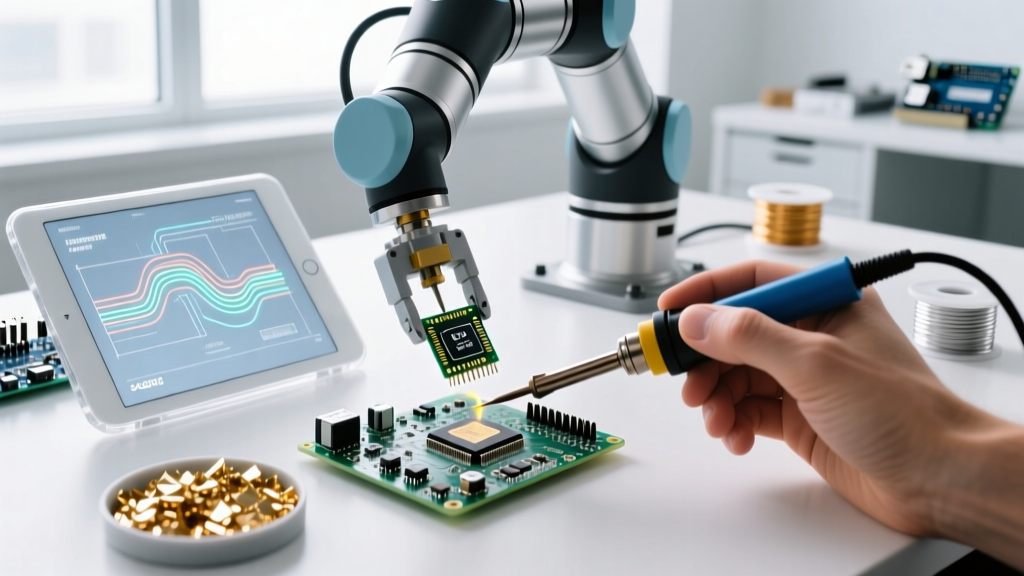
For IPC Class 3 and NASA-level requirements, automated robotic arms equipped with high-end iron tips mimic human hand soldering but with repeatable thermal profiles. Systems integrated with JBC CDS-QF stations provide instantaneous heat recovery, ensuring that heavy ground planes do not wick heat away from the joint, which is a primary cause of cold solder joints in aerospace harnesses.
Alloy Metallurgy: Leaded vs. Lead-Free in 2026
The transition to lead-free manufacturing, driven by the EU RoHS Directive, fundamentally changed industrial soldering. However, the landscape in 2026 is nuanced, with specific exemptions and new alloy developments.
- SAC305 (Sn96.5/Ag3.0/Cu0.5): The undisputed workhorse of lead-free manufacturing. It offers a melting point of 217°C and excellent wetting characteristics. However, its high silver content makes it expensive, and it is prone to pad cratering under mechanical drop-shock.
- SAC-Bi (Bismuth-Doped): Rapidly gaining traction in automotive EV applications. Adding Bismuth lowers the melting point to around 138°C–170°C (depending on the exact ratio) and significantly improves drop-shock reliability, though it requires specialized low-temp compatible components.
- Sn63Pb37 (Eutectic Leaded): Still legally required and heavily utilized in aerospace, military, and implantable medical devices where RoHS exemptions apply. Its 183°C melting point and lack of tin-whisker growth make it mandatory for mission-critical NASA workmanship standards.
Industry Insight: When transitioning from SAC305 to SnPb or vice versa, cross-contamination in the solder pot is a critical failure point. Even a 1% lead contamination in a lead-free wave pot can cause catastrophic grain boundary weakening in the joints, leading to field failures.
Critical Failure Modes in Industrial Soldering
Understanding what's soldering at a microscopic level requires understanding how it fails. In high-density interconnect (HDI) and ball grid array (BGA) assemblies, the following defects cost OEMs millions in recalls:
- Head-in-Pillow (HiP): Common in BGA components. The solder paste on the PCB and the solder sphere on the BGA melt, but fail to coalesce into a single joint due to warpage during the reflow thermal profile. It looks like a head resting on a pillow and is often invisible to standard 2D X-ray.
- Pad Cratering: A mechanical failure where the SAC305 solder joint is so rigid that upon physical shock, the fracture does not occur in the solder, but rather tears the copper pad and underlying fiberglass laminate out of the PCB.
- Tombstoning: Exclusively an SMT reflow defect where unequal wetting forces on a small chip component (like a 0201 resistor) pull it upright, leaving one end completely unsoldered.
Buyer’s Framework: Choosing Industrial Soldering Equipment
Procuring industrial soldering equipment requires looking past the initial hardware cost and evaluating total cost of ownership (TCO), which includes tip longevity, power consumption, and nitrogen requirements.
1. Hand & Benchtop Stations (R&D and Rework)
For rework stations and low-volume assembly, the Pace ADS200 (approx. $650) and Metcal MX-5200 (approx. $1,100) lead the market. Metcal’s SmartHeat® inductive technology is highly recommended for heavy multilayer boards, as it adjusts power output based on the thermal load of the joint rather than relying on a simple thermocouple feedback loop.
2. Selective Soldering Systems
Mid-volume CMs should evaluate the Nordson SELECT line or ERSA VERSELECT. Expect to budget between $60,000 and $90,000 for a fully configured inline system with drop-jet fluxers and optical fiducial correction. Ensure the vendor provides local process engineering support, as programming thermal profiles for mixed-mass boards is highly complex.
3. Fume Extraction & Environmental Compliance
Industrial soldering generates colophony and rosin-based flux fumes, which are known respiratory sensitizers. OSHA and international equivalents mandate source-capture extraction. Budget an additional $3,000 to $8,000 per bench for BOFA or Weller Zero Smog HEPA/activated carbon extraction units.
Frequently Asked Questions
Is hand soldering acceptable for IPC Class 3 aerospace assemblies?
Yes, but it requires certified operators, strict ESD controls, and 100% optical or X-ray inspection. Automated selective soldering is increasingly preferred to remove human variability, but hand soldering remains essential for complex wire harnesses and electromechanical assemblies where automation cannot reach.
How often should industrial solder pots be analyzed for contamination?
High-reliability manufacturers should perform spectrographic analysis of their wave and selective solder pots every 30 to 90 days, or after every 5,000 operating hours, to monitor copper dissolution and lead/cadmium cross-contamination.
What is the difference between soldering and brazing in industrial contexts?
The defining threshold is temperature. Soldering occurs below 450°C (840°F), relying on capillary action and flux to achieve metallurgical bonding. Brazing occurs above 450°C, often used in HVAC, heavy plumbing, and aerospace structural joints, and generally produces a joint stronger than the base metals themselves.