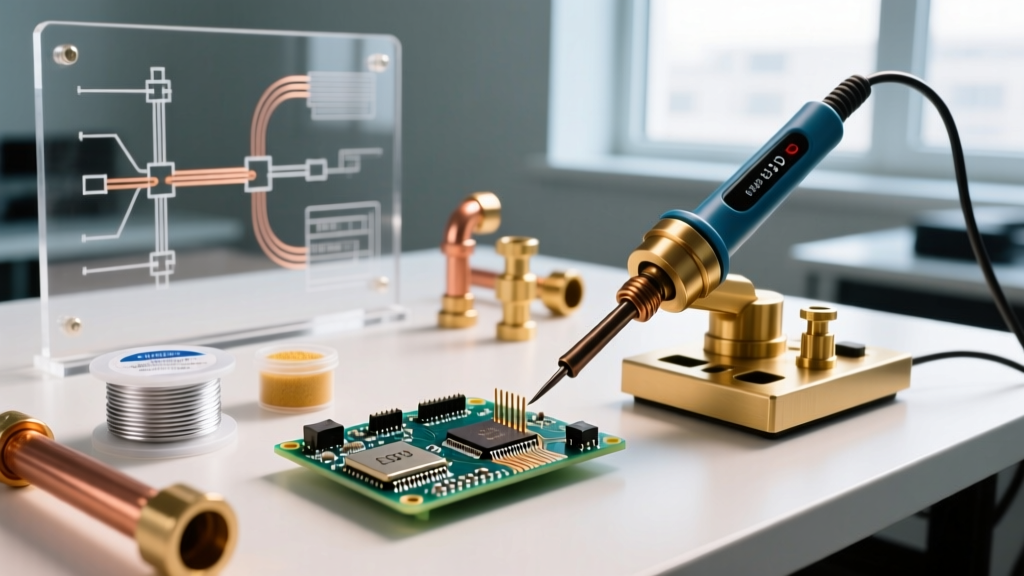

The Metallurgical Reality: Why Brass and Copper Fight Back
Soldering brass to copper is not a simple extension of standard copper-to-copper joining; it is a complex exercise in managing dissimilar thermal masses and volatile alloying elements. Brass is fundamentally an alloy of copper and zinc (typically 5% to 40% zinc). While copper boasts a massive thermal conductivity of 401 W/m·K, acting as an aggressive heat sink, zinc presents a much more severe challenge: it vaporizes at 907°C (1665°F). If your thermal delivery is too slow or too hot, the zinc boils out of the brass matrix, leaving a porous, spongy joint susceptible to catastrophic mechanical failure and micro-leaks.
To execute a flawless brass to copper soldering joint in 2026, you must abandon guesswork. This decision framework will guide you through application profiling, filler metal selection, flux chemistry, and thermal delivery, ensuring structural integrity whether you are building a high-pressure plumbing manifold or a precision RF shield.
Phase 1: Application Profiling Matrix
Before selecting a single consumable, you must define the operational environment of the joint. The requirements for a potable water line are diametrically opposed to those of a high-vibration mechanical linkage.
| Application Domain | Primary Stressor | Required Alloy Trait | Mandatory Flux Type |
|---|---|---|---|
| Potable Plumbing | Hydrostatic pressure, corrosion | Lead-free, capillary flow | Water-soluble acid (Zinc Chloride) |
| Electronics / RF | Thermal cycling, signal integrity | Low temp, high conductivity | High-activity Rosin (RA) or No-Clean |
| HVAC / Structural | Vibration, high shear stress | High tensile strength, ductility | Fluoride/Borax-based Brazing Paste |
Phase 2: Filler Metal Selection Framework
The filler metal must bridge the gap between the copper's high melting point (1085°C) and the brass's zinc vaporization threshold. Here is how to select your alloy based on the matrix above.
1. Plumbing & Potable Water (The Lead-Free Mandate)
Under the EPA's Lead-Free Plumbing regulations, all wetted surfaces must contain less than 0.25% lead. For brass-to-copper plumbing, standard 95/5 Tin-Antimony is often too brittle for the thermal expansion differences between the two metals. Instead, opt for a SAC (Tin-Silver-Copper) alloy or a Tin-Silver blend.
- Top Pick: Worthington 333004 SAC305 (96.5% Sn, 3.0% Ag, 0.5% Cu).
- Melting Range: 217°C - 220°C (Solidus to Liquidus).
- 2026 Market Price: Approximately $18 - $24 per 4oz spool.
- Why it works: The silver content drastically improves wetting on the brass surface and increases the shear strength of the joint, compensating for the differing expansion coefficients of copper and brass.
2. High-Strength Mechanical & HVAC (Brazing Territory)
When soft soldering (below 450°C) cannot provide the necessary tensile strength for refrigerant lines or load-bearing brackets, you must transition to silver brazing.
- Top Pick: Harris Safety-Silv 45 (45% Silver, 30% Copper, 25% Zinc).
- Melting Range: 618°C - 743°C.
- 2026 Market Price: $95 - $115 per 1oz tube (silver commodity surges have impacted pricing heavily in recent years).
- Why it works: The 45% silver content provides exceptional capillary action and a tensile strength exceeding 70,000 PSI. However, you must work quickly to avoid boiling the zinc out of both the brass base metal and the filler alloy itself.
3. Electronics & PCB Shielding
For soldering brass RF cans to copper ground planes, thermal mass is lower, but component sensitivity is high.
- Top Pick: Kester 275 (SAC305 with a specialized no-clean flux core).
- Diameter: 0.031" or 0.020" for precise thermal control.
- Why it works: Provides reliable wetting on lightly oxidized brass without the need for post-soldering aqueous cleaning, which could trap moisture under the RF shield.
Phase 3: Flux Chemistry & Surface Preparation
CRITICAL WARNING: Standard RMA (Rosin Mildly Activated) flux is virtually useless on brass. Rosin cannot break down the tough, instantaneous zinc oxide layer that forms the moment brass is heated. Attempting to solder brass with rosin flux will result in immediate cold-joint failure.To achieve metallurgical bonding, your flux must match the oxide layer's tenacity:
- For Plumbing (Acid Flux): Use a Zinc Chloride-based liquid flux like Rubyfluid or Harris Stay-Clean ($8 - $12 per bottle). Zinc chloride actively strips the zinc oxide layer at soldering temperatures. Note: You must flush the joint with water and a baking soda solution post-soldering to neutralize the acid and prevent long-term pinhole corrosion.
- For Brazing (Fluoride/Borax): When using Safety-Silv 45, use a white paste flux like Harris Stay-Silv White Flux. The fluorides in the paste dissolve refractory oxides at the 600°C+ range required for silver brazing.
- For Electronics (Highly Activated Rosin): If you must use a flux-core wire, ensure it is an RA (Rosin Activated) formulation with higher halide content, or apply a liquid tacky flux (like Amtech NC-559) specifically rated for difficult-to-solder alloys.
Mechanical Prep: Never use standard sandpaper on brass before soldering; silica embeds in the soft metal and blocks wetting. Use a Scotch-Brite pad or a dedicated brass wire brush, followed by an isopropyl alcohol wipe immediately before flux application.
Phase 4: Thermal Delivery Systems
Copper acts as a massive heat sink, pulling thermal energy away from the brass interface. Your heat source must overcome this sink without lingering long enough to vaporize the brass's zinc.
Electronics & Micro-Joining
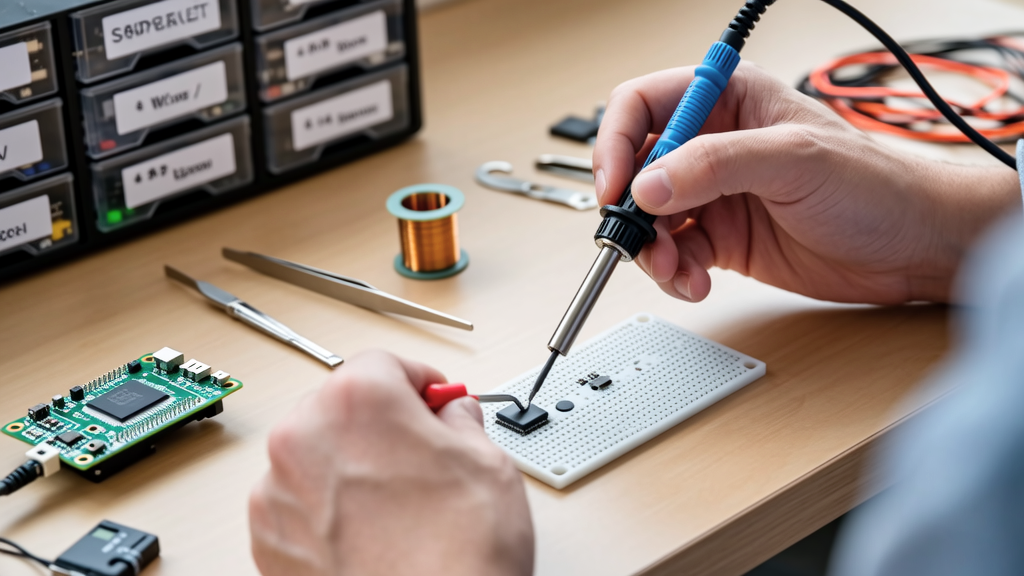
For PCB work, a standard 40W iron will stall when touching a copper ground plane. You need high thermal recovery.
- Recommended Station: Weller WE1010NA (70W, approx. $115).
- Tip Selection: Use a massive chisel tip (e.g., Weller ETA or ETB). The large surface area maximizes thermal transfer. Set the station to 340°C (644°F). Apply heat to the copper side first, allowing the heat to conduct into the brass, then introduce the solder to the brass side.
Plumbing & Structural Brazing
Standard propane torches (burning at ~1,980°C) often require too much dwell time on large copper pipes, inadvertently overheating the brass fitting and causing dezincification.
- Recommended Torch: Bernzomatic TS8000 (approx. $55) paired with a MAP-Pro cylinder.
- Why MAP-Pro: MAP-Pro burns at 2,020°C with a higher BTU output, allowing you to bring the copper up to temperature in seconds rather than minutes. Keep the inner cone of the flame moving; never hold it statically on the brass fitting.
Phase 5: Failure Mode & Troubleshooting Guide
Even with the right materials, technique errors will compromise the joint. Consult this troubleshooting matrix if your joints fail visual or pressure testing.
- Failure Mode 1: Spongy, Porous Joint (Zinc Burnout)
Cause: Overheating the brass. The zinc boiled off, leaving voids.
Fix: Switch to a higher BTU heat source to reduce dwell time, or pre-heat the copper exclusively and let conduction heat the brass. - Failure Mode 2: Solder Balls Up and Refuses to Wet (Cold Lap)
Cause: Inadequate flux activity or silica contamination from sandpaper.
Fix: Re-prep with Scotch-Brite, apply a fresh, heavy coat of zinc-chloride flux, and ensure the base metal is actually reaching the solder's liquidus temperature. - Failure Mode 3: Joint Cracks Upon Cooling (Thermal Shock)
Cause: Quenching the joint with a wet rag or water immediately after soldering.
Fix: Allow the joint to air-cool naturally. The differing contraction rates of copper and brass will tear the semi-solid solder apart if shocked.
Safety & Ventilation Protocols
Heating brass generates zinc oxide fumes, which can cause 'metal fume fever'—a severe, flu-like respiratory condition. The National Institute for Occupational Safety and Health (NIOSH) strictly mandates localized exhaust ventilation when soldering or brazing zinc-bearing alloys. Always use a fume extractor with a HEPA and activated carbon filter for bench work, or a properly rated respirator (P100 with acid gas cartridges) for field plumbing.
Summary: The Brass-to-Copper Checklist
Before striking an arc or lighting a torch, verify your setup against this final checklist:
- Identify the Alloy: Is it lead-free plumbing, structural HVAC, or electronics?
- Select the Filler: SAC305 for plumbing/electronics; Safety-Silv 45 for high-strength HVAC.
- Ditch the Rosin: Use Zinc Chloride (plumbing) or Fluoride paste (brazing) to defeat zinc oxide.
- Prep Mechanically: Scotch-Brite and IPA only. No sandpaper.
- Manage the Heat Sink: Heat the copper first; let conduction warm the brass to prevent zinc vaporization.
By treating brass to copper soldering as a calculated metallurgical process rather than a simple crafting task, you ensure joints that withstand pressure, time, and thermal cycling. For further reading on copper alloy properties and joining best practices, consult the technical resources provided by the Copper Development Association (CDA).