
Understanding the Process: What Is Wave Soldering?
If you are scaling up from manual hand-soldering or selective soldering, you will inevitably ask: what is wave soldering? In printed circuit board (PCB) manufacturing, wave soldering is a bulk automated process where populated boards are passed over a continuous, pumped wave of molten solder. This creates reliable through-hole and surface-mount (SMT) electrical connections in a single pass.
As of 2026, modern wave soldering systems—such as the ERSA POWERFLOW e N2 or Heller WS series—represent a capital investment ranging from $45,000 for basic air-atmosphere models to over $130,000 for fully enclosed, nitrogen-inerted machines. However, the sheer volume of molten alloy (often 400kg to 800kg capacity) and volatile chemical fluxes introduces severe occupational hazards. Understanding these risks is mandatory before purchasing or operating this equipment.
The Four Stages of Wave Soldering (and Their Hazards)
To implement proper safety controls, shop managers must understand the four distinct stages of the wave soldering process:
- Flux Application: Boards are sprayed with rosin-based or VOC-free no-clean flux. Hazard: Inhalation of atomized flux, volatile organic compounds (VOCs), and fire risk from flammable carriers.
- Preheating: Infrared or convection heaters raise the PCB temperature to 110°C–150°C to activate the flux and prevent thermal shock. Hazard: Contact burns and localized exhaust requirements.
- The Solder Wave: The PCB contacts the crest of the molten solder wave, typically SAC305 (lead-free) at 255°C or Sn63/Pb37 (leaded) at 245°C. Hazard: Severe thermal burns, toxic fume generation, and molten metal splashes.
- Cooling: Boards exit the machine and cool. Hazard: Moving conveyor pinch points and residual thermal transfer.
Critical Safety Hazards and Engineering Controls
When evaluating a wave soldering machine for purchase, safety features should not be treated as optional add-ons. They are critical engineering controls that protect your operators and ensure regulatory compliance.
1. Chemical Exposure: Colophony and Flux Fumes
Rosin (colophony) based fluxes are known occupational asthmagens. When atomized and heated, they release complex aliphatic aldehydes and gases. According to the UK Health and Safety Executive (HSE), prolonged exposure to colophony fumes can cause irreversible respiratory sensitization. Even with modern 'no-clean' or water-soluble fluxes, thermal decomposition produces irritants.
Buyer Requirement: Ensure the machine features an enclosed, negatively pressurized fluxing chamber with integrated Local Exhaust Ventilation (LEV). The LEV must capture fumes at the source, maintaining a minimum capture velocity of 100–150 CFM before routing them through HEPA and activated carbon filtration.
2. Thermal Burns and the Dross Moisture Explosion
The solder pot operates at temperatures exceeding 250°C. Over time, tin oxidizes and forms 'dross' (a crusty tin-oxide layer) on the surface. Operators must skim this dross regularly. The most catastrophic edge-case failure in wave soldering is the moisture explosion.
WARNING: If a wet skimming tool, a drop of condensation, or a damp PCB touches the 255°C molten solder, the water instantly flashes to steam. Water expands by approximately 1,700 times its volume when converted to steam, resulting in a violent geyser of molten solder that can easily bypass standard polycarbonate shields and cause third-degree burns.
Buyer Requirement: Look for machines with automated dross removal systems (like the ERSA SmartWave) or integrated nitrogen (N2) inerting. Nitrogen blanketing reduces dross formation by up to 85%, drastically minimizing the need for manual skimming.
Mandatory PPE and Safety Matrix
Engineering controls cannot eliminate all risks. Operators performing maintenance, dross skimming, or pallet loading must use specific Personal Protective Equipment (PPE). The CDC and NIOSH emphasize that administrative controls and PPE are the last line of defense.
| Hazard Category | Specific Risk | Required PPE Specification |
|---|---|---|
| Thermal / Splash | Molten solder splatter during dross skimming or pump maintenance | Kevlar/Nomex sleeves, heavy-duty leather apron, ANSI Z87.1+ face shield |
| Respiratory | Flux VOCs and colophony particulates during manual fluxer cleaning | NIOSH-approved half-mask (e.g., 3M 6200) with P100/OV cartridges (2097) |
| Contact Burns | Touching preheated PCBs, pallets, or internal machine chassis | Heat-resistant Kevlar gloves (rated to 300°C+) |
| Mechanical | Conveyor pinch points and finger entrapment | Fitted clothing, no loose jewelry, mandatory E-stop training |
Standard Operating Procedure: Safe Dross Removal
If your facility relies on manual dross skimming (common in older or budget-tier machines), enforce this strict protocol to prevent steam explosions:
- Verify Tool Dryness: Inspect the titanium dross skimmer. It must be bone-dry and stored in a heated cabinet or pre-heated on the machine's designated tool rest for at least 5 minutes.
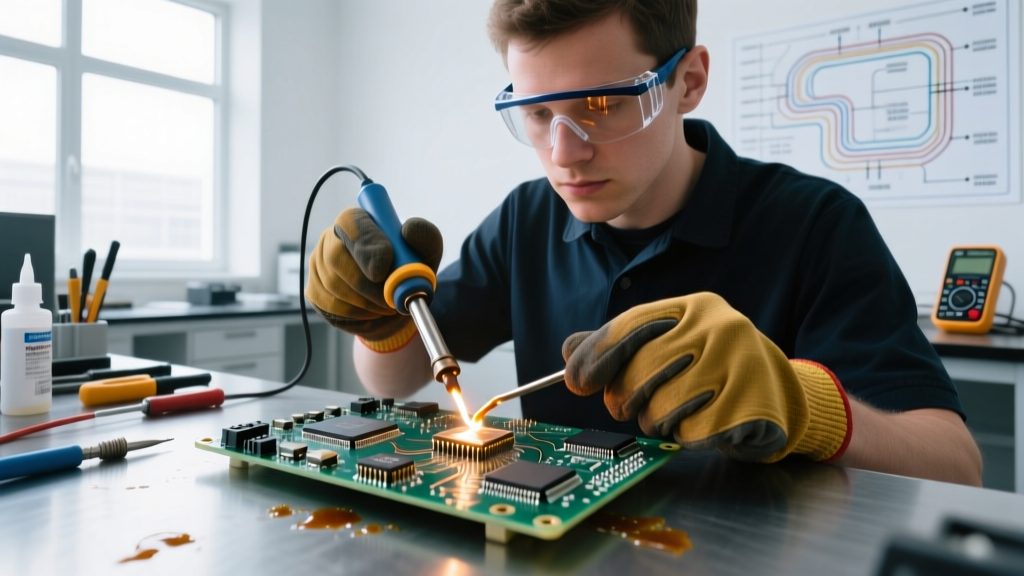
- Don Full PPE: Put on the face shield, Kevlar sleeves, and heavy leather apron. Do not rely solely on safety glasses.
- Skim Slowly: Gently break the dross crust. Do not plunge the skimmer deep into the liquid solder, as this traps dross and pulls up molten alloy.
- Transfer to Safe Receptacle: Deposit the hot dross into a dedicated, dry, fire-proof steel bin with a tight-fitting lid. Never use plastic bins or bins containing moisture or previous cold dross that may have trapped condensation.
- Apply Dross Reducer (Optional): Use a specialized dross-reducing powder (e.g., Kester Dross Plus) to separate trapped solder from the oxide, maximizing yield and reducing waste volume.
Evaluating Machines: Safety Features to Look For in 2026
When comparing quotes from manufacturers like ERSA, Pillarhouse, or SEHO, prioritize the following safety-centric upgrades:
- Nitrogen (N2) Inerting Systems: By displacing oxygen in the solder tunnel, N2 systems reduce dross generation from ~1.5 kg/hour to less than 0.2 kg/hour. This vastly improves operator safety and yields a return on investment through solder savings (with SAC305 bar solder costing roughly $35–$45 per kg in 2026).
- Automated Fire Suppression: The fluxing zone should have integrated UV/IR flame detectors linked to an automated CO2 or dry chemical suppression system. Atomized alcohol-based fluxes are highly combustible.
- Closed-Loop Exhaust Monitoring: Premium machines feature airflow sensors that trigger an automatic E-stop if the LEV extraction drops below the required CFM threshold, preventing operators from working in a fume-filled environment.
- Lockout/Tagout (LOTO) Integration: Ensure the machine's main electrical panel and solder pot heaters have standardized LOTO points for safe maintenance, complying with OSHA guidelines for hazardous energy control.
Frequently Asked Questions
Is wave soldering safe for lead-free assemblies?
Yes, but lead-free alloys like SAC305 require higher operating temperatures (255°C–265°C) compared to leaded Sn63 (245°C). This increases the risk of thermal burns and accelerates flux volatilization, making robust LEV extraction and heat-resistant PPE even more critical.
Can I use a standard shop vacuum to clean up flux residue?
No. Standard vacuums can ignite flammable flux vapors or spread fine, combustible rosin dust, creating a dust explosion hazard. Always use intrinsically safe, explosion-proof vacuums rated for VOC and combustible dust environments.
How often should the solder pot be drained and cleaned?
For high-volume lead-free production, the solder pot should be drained, cleaned of sludge, and refilled every 6 to 12 months, or when copper contamination exceeds 0.8% by weight (verified via XRF spectrometer analysis). This maintenance must only be performed under strict LOTO procedures with specialized high-temp PPE.