
Beyond the Solder Joint: Engineering a Safe Workspace
When planning a complex soldering project, enthusiasts and professionals alike often hyper-focus on selecting the right solder alloy, choosing a high-wattage station, or mastering surface-mount techniques. However, the foundation of any successful electronics workbench is a rigorous safety protocol. A soldering iron operates at temperatures exceeding 400°C (752°F), and the vaporization of flux chemicals introduces significant respiratory hazards. Ignoring these variables doesn't just risk your health; it compromises the integrity of your work.
This guide details the exact safety best practices, equipment specifications, and environmental controls required to execute your next soldering project without thermal, chemical, or electrical incidents.
The Invisible Hazard: Fume Extraction and Ventilation
The most insidious danger in electronics assembly is not the heat, but the smoke. When rosin-based (colophony) flux reaches its activation temperature—typically between 200°C and 250°C—it decomposes and releases a complex mixture of aliphatic aldehydes and acidic gases. Prolonged exposure to these fumes is a well-documented cause of occupational asthma and chronic respiratory sensitization. The UK Health and Safety Executive (HSE) strictly classifies colophony as a severe respiratory sensitizer, mandating local exhaust ventilation (LEV) in professional environments.
Fume Extractor Comparison Matrix (2026 Market)
For a DIY or light-professional soldering project, relying on a desk fan to blow fumes into your face is a critical failure mode. You need active carbon or HEPA filtration. Below is a comparison of current, highly effective extraction units:
| Model | Filtration Technology | Price Range (USD) | Best Application |
|---|---|---|---|
| Hakko FA-400 | Activated Carbon Filter | $45 - $55 | Light hobbyist work; occasional through-hole soldering. |
| Weller WSA3D | HEPA + Dual Carbon Stage | $110 - $130 | Extended SMD rework; lead-free flux vaporization. |
| Hakko FA-430 | Multi-stage Carbon/HEPA | $280 - $320 | Professional bench setups; continuous production. |
Pro Tip: Position the extraction nozzle no more than 4 to 6 inches from the solder joint. The capture velocity of desktop extractors drops exponentially beyond this distance, rendering the unit useless.
Thermal Safety: Mitigating Burns and Fire Risks
A standard 65W soldering iron holds enough thermal energy to instantly cause third-degree burns and ignite common workspace materials. Thermal safety requires both physical barriers and behavioral automation.
Workspace Matting and Iron Holders
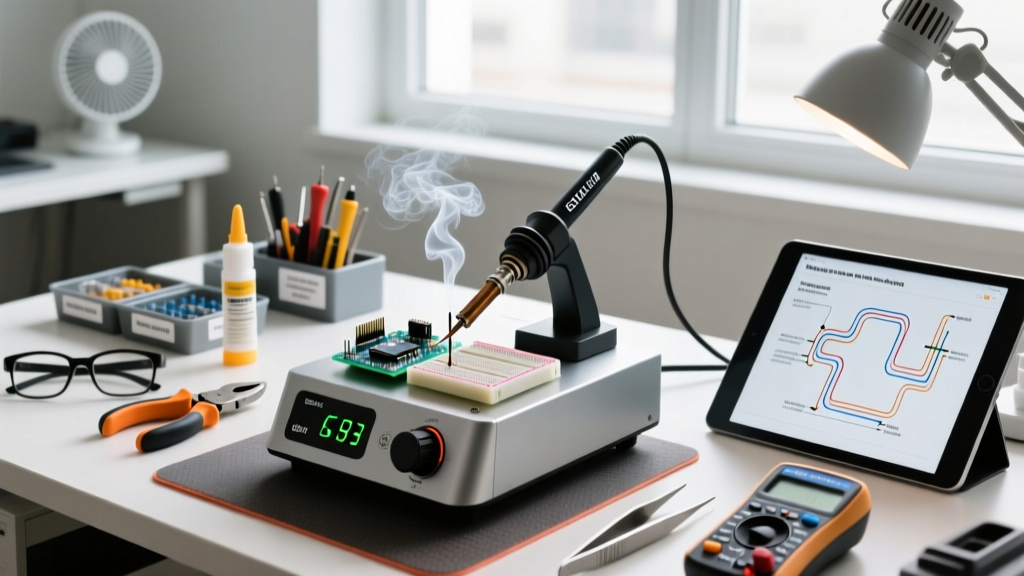
Never solder directly over a wooden desk or standard plastic cutting mat. You must use a high-temperature silicone soldering mat rated for at least 500°C (932°F). Brands like Kaisi or Caple offer reinforced silicone mats ($15–$25) that prevent scorching and provide ESD-safe grounding properties.
Furthermore, evaluate your iron's resting holster. Many entry-level stations use cheap cellulose sponges in the holder. Failure Mode: If a cellulose sponge dries out and the 350°C iron rests against it, the sponge will char, degrade, and potentially emit carbon monoxide or catch fire. Replace all cellulose sponges with brass wire sponges. Brass shavings clean the oxidized iron tip effectively without requiring water, eliminating the thermal shock that micro-fractures your iron's plating and removing the fire hazard entirely.
Automated Sleep Functions
Human memory is fallible. If your soldering project requires frequent pauses to consult schematics or use a multimeter, an iron left on at 380°C will rapidly oxidize and pose a severe burn risk. Invest in a smart station like the Pinecil V2 ($26) or a Hakko FX-951 ($250). These units feature motion-detecting accelerometers or magnetic switch stands that drop the tip temperature to 150°C or cut power entirely after 5 minutes of inactivity.
Personal Protective Equipment (PPE) for Electronics
While you don't need a hazmat suit for basic electronics, specific PPE is non-negotiable for preventing acute injuries.
- Optical Protection: Flux splatter and clipped component leads (which can fly at high velocities when cut with flush cutters) are major eye hazards. The Occupational Safety and Health Administration (OSHA) mandates impact-rated eyewear for such tasks. Always wear safety glasses stamped with the ANSI Z87.1+ mark. The Uvex Genesis XC ($12–$18) provides excellent wraparound protection and anti-fog coating.
- Respiratory Protection: If you are working in a poorly ventilated room or performing heavy SMD rework with no local extraction, a half-face respirator like the 3M 6200 equipped with 6001 Organic Vapor (OV) cartridges ($35–$45) is required. Standard N95 masks do not filter chemical vapors; they only block particulates.
- Thermal Finger Guards: When holding wires or components close to the joint during a soldering project, use Kevlar or Nomex finger cots. Avoid holding bare copper wires with your fingers, as copper is highly thermally conductive and will transfer 300°C heat to your skin in under a second.
Industry Standard Note: According to IPC J-STD-001 (Requirements for Soldered Electrical and Electronic Assemblies), proper handling and cleaning of flux residues are not just for cosmetic reliability; they are essential to prevent long-term electrochemical migration (dendritic growth) which can cause latent short circuits in your finished project.
Lead vs. Lead-Free: Distinct Safety Protocols
The transition from Leaded (Sn63/Pb37) to Lead-Free (SAC305) solder has fundamentally altered the thermal landscape of electronics work.
The Lead Poisoning Myth vs. Reality
According to the Environmental Protection Agency (EPA), lead exposure is a severe neurological hazard. However, in a soldering project, the risk of lead poisoning does not come from inhaling solder smoke. Lead melts at 327°C, but it does not vaporize until it reaches 1,749°C. Your iron is not hot enough to vaporize lead. The actual danger is ingestion via cross-contamination. If you touch leaded solder, then touch your mouth, food, or keyboard, you introduce lead into your system. Rule: Never eat at your workbench, and always wash your hands with cold water and soap immediately after handling leaded solder.
The Lead-Free Thermal Hazard
Lead-free SAC305 solder requires tip temperatures of 350°C to 380°C (compared to 320°C for leaded). This higher temperature drastically accelerates flux vaporization, creating more toxic smoke and increasing the severity of accidental thermal burns. If your soldering project utilizes lead-free solder, upgrading your fume extraction and using thermal-resistant matting is mandatory.
Electrical Safety and Ergonomics
Electrostatic Discharge (ESD) safety is designed to protect your components, but human electrical safety protects you. If you are working on a soldering project involving mains voltage (e.g., repairing an AC/DC power supply or a tube amplifier), you must understand the difference between an ESD wrist strap and a mains-rated isolation protocol.
All reputable ESD wrist straps contain a built-in 1-megohm resistor. This resistor is a critical safety feature: it bleeds off static electricity slowly to protect sensitive MOSFETs, but if you accidentally touch a live 120V/240V AC mains wire, the 1-megohm resistor limits the current passing through your heart to a non-lethal microamp level. Never use a solid copper ground wire as a wrist strap; a direct ground connection while touching mains voltage will result in fatal electrocution.
Pre-Flight Safety Checklist
Before applying power to your station for any soldering project, run through this 60-second verification protocol:
- Extraction Check: Turn on the fume extractor and verify airflow by holding a tissue near the intake.
- Mat Clearance: Ensure the silicone mat is clear of flammable solvents (like 99% isopropyl alcohol bottles).
- Cable Routing: Route the iron's power cord behind the workbench to prevent your arm from snagging it and pulling the 400°C iron onto your lap.
- Tip Inspection: Check the iron tip for severe pitting or black oxidation. A damaged tip transfers heat poorly, leading to excessive dwell times and burnt PCB pads.
- PPE Verification: Put on ANSI Z87.1+ safety glasses before the iron reaches operating temperature.
Incident Response Protocol
When accidents happen, immediate and correct action minimizes long-term damage.
| Incident Type | Immediate Action Required | What NOT To Do |
|---|---|---|
| Flux Splatter in Eye | Flush immediately with sterile saline or clean water for 15 minutes. Seek medical attention. | Do NOT rub the eye; flux contains mild acids that can cause corneal abrasion if rubbed. |
| Minor Thermal Burn (Fingertip) | Run under cool (not ice-cold) water for 10-15 minutes. Apply a sterile, non-stick dressing. | Do NOT apply butter, ointments, or ice directly to the burn, which traps heat and damages tissue. |
| Iron Dropped on Carpet/Floor | Unplug immediately. Let it cool completely before inspecting the cord for melted insulation. | Do NOT pick it up by the cord or attempt to catch it mid-air. |
Frequently Asked Questions (FAQ)
Can I use a standard desk fan instead of a fume extractor?
No. A desk fan merely dilutes and redirects the fumes, forcing you to breathe them in a wider radius. It does not filter the harmful aliphatic aldehydes created by rosin flux. You must use a localized extractor with an activated carbon filter to adsorb the chemical vapors.
Is it safe to drink water at my soldering workbench?
It is highly discouraged. Workbenches accumulate microscopic metallic dust, flux residue, and chemical contaminants. Keeping an open beverage container on the bench risks cross-contamination. Always step away from the workstation to eat or drink, especially when handling leaded alloys.
Why did my cellulose sponge catch fire when the iron was resting on it?
Cellulose sponges are made of organic wood fibers. If the sponge is completely dry and a 350°C+ iron rests directly against the edge of the sponge (rather than in the designated metal groove), the sustained thermal transfer can reach the autoignition temperature of the dry cellulose, causing it to smolder and smoke. Always use brass wool for tip cleaning to eliminate this hazard entirely.