
The Intersection of Sentiment and High-Temperature Metallurgy
At Electrical Flux, we typically focus on the precise, low-temperature world of electronics assembly, microcontrollers, and PCB repair. However, the fundamental physics of capillary action, alloy eutectics, and flux chemistry transcend circuit boards. One of the most fascinating crossovers into high-temperature metallurgy is the practice of having wedding rings soldered together. While an electronics engineer uses a 40W iron and rosin flux to join copper traces at 450°F, a master jeweler wields an oxy-acetylene torch and fluoride-based fluxes to fuse precious metals at over 1,400°F.
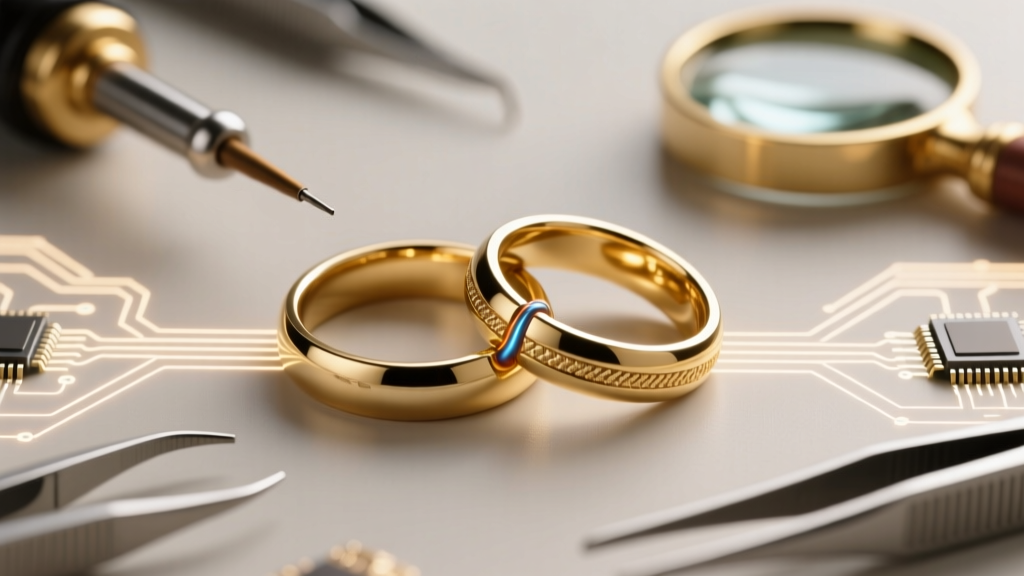
Why do couples choose to permanently fuse their engagement and wedding bands? How did this practice evolve from ancient blacksmithing techniques to the precision laser welding of 2026? This guide explores the rich history, metallurgical science, and practical realities of joining bridal sets.
Ancient Origins: From Blowpipes to Brazing
The concept of joining two separate rings into a single, unified band is not a modern invention. The metallurgical roots of jewelry soldering trace back to ancient Mesopotamia and Egypt, where artisans used primitive blowpipes to direct flame onto charcoal blocks, achieving temperatures high enough to melt gold and silver alloys. According to historical archives maintained by the Gemological Institute of America (GIA), early Egyptian goldsmiths utilized a primitive form of hard soldering—often called brazing in modern industrial contexts—to attach bezels and join ring shanks.
Unlike the soft tin-lead solders used in 20th-century electronics, ancient jewelers relied on alloy matching. To join two pieces of 18k gold, they would create a custom solder alloy with a slightly lower melting point by adjusting the zinc and copper ratios, ensuring the base metal would not melt during the joining process.
The Metallurgical Divide: Jewelry vs. Electronics Solder
To understand the evolution of wedding rings soldered together, one must understand the stark chemical differences between electrical soldering and jewelry soldering. The American Welding Society (AWS) classifies jewelry soldering under the umbrella of brazing, as the filler metal melts above 840°F (450°C), whereas electronics soldering operates well below this threshold.
| Parameter | Electronics Solder (Sn63/Pb37) | Lead-Free Electronics (SAC305) | 14K Yellow Gold Hard Solder | Platinum Solder (950 Pt) |
|---|---|---|---|---|
| Primary Composition | 63% Tin, 37% Lead | 96.5% Sn, 3% Ag, 0.5% Cu | Gold, Silver, Copper, Zinc | Platinum, Cobalt, Gallium |
| Melting Point | 361°F (183°C) | 424°F (217°C) | ~1,450°F (788°C) | ~2,550°F (1,399°C) |
| Flux Chemistry | Rosin (RMA), Mild Organic | No-Clean, VOC-Free Organic | Borax, Boric Acid, Fluorides | Specialized Platinum Flux |
| Capillary Gap | 0.002 - 0.005 inches | 0.002 - 0.005 inches | 0.003 - 0.008 inches | Tight butt-joint or laser |
The 20th Century Catalyst: The Friction Problem
The widespread consumer demand for having wedding rings soldered together did not truly materialize until the mid-20th century. Following the aggressive marketing campaigns by De Beers in the 1940s, the diamond engagement ring became a cultural staple, soon followed by the matching contoured wedding band.
This created an immediate mechanical problem: ring spin and galvanic friction. When worn separately on the same finger, the harder wedding band (often high-karat gold or platinum) would constantly rub against the engagement ring. Over a decade, this friction would literally sand away the metal, thinning the shanks and wearing down the prongs holding the center diamond.
Expert Insight: "Soldering the rings together transforms two independent, friction-generating bodies into a single structural unit. It eliminates the micro-abrasion that causes shank thinning and prevents the rings from spinning independently, which keeps the center stone perfectly aligned on the dorsal side of the finger."
The Evolution of the Flame and Flux Chemistry
As the demand for bridal sets grew, so did the need for precise thermal control. A jeweler cannot simply apply a blanket of heat; diamonds and certain gemstones (like emeralds or opals) will shatter or burn if exposed to the 1,400°F required to flow gold solder.
From Mouth Blowpipes to the Smith Little Torch
In the early 1900s, jewelers used mouth-blown blowpipes mixed with town gas. By the 1950s, the invention of the Smith Little Torch revolutionized the industry. This oxy-acetylene torch allowed jewelers to use a pinpoint flame (as small as a needle) to heat only the specific millimeter of the ring shank where the solder would flow, leaving the diamond and the rest of the band completely cool.
Flux Evolution: Conquering Copper Oxides
In electronics, rosin flux dissolves mild tin oxides. In jewelry, the high copper content in 14k and 18k gold creates stubborn, refractory copper oxides when heated. The evolution of jewelry fluxes led to the creation of Handy Flux (a potassium fluoride and borax mixture). Fluorides are aggressive enough to dissolve heavy copper oxides at 1,400°F, allowing the molten gold solder to wet the joint via capillary action. Post-soldering, the rings are dropped into a warm "pickle" solution (traditionally sulfuric acid, now mostly food-grade citric acid) to strip the remaining flux glass and oxides.
The 2026 Landscape: Laser Welding vs. Traditional Torch
Today, the methodology for getting wedding rings soldered together has bifurcated into two distinct paths, heavily influenced by the rise of alternative metals and complex CAD/CAM ring designs.
- Traditional Torch Soldering: Still the gold standard for standard 14k/18k gold and simple shanks. It relies on capillary action drawing the molten solder into the microscopic gap between the two rings. It is cost-effective and incredibly strong.
- Pulse Arc & Laser Welding: For platinum rings, titanium, or rings set with heat-sensitive stones (like tanzanite) that cannot be removed, jewelers now use Nd:YAG laser welders. Instead of a filler solder, the laser melts the exact parent metals of the two rings together at a microscopic focal point, requiring no flux and generating almost zero ambient heat.
Cost & Practical Guide for Consumers
If you are considering having your bridal set fused, here is what you should expect in terms of pricing and structural integrity in the current market:
- Standard Yellow/White Gold (Torch): $45 to $120. The jeweler will use a "Hard" or "Medium" grade karat-matched solder.
- Platinum (Laser or Oxy-Hydrogen): $150 to $300+. Platinum requires significantly higher temperatures and specialized equipment.
- Alternative Metals (Tungsten, Cobalt Chrome): Cannot be soldered. These metals must be joined via mechanical interlocking or specialized industrial laser bonding, which many local jewelers cannot perform.
Pro-Tip: Always ask your jeweler to use plumb solder. Plumb solder is formulated to match the exact karat purity of your ring (e.g., exactly 58.5% gold for 14k). Non-plumb solders use higher amounts of silver and zinc to lower the melting point, which can result in a visible, slightly discolored seam that may tarnish over time. Suppliers like Rio Grande provide certified plumb solders that ensure the seam remains invisible and chemically identical to the base metal.
FAQ: Wedding Rings Soldered Together
Does soldering rings together ruin them?
No. When performed by a skilled jeweler using karat-matched plumb solder, the process is entirely reversible. A jeweler can easily cut the solder joint with a laser or a specialized saw blade and polish the shanks back to their original, separate states without damaging the rings.
Will the solder joint be visible?
If the rings have a flat interior profile and are properly aligned, the joint should be virtually invisible to the naked eye. However, if one ring has a heavily rounded "comfort fit" interior and the other is flat, a slight step-off may be felt on the inside of the finger.
Can rings with diamonds be soldered?
Yes, but with caveats. Diamonds are highly thermally conductive and can generally withstand torch soldering if protected by a heat-shield paste or if the heat is applied strictly to the bottom shank. However, fracture-filled diamonds or stones like emeralds must be removed from their settings before torch soldering, or the jeweler must opt for cold laser welding.