
The Economics of Illumination: SMD LED Assembly in 2026
Surface mount LEDs (SMD LEDs) have entirely replaced through-hole variants in modern PCB design, offering superior thermal management, lower profile heights, and automated assembly compatibility. However, for hardware startups, DIY enthusiasts, and small-batch manufacturers, the transition from through-hole to surface mount technology (SMT) introduces a complex cost matrix. The core question is no longer just 'how to solder it,' but rather 'what is the most cost-effective way to assemble it at scale?'
In this comprehensive 2026 cost analysis, we break down the true financial impact of surface mount LED soldering. We compare precision hand soldering, DIY reflow hotplate methods, and turnkey Printed Circuit Board Assembly (PCBA) outsourcing. By examining capital expenditure (CapEx), operational expenditure (OpEx), and the hidden costs of yield loss, you will discover the exact break-even points for your next lighting or indicator project.
The Capital vs. Operational Cost Breakdown
Before calculating per-board costs, we must establish the baseline equipment required for SMD LED assembly. The barrier to entry for hand soldering 0805 (2.0mm x 1.25mm) and 0603 (1.6mm x 0.8mm) LEDs has dropped significantly, but professional-grade reflow requires a steeper initial investment.
| Equipment / Method | CapEx (2026 Est.) | OpEx per Board | Best Use Case |
|---|---|---|---|
| Pinecil V2 Soldering Iron | $28.00 | $0.05 (solder/flux) | 1-5 Prototypes |
| Hakko FX-951 Station | $365.00 | $0.05 (solder/flux) | Daily Prototyping |
| DIY PID Hotplate + Stencil | $115.00 | $0.15 (paste/stencil) | 10-50 Batch Runs |
| Turnkey PCBA Service | $0.00 | $0.12 - $0.35 | 50+ Volume Production |
Batch Cost Analysis: Hand Soldering vs. DIY Reflow vs. PCBA
To provide actionable data, let us model a specific scenario: assembling a batch of 50 custom PCBs, each populated with four 0603 SMD indicator LEDs and one PLCC-4 RGB LED (total 5 SMD components per board, 250 components total). We will assume an engineering labor rate of $50/hour for time-cost calculations.
Method 1: Precision Hand Soldering (Tweezer Irons)
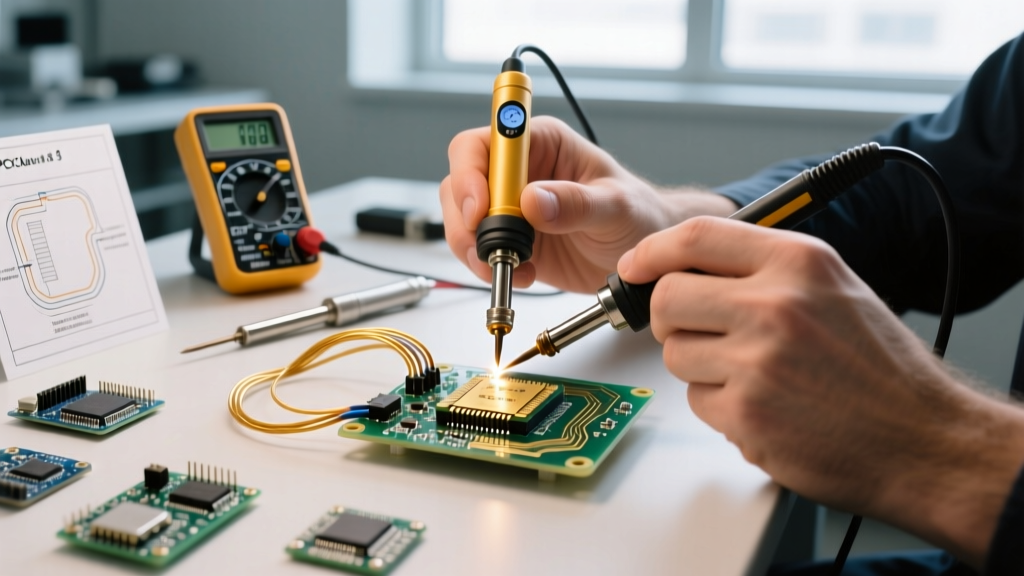
Hand soldering 0603 LEDs requires a micro-pencil tip (e.g., Hakko T15-IL or Pinecil TS-IL) and 0.3mm diameter Sn63/Pb37 rosin-core wire. While lead-free SAC305 is standard for commercial goods, DIYers often use leaded solder to lower the thermal budget, reducing the risk of cooking the LED phosphor.
- Material Cost: $15 for a spool of 0.3mm Sn63/Pb37 and $12 for a syringe of Amtech NC-559-V2-TF tacky flux. Total: $27.00.
- Time Cost: An experienced technician takes roughly 45 seconds per 0603 LED (including flux application, tinning, placement, and cleaning). For 250 components, this equals 3.12 hours. At $50/hr, labor is $156.00.
- Total Batch Cost: $183.00 (approx. $3.66 per board).
Failure Mode Risk: Hand soldering introduces high thermal shock. Exceeding 260°C for more than 10 seconds degrades the YAG phosphor layer and the InGaN quantum wells, leading to chromaticity shifts (color temperature changes) and reduced lumen output.
Method 2: DIY Reflow Hotplate
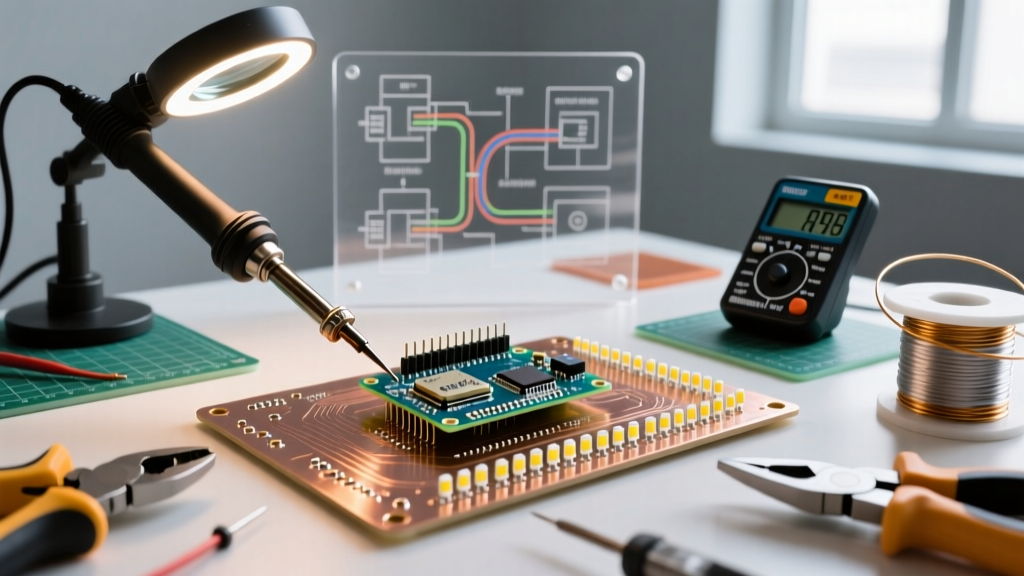
Using a modified hotplate with an Inkbird PID controller and a custom stainless steel stencil allows for simultaneous reflow of all SMD LEDs on a board. This method relies on solder paste (e.g., Chip Quik SMD291SNL10).
- Material Cost: $18 for a 10g syringe of SAC305 paste (enough for 50 boards) and $25 for a framed stainless steel stencil. Total: $43.00.
- Time Cost: Stencil squeegee application and manual component placement with tweezers takes about 2 minutes per board. Reflow takes 6 minutes. Total time for 50 boards: ~2.5 hours. Labor: $125.00.
- Total Batch Cost: $168.00 (approx. $3.36 per board).
Method 3: Turnkey PCBA Outsourcing
In 2026, turnkey assembly has become aggressively cheap. Using a service like JLCPCB SMT Assembly or PCBWay, you can order the bare PCBs and have the SMD LEDs placed and reflowed by automated pick-and-place machines.
- Setup Fee: ~$8.00 to $15.00 base setup fee for economic SMT assembly.
- Component & Joint Cost: SMD LEDs count as standard passive components. At approximately $0.004 per joint and $0.01 per basic LED component, the machine cost is minimal.
- Time Cost: 1 hour of engineering time to prepare the BOM, CPL (Component Placement List), and verify part numbers in the PCBA library. Labor: $50.00.
- Total Batch Cost: ~$75.00 to $95.00 (approx. $1.50 to $1.90 per board, assuming PCB fabrication costs are separated).
The Hidden Costs: Yield Loss and Thermal Degradation
When calculating the cost of surface mount LED soldering, amateurs often ignore yield loss. According to the IPC-A-610 standard for electronic assemblies, SMD components must meet strict wetting and fillet requirements. However, LEDs introduce unique vulnerabilities:
Expert Insight: SMD LEDs are highly sensitive to Moisture Sensitivity Levels (MSL). If a reel of PLCC-4 RGB LEDs has been exposed to ambient humidity for more than 168 hours (MSL 3), the moisture trapped inside the silicone resin will vaporize during reflow. This 'popcorn effect' delaminates the die attach, causing instant or latent catastrophic failure.
If you are running a DIY reflow hotplate and experience a 10% yield loss due to improper thermal profiling or tombstoning (where surface tension pulls the LED upright), the cost of replacing the ruined custom PCBs often eclipses the money saved by avoiding PCBA outsourcing. Turnkey assembly houses bake MSL-sensitive components and utilize nitrogen-atmosphere reflow ovens to eliminate tombstoning and oxidation, ensuring near-100% yield on SMD LED joints.
Solder Paste Shelf Life and Storage Costs
Another hidden operational cost is solder paste management. Type 4 (T4) and Type 5 (T5) solder pastes required for fine-pitch 0402 and 0201 LEDs have a strict shelf life of 6 months at room temperature, or up to 12 months if refrigerated between 0°C and 10°C. If a DIY lab purchases a $45 jar of Sn63/Pb37 paste but only uses 10% of it for a small LED batch, the remaining 90% expires before the next project. This effectively multiplies the per-board OpEx of DIY reflow for low-volume users. Conversely, PCBA services amortize paste costs across millions of joints, eliminating this waste for the end user.
Decision Matrix: Which Method Wins in 2026?
Based on our cost modeling and technical constraints, here is the definitive decision framework for surface mount LED soldering:
- 1 to 5 Boards (Prototyping): Winner - Hand Soldering. The CapEx of a $28 Pinecil V2 and a $12 flux pen is unbeatable. Use Sn63/Pb37 0.3mm wire to minimize thermal stress on the LED die. Refer to the SparkFun SMT soldering tutorial for proper tweezer technique.
- 10 to 30 Boards (Beta Testing): Winner - DIY Reflow Hotplate. If you already own a PID-controlled hotplate and stencil frame, the per-board cost is low. However, factor in the time required to manually place hundreds of tiny 0603 LEDs with tweezers.
- 50+ Boards (Production / Crowdfunding): Winner - Turnkey PCBA. The math is undeniable. Outsourcing eliminates CapEx, removes the risk of thermal LED degradation, guarantees IPC-A-610 compliance, and frees up engineering hours for firmware development rather than manual labor.
Expert Tips to Minimize SMD LED Assembly Costs
- Standardize on 0805 or 0603 Packages: While 0402 LEDs save microscopic amounts of board space, they require T5 solder paste, high-precision stencils, and optical inspection. Sticking to 0603 keeps DIY and PCBA costs at their absolute lowest tier.
- Use 'Standard' PCBA Library Parts: When outsourcing, select SMD LEDs that are already in the assembly house's basic parts library (e.g., standard Lite-On or Wurth Elektronik indicator LEDs). Using 'extended' or custom-sourced LEDs incurs $3 to $5 feeder setup fees per unique part number.
- Design Thermal Relief Pads: To prevent tombstoning during DIY reflow, ensure your PCB footprint features symmetrical thermal relief on both the anode and cathode pads. Asymmetrical heating causes uneven solder paste melting, resulting in the LED standing on its end and ruining the board.
Final Verdict
The landscape of surface mount LED soldering has shifted dramatically. While hand soldering remains a vital skill for rapid debugging and one-off prototypes, the economic threshold for DIY reflow has been crushed by the aggressive pricing of automated PCBA services. By understanding the hidden costs of yield loss, MSL moisture damage, and solder paste expiration, engineers can make data-driven decisions that protect both their project budgets and their luminous efficacy.