
The Invisible Hazard: Why Room Ventilation Isn't Enough
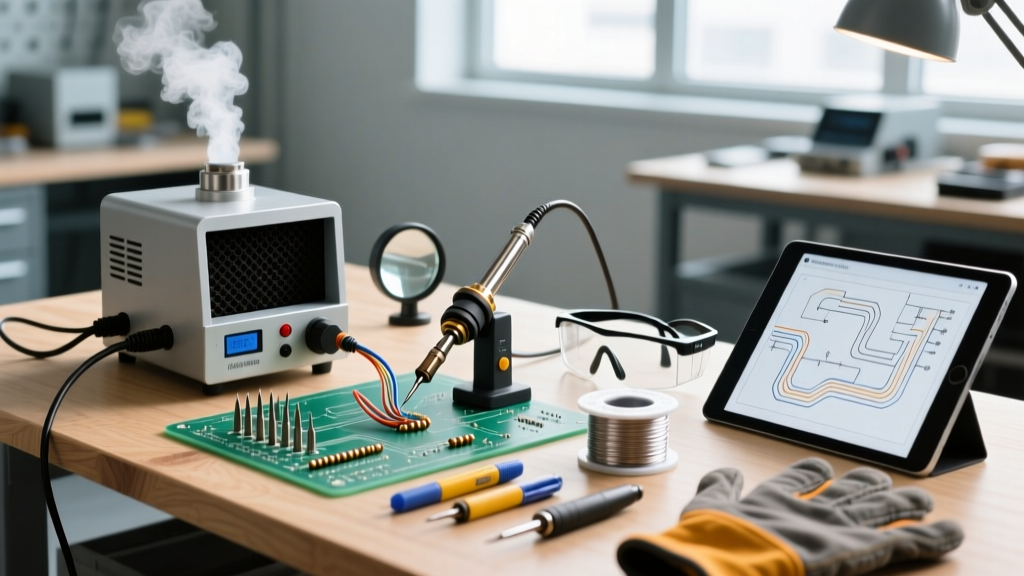
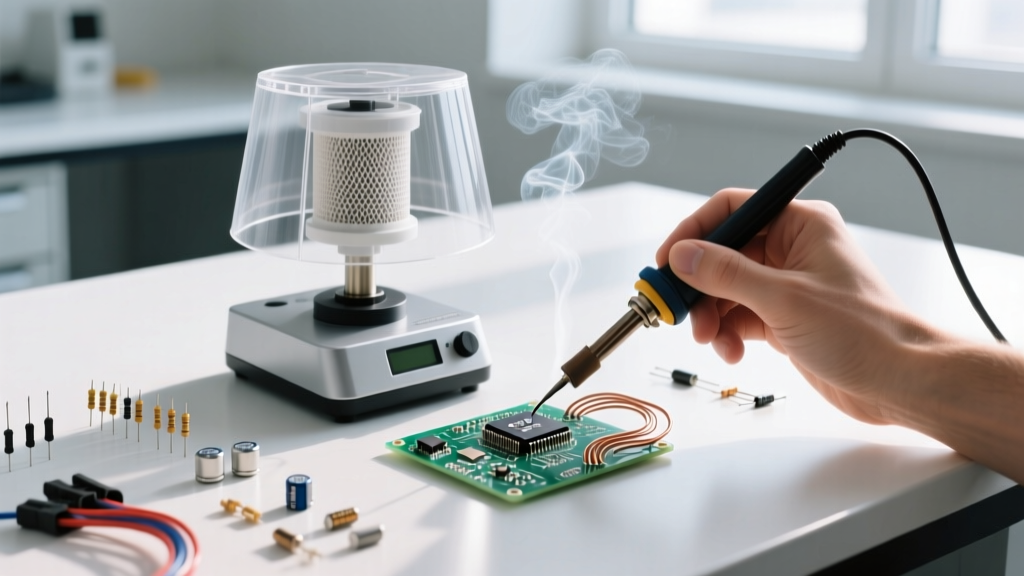
When assembling a custom mechanical keyboard or repairing a damaged PCB trace, the immediate focus is usually on solder joint quality, flux activity, and iron temperature. However, the most significant long-term risk in electronics work is entirely invisible. A dedicated soldering shield—encompassing both fume extraction enclosures and physical splatter barriers—is not an optional accessory; it is a fundamental piece of personal protective equipment (PPE). According to Cornell University Environmental Health and Safety, soldering fumes contain vaporized flux, fine metallic particulates, and volatile organic compounds (VOCs) that standard room ventilation simply cannot manage at the source.
The primary culprit in traditional rosin-based (colophony) flux is the thermal decomposition that occurs between 150°C and 300°C. This process releases aliphatic aldehydes, hydrogen chloride, and other respiratory sensitizers. The UK Health and Safety Executive (HSE) explicitly classifies colophony fume as a leading cause of occupational asthma. Even modern 'no-clean' synthetic fluxes emit VOCs and micro-particulates that can cause chronic sinus irritation and contact dermatitis. Relying on a desk fan to blow these fumes away merely disperses them into your breathing zone. A properly engineered soldering shield captures the thermal plume at the source before it can expand and cool.
Decoding the Term: Fume Extraction vs. Physical Splatter Shields
In the electronics industry, the term 'soldering shield' refers to two distinct safety categories. Understanding the difference is critical for outfitting a compliant and safe workbench.
| Feature | Fume Extraction Shield (Active) | Physical Splatter Shield (Passive) |
|---|---|---|
| Primary Function | Captures and filters VOCs and particulates | Blocks molten solder splash and thermal radiation |
| Mechanism | High-static-pressure blower + HEPA/Carbon | High-temp silicone, PETG, or acrylic barriers |
| Placement | 2 to 6 inches from the soldering iron tip | Between the workpiece and the operator's hands/face |
| Maintenance | Filter weighing and scheduled replacement | Wiping down with isopropyl alcohol (IPA) |
| Average Cost (2026) | $65 to $850+ | $15 to $45 |
2026 Buyer's Matrix: Top Fume Extraction Shields
Choosing the right active fume shield depends heavily on your soldering volume, the types of flux you use, and your bench space constraints. Below is a breakdown of the most effective models currently on the market, categorized by user profile.
1. The Hobbyist Standard: Hakko FA-400
Price Range: $65 - $85
Airflow: ~35 CFM (Cubic Feet per Minute)
Filter Type: HAK-100F (Activated Carbon + Particulate mesh)
The Hakko FA-400 remains the most ubiquitous benchtop soldering shield for DIYers and makerspaces. It features a flexible gooseneck tube that allows you to position the capture nozzle directly over the workpiece. Expert Caveat: The FA-400's carbon filter contains roughly 1.2 ounces of activated carbon. While sufficient for occasional weekend projects, this low carbon mass means the filter will saturate quickly if you are doing high-volume THT (Through-Hole Technology) work with heavy rosin flux. It is best paired with low-solid, no-clean fluxes for extended sessions.
2. The Mid-Tier Workhorse: Weller WSA100F
Price Range: $130 - $160
Airflow: 75 CFM
Filter Type: Weller 100-13 (High-density Carbon/HEPA combo)
Weller's WSA100F utilizes a high-static-pressure blower rather than a standard axial fan. This allows it to maintain airflow even as the dense carbon filter begins to load with particulates. The larger filter cartridge contains significantly more activated carbon, providing a dwell time (the time the air is in contact with the carbon) of over 0.1 seconds, which is the minimum threshold required to effectively adsorb complex VOC gases. This is the ideal shield for serious hobbyists and small repair shops.
3. The Professional Enclosure: Metcal BTX-1000
Price Range: $800 - $950
Airflow: 150+ CFM (Adjustable)
Filter Type: 3-Stage (Pre-filter, HEPA, Acid Gas/Carbon)
For production environments or daily repair technicians, a localized nozzle isn't enough; you need an extraction arm or a full benchtop enclosure shield. The Metcal BTX-1000 is a powerhouse that easily handles the heavy, acidic fumes generated by plumbing soldering or high-temp lead-free profiles (SAC305). It features a digital filter saturation monitor, eliminating the guesswork from maintenance schedules.
Physical Soldering Shields: Guarding Against Thermal Splatter
While fume extraction protects your lungs, physical soldering shields protect your skin, eyes, and sensitive components from molten solder splatter and accidental iron contact. When working with large ground planes or thick multi-layer PCBs, the thermal shock can cause flux to violently boil and eject micro-droplets of liquid solder.
- High-Temp Silicone Baffles (2mm - 3mm thick): Brands like Caplugs or generic high-temp silicone mats can be folded or propped up to create a physical wall between the soldering iron and your face. Silicone withstands temperatures up to 300°C without melting or off-gassing.
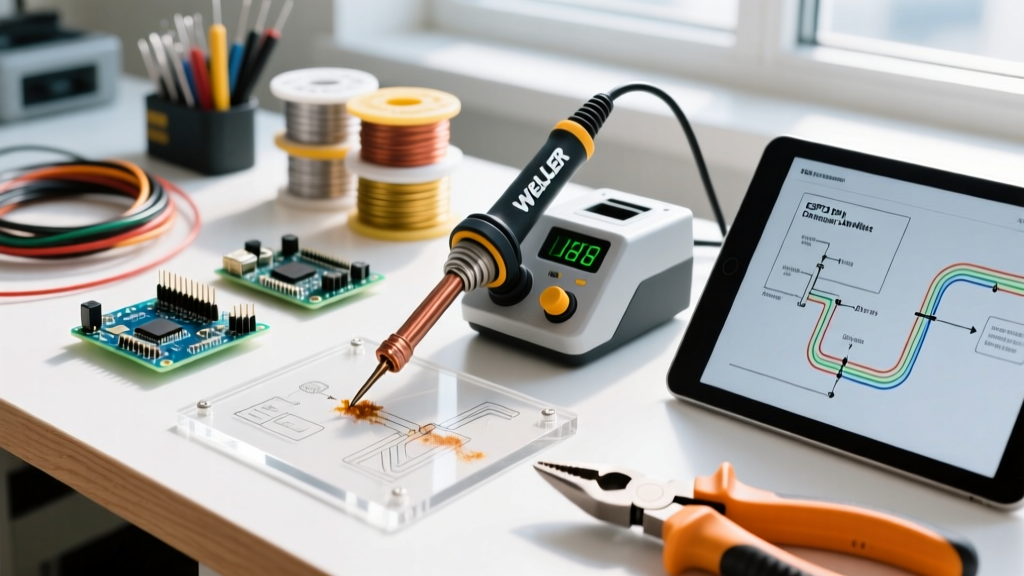
- Acrylic/PETG Component Shields: Often 3D-printed or laser-cut, these small, clear shields are placed directly on the PCB to protect adjacent sensitive components (like electrolytic capacitors or plastic connectors) from the radiant heat of the iron. Note: Never use standard PLA for 3D printed shields, as it will warp at 60°C. Use PETG or ABS.
- Finger Guards (Thermal Tape): Polyimide (Kapton) tape or specialized fiberglass finger shields act as a micro-shield for your hands when working in tight SMD (Surface Mount Device) clusters.
The Physics of Airflow: Positioning Your Shield Correctly
The most common failure mode in soldering safety is improper shield placement. Airflow velocity follows the inverse square law relative to the distance from the intake. If you place your fume extraction shield 12 inches away from the solder joint, the capture velocity drops to nearly zero, rendering the unit useless against the thermal plume rising from the iron.
The 6-Inch Rule: For benchtop fume extractors rated under 100 CFM, the intake nozzle must be positioned no more than 4 to 6 inches from the soldering iron tip, and ideally slightly below the tip to intercept the natural upward convection current of the heated air.
To test your shield's effectiveness, use a piece of thin tissue paper. Hold it near the solder joint while the iron is hot. If the tissue pulls sharply toward the shield's intake, your capture velocity is adequate (typically >50 feet per minute). If the tissue flutters or blows away from the heat, your shield is too far away or your room's HVAC system is creating a cross-draft that is overpowering the extractor.
Filter Saturation: The Weight-Gain Method
A critical safety best practice often ignored by DIYers is knowing when to replace the soldering shield's carbon filter. Activated carbon does not just trap particles; it adsorbs gases into its microscopic pores. Once the pores are full, the VOCs pass straight through, even if the fan is still pulling air.
Pro-Tip for Filter Maintenance: Weigh your new carbon filter on a digital kitchen scale before installing it. Write the baseline weight on the filter housing. Every 30 days, remove and weigh the filter. If the filter has gained 10% to 15% of its original dry weight, the carbon is fully saturated with flux resins and moisture. It must be replaced immediately. Storing filters in a sealed ziplock bag when not in use will prevent them from adsorbing ambient humidity, extending their operational lifespan.
Troubleshooting: When Your Shield Stops Pulling Fumes
- Check the Pre-Filter: Most shields have a foam or mesh pre-filter to catch large dust bunnies and hair. If this clogs, the static pressure drops, and the main carbon filter starves for air.
- Inspect for Flux Creep: Over time, vaporized flux can condense inside the blower housing and on the fan blades, creating a sticky residue that slows the motor's RPM. Clean the internal housing with 99% isopropyl alcohol annually.
- Verify Fan Orientation: If you recently replaced a noisy axial fan in a budget shield, ensure the airflow directional arrows are pointing toward the exhaust, not back into the workspace.
Investing in a high-quality soldering shield and adhering to strict positioning and maintenance protocols ensures that your electronics workspace remains safe, compliant, and healthy for decades to come. Do not compromise on respiratory protection; the cumulative effects of flux exposure are irreversible, but entirely preventable with the right equipment.