
The Metallurgical Roots: Understanding the Soldering Rings Together Cost
While ElectricalFlux primarily focuses on electronic circuitry and microcontrollers, the fundamental physics of soldering—capillary action, thermal conductivity, and filler metal metallurgy—transcend the printed circuit board. Nowhere is this more evident than in precious metal joinery. When evaluating the modern soldering rings together cost, whether for stacking wedding bands, resizing, or structural repair, one must look beyond the immediate service fee. The price you pay at the jeweler's bench in 2026 is the culmination of thousands of years of metallurgical evolution, shifting from labor-intensive scarcity to high-tech precision.
Historically, the soldering rings together cost was measured not in dollars, but in the sheer scarcity of precious metals and the immense time required to achieve a localized melt without destroying the workpiece. Today, we explore how the tools, techniques, and economics of ring soldering have evolved, providing a comprehensive buyer's and historical guide for modern jewelers, hobbyists, and consumers.
The Pre-Industrial Era: Blowpipes and Scarcity Economics
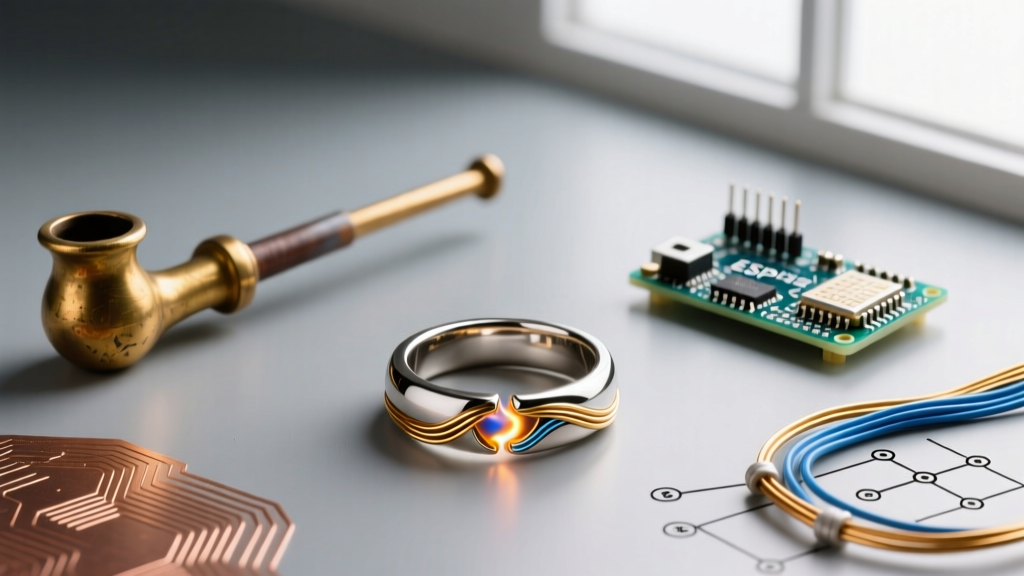
Before the advent of compressed gases, joining precious metal rings relied on the mouth blowpipe and the charcoal block. Artisans would use a hollow reed or metal tube to direct their breath through a flame (typically from an oil lamp or beeswax candle), creating a localized reducing flame. According to Britannica's historical archives on soldering technology, early soldering required immense lung capacity and an intuitive understanding of oxidation.
In this era, the concept of a standardized 'service cost' did not exist. You were paying a master goldsmith for their apprenticeship-honed muscle memory. The filler metals were not the precisely alloyed 'Easy, Medium, and Hard' solders we use today; they were often lower-karat gold alloys or silver-copper eutectics that frequently resulted in visible, brittle seams.
'The true cost of ancient soldering was the risk of catastrophic failure. Without modern fluxes to prevent oxidation, a single misdirected breath could oxidize an entire gold band, forcing the artisan to melt the piece down and start over.'
The 20th Century: Gas Torches and Standardized Pricing
The industrial revolution brought compressed gases—first hydrogen, then acetylene and oxygen—fundamentally altering the economics of jewelry repair. The introduction of the oxy-acetylene torch allowed for higher, more controllable temperatures. However, the true paradigm shift occurred in the mid-20th century with the invention of the mixed-gas micro-torch.
Technical Milestone: The Smith Little Torch
Introduced in the 1940s, the Smith Little Torch (Model 23-1001) remains a staple on jeweler's benches in 2026. By utilizing an oxygen-propane or oxygen-acetylene mix with interchangeable tips (ranging from a pinpoint #00 tip to a broader #5 tip), jewelers could finally solder a 1mm prong without melting the adjacent ring shank. This precision drastically reduced the 'failure tax'—the hidden cost of ruined gemstones and melted shanks—which in turn allowed jewelers to lower and standardize the soldering rings together cost for the general public.
The Modern Era (2000–2026): Laser and Pulse Arc Technology
As we navigate 2026, the traditional torch is increasingly supplemented—or replaced—by Laser Welders and Pulse Arc Welders (like the Sunstone Orion series). Why? Because modern ring designs feature tension settings, micro-pavé diamonds, and heat-sensitive gemstones (like emeralds and opals) that cannot withstand the ambient heat of a gas torch.
Laser welding uses concentrated light to melt metal in milliseconds, while pulse arc welding uses a high-voltage electrical spark. Both methods eliminate the need for traditional flux and prevent thermal shock. According to research on gemstone durability and thermal limits published by the Gemological Institute of America (GIA), localized heating technologies have virtually eliminated the risk of fracturing included diamonds during sizing and joining operations. Consequently, while the equipment overhead for the jeweler has skyrocketed, the value provided to the consumer justifies the modern premium pricing.
Comparative Matrix: Soldering Rings Together Cost (1950 vs. 2026)
To understand the economic shift, we must compare the historical service costs, adjusted for inflation, against modern 2026 pricing, factoring in the technology used.
| Era & Technology | Typical Equipment Cost (Jeweler) | Consumer Service Cost (Joining 2 Bands) | Risk of Gemstone Thermal Shock | Primary Consumables |
|---|---|---|---|---|
| 1950s (Oxy-Acetylene Torch) | $150 - $300 | $12 - $18 ($150+ adjusted) | High (Requires stone removal) | Acetylene, Borax Cone |
| 1990s (Smith Little Torch) | $200 - $400 | $25 - $45 ($90+ adjusted) | Medium (Heat sinks required) | Oxygen/Propane, Handy Flux |
| 2026 (Pulse Arc / Laser) | $4,500 - $12,000+ | $65 - $150+ | Negligible (No stone removal) | Argon Gas, Electricity |
Metallurgical Deep Dive: Flux, Filler Metals, and Failure Modes
Whether you are a DIY metalsmith setting up a home bench or a consumer trying to understand your jeweler's invoice, understanding the chemistry of the joint is crucial. The soldering rings together cost is heavily influenced by the karat and color of the gold, which dictates the filler metal required.
- Hard Solder (Melting point ~750°C): Used for the first joint. Contains higher gold content to match the ring's color and pass The London Assay Office hallmarking and solder standards for precious metal purity.
- Medium Solder (Melting point ~700°C): Used for secondary joints or sizing. Slightly lower karat, often resulting in a marginally lighter color seam.
- Easy Solder (Melting point ~650°C): Used for final, low-heat repairs. High zinc/cadmium content (historically), though modern cadmium-free alloys are standard in 2026 due to toxicity regulations.
Common Failure Modes in Ring Soldering
- Fire Scale (Cuprous Oxide): When copper in the gold alloy oxidizes beneath the surface, creating a dark, stubborn shadow. Prevented by using Cupronil anti-firescale flux, but requires costly polishing to remove if ignored.
- Capillary Starvation: If the joint isn't perfectly flush, the solder will not draw through the seam via capillary action, resulting in a weak 'cold joint' that will snap under finger tension.
- Flux Inclusions: Trapped glassy flux residue inside the joint, weakening the structural integrity. Requires proper pickling in a warm citric acid or sodium bisulfate bath post-solder.
2026 Buyer’s Framework: Equipping a Modern Soldering Bench
If you are an aspiring jeweler or a serious DIY enthusiast looking to bring the soldering rings together cost in-house, here is a realistic 2026 buyer's guide for your bench setup:
Tier 1: The Traditionalist Setup (Under $400)
Ideal for basic band soldering, sizing, and heavy silver work.
- Torch: Smith Little Torch 23-1001C with Oxygen/Propane regulators ($180).
- Solder & Flux: Rio Grande 14k Hard/Medium/Easy solder wire ($120) and Handy Flux paste ($25).
- Pickling: Copper pot with Sparex #2 sodium bisulfate ($45).
- Limitations: Cannot safely solder near heat-sensitive stones without thermal paste (e.g., Gesswein Heat Shield).
Tier 2: The Modern Precision Setup ($5,000 - $8,000)
Required for modern commercial jewelry repair, micro-pavé, and multi-metal joinery.
- Welder: Sunstone Orion 150s Pulse Arc Welder ($6,500). Uses a microscope and electrical arcing to weld rings together without heating the surrounding metal.
- Atmosphere Control: Medical-grade Argon tank and regulator ($250) to prevent oxidation during the arc flash.
- ROI: At an average consumer charge of $85 per laser weld, the machine pays for itself after roughly 85 ring-joining jobs, completely bypassing the need for stone removal and re-tipping.
Conclusion
The trajectory of the soldering rings together cost is a fascinating case study in technological deflation and precision inflation. While the raw cost of labor and fuel has decreased relative to the 1950s, the demand for zero-damage, stone-in-place precision has driven the adoption of $10,000 laser and pulse-arc systems. Whether you are paying a master jeweler for their time or investing in a Smith Little Torch for your own home workbench, understanding the thermal dynamics and historical evolution of the craft ensures you get a joint that will last a lifetime.