
The Demands of Professional Soldered Stained Glass Production
In the commercial glassworking industry, the transition from hobbyist crafting to high-volume production requires a fundamental reevaluation of tooling. Professional studios producing architectural panels, custom transoms, and high-volume retail pieces cannot rely on standard 40-watt electronics irons. The physics of soldered stained glass dictate that copper foil, lead came, and the glass itself act as massive heat sinks. When an iron touches a joint, thermal energy is rapidly dispersed. If the tool lacks the wattage and thermal recovery speed to maintain a stable working temperature, the result is structurally compromised panels, grainy cold joints, and severe artisan fatigue.
As we move through 2026, commercial studios are also navigating stricter occupational safety mandates and a shift toward specialized tip geometries. This guide breaks down the exact soldering stations, wattages, and thermal profiles required for professional stained glass fabrication, ensuring your production line maintains both structural integrity and aesthetic perfection.
Critical Iron Specifications for Glass Studios
Wattage and Thermal Recovery
For continuous soldering of copper-foiled panels, a minimum of 60 watts is required, though 80W to 100W is the industry standard for heavy architectural work. Wattage does not determine how hot the iron gets; it determines how fast the iron recovers its heat after transferring energy to the copper and glass. When dragging a bead of 60/40 solder along a 3-foot seam, a low-wattage iron will experience a temperature drop, causing the solder to freeze and form a dull, jagged ridge. High-wattage irons with ceramic heating elements maintain a constant thermal equilibrium, allowing for a smooth, convex meniscus.
Tip Geometry and Material
Electronics soldering relies on fine conical tips, but stained glass requires broad surface area for heat transfer. The industry standard is the 1/4-inch or 3/8-inch chisel or bevel tip. The flat face of the chisel allows the artisan to melt the solder wire and simultaneously smooth the bead in a single, continuous motion. In 2026, iron-clad copper tips remain the preferred choice, as pure lead-free solders (increasingly mandated in public installations) rapidly degrade standard tips through dissolution.
2026 Industry-Standard Soldering Iron Comparison Matrix
Below is a comparison of the top-performing soldering irons utilized by professional Stained Glass Association of America (SGAA) affiliated studios this year.
| Model | Wattage | Temp Range | Standard Tip | 2026 Est. Price | Best Application |
|---|---|---|---|---|---|
| Hakko FX-601 | 67W | 200°F - 900°F | T19-D24 (Chisel) | $85 - $95 | Copper foil, detailed zinc came work |
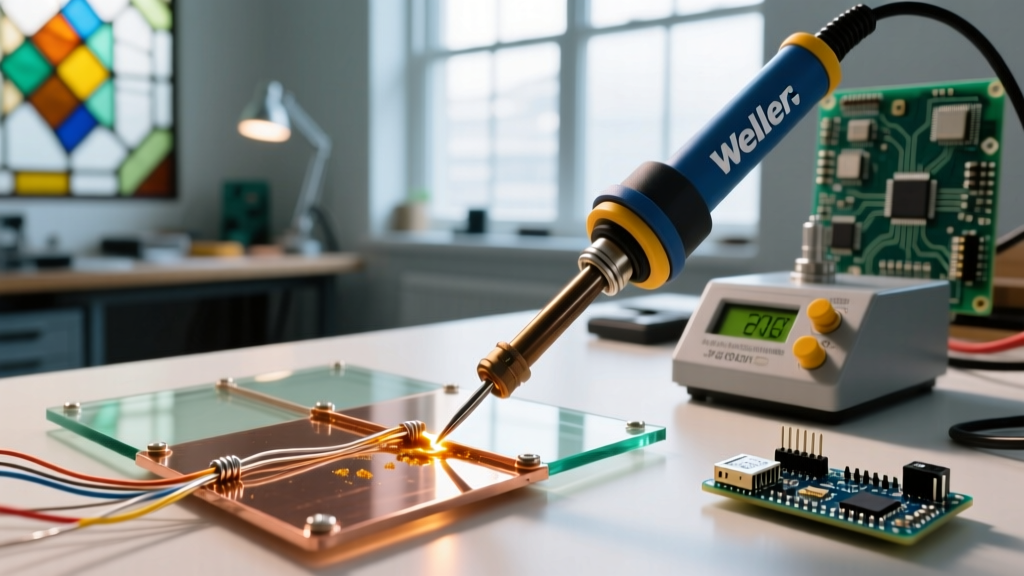
| Weller 100PG | 100W | Fixed (~800°F) | 1/4" Heavy Chisel | $110 - $130 | Heavy lead came, continuous production |
| Grobet 100W Rheostat | 100W | Variable (Dial) | 3/8" Bevel | $140 - $160 | Large architectural panels, U-came borders |
| Pace TF-700 | 70W | 200°F - 850°F | Flat Blade | $210 - $230 | Precision lead-free commercial mandates |
Solder Alloys and Flux Chemistry in Commercial Studios
60/40 vs. Lead-Free Mandates
The traditional alloy for soldered stained glass is 60/40 (60% Tin / 40% Lead). It melts at roughly 370°F (188°C) but requires a working tip temperature of 700°F to 750°F to account for heat dissipation. This alloy provides the longest working time, allowing artisans to manipulate the surface tension into a perfect, rounded bead.
However, commercial and public-sector contracts in 2026 increasingly specify lead-free solder (typically Sn99.3/Cu0.7) to comply with environmental and safety standards. Lead-free alloys melt higher (around 440°F / 227°C) and require tip temperatures exceeding 800°F. They also exhibit a shorter plastic range, meaning the solder transitions from liquid to solid almost instantly. Artisans must increase their travel speed and utilize high-activity gel fluxes to prevent cold joints when working with lead-free alternatives.
Flux Selection: Gel vs. Liquid
Flux is the chemical catalyst that removes oxidation from the copper foil, allowing the solder to bond via capillary action. For vertical seams and intricate 3D glass boxes (like terrariums or lampshades), oleic acid-based gel fluxes (e.g., Novacan Super Pro) are mandatory. They cling to the foil without dripping, reducing the risk of flux seeping under the foil and compromising the adhesive backing. For flat, horizontal lead came work, traditional zinc chloride liquid flux remains the most cost-effective and aggressive option.
Mitigating Failure Modes: Thermal Shock and Burnt Foil
Even with premium equipment, improper technique in a high-pressure studio environment leads to costly material waste. Understanding the thermodynamics of the glass-solder interface is critical.
- Thermal Shock Cracking: Glass is a poor conductor of heat. If an artisan holds a 100W iron stationary on a copper joint for more than 3-4 seconds, the localized heat transfers through the foil and into the glass edge. This rapid, uneven expansion causes the glass to fracture, often along the score line. Solution: Keep the iron in constant motion and use a heat-absorbing jig.
- Foil Burn-Through and Lifting: Copper foil relies on an acrylic or rubber-based adhesive. If the iron temperature exceeds 850°F, or if the artisan pauses too long, the adhesive boils and degrades. The foil will lift away from the glass, creating a hollow pocket that will eventually leak or fail structurally.
- Grainy/Dull Joints: A dull, crystalline appearance indicates a "cold joint." This happens when the iron's thermal recovery lags behind the artisan's travel speed, causing the solder to freeze before it can properly wet the copper. The joint lacks metallurgical bonding and will crack under the panel's own weight.
Studio Manager Insight: "When training new apprentices on the Hakko FX-601, we mandate a strict 750°F limit for 60/40 solder. We use infrared thermometers to audit the glass surface temperature post-soldering. If the glass edge exceeds 140°F, the artisan is moving too slowly and risking thermal shock."
Occupational Safety and Ventilation Standards
Operating a commercial stained glass studio requires strict adherence to occupational health regulations. The process of cutting, grinding, and soldering generates both lead particulate and hazardous flux fumes. According to the Occupational Safety and Health Administration (OSHA), any environment where lead is heated or manipulated requires rigorous housekeeping, dedicated hand-washing stations, and air monitoring to ensure blood lead levels remain safe.
Furthermore, heating rosin or acid-based fluxes releases volatile organic compounds (VOCs) and aldehydes, which are known respiratory sensitizers. The CDC's National Institute for Occupational Safety and Health (NIOSH) emphasizes the need for local exhaust ventilation. In 2026, professional studios are moving away from simple desktop fans and investing in HEPA and activated carbon fume extraction arms (such as the BOFA PrintPro or Hakko FA-400) positioned within 6 inches of the solder joint to capture particulate and vapor before it reaches the artisan's breathing zone.
Frequently Asked Questions (FAQ)
Can I use a standard electronics soldering station for stained glass?
While a station like the Weller WE1010 (70W) can handle small hobby projects, it lacks the thermal mass and heavy-duty tip geometry required for continuous production. Electronics tips are too narrow to smooth a wide stained glass bead, and the stations are not calibrated for the extreme heat-sinking properties of lead came.
Why does my solder bead look flat and spread out?
A flat bead usually indicates over-fluxing or an iron temperature that is too high. Excess flux reduces the surface tension of the molten solder, causing it to spread laterally rather than building up into a convex dome. Reduce your flux application and lower the iron temperature by 25°F increments until the bead profiles correctly.
How often should I replace the tip on a 100W glass iron?
In a full-time commercial studio soldering 40+ hours a week, a standard iron-clad tip working with 60/40 solder will last roughly 3 to 4 months. If you are using lead-free solder, the higher operating temperatures and tin content will accelerate tip erosion, requiring replacements every 4 to 6 weeks. Always keep a layer of molten solder on the tip when resting it in the holder to prevent oxidation.