
The Metallurgical Shift: Why Soldering Removal Got Harder
To understand the evolution of soldering removal, we must first look at the metallurgy of the joints themselves. For decades, the electronics industry relied on Sn63/Pb37 (tin-lead) solder, which boasts a low, predictable melting point of 183°C. Desoldering was relatively forgiving; a 40W iron and a manual vacuum pump were sufficient to lift components without destroying the fragile copper pads on FR4 fiberglass substrates.
The landscape changed permanently with the global adoption of RoHS (Restriction of Hazardous Substances) directives. The shift to lead-free alloys, primarily SAC305 (Sn96.5/Ag3.0/Cu0.5), pushed the liquidus melting point up to 217°C–220°C. In practical terms, this meant desoldering tools now had to deliver sustained thermal energy at 300°C–350°C just to achieve adequate wetting and flow. This thermal leap introduced severe failure modes, including pad cratering, PCB delamination, and the rapid dissolution of copper traces into the molten solder bath. The history of desoldering tools is essentially a timeline of engineers trying to solve the thermal problems created by lead-free metallurgy.
Era 1: Capillary Action and Mechanical Shock (1950s–1980s)
In the through-hole era, soldering removal relied on two fundamental physics principles: capillary action and pneumatic shock.
Copper Braids and Flux Chemistry
Solder wick, or copper braid, was the original desoldering staple. Brands like Chemtronics Soder-Wick popularized tightly woven copper strands infused with rosin-based flux. When heated, the flux breaks down surface oxides, and the braided copper acts as a thermal and capillary sponge, drawing molten solder away from the joint. While still used today for fine-pitch SMD cleanup, early wicks required prolonged iron contact, frequently leading to heat damage on early phenolic circuit boards.
The Spring-Loaded Solder Sucker
The manual desoldering pump—colloquially known as a "solder sucker"—was the workhorse of the 1970s and 80s. The user would heat the joint, place the PTFE tip of the pump over the molten solder, and trigger a spring-loaded plunger.
- Historic Gold Standard: The Engineer SS-02 (still available today for roughly $28) revolutionized this space with a silicone nozzle that could withstand 350°C and a high-suction vacuum mechanism.
- The Failure Mode: Manual pumps suffer from mechanical shock. The violent yank of the vacuum, combined with the high thermal mass required for lead-free solder, often resulted in ripped PTH (plated through-hole) barrels and lifted pads.
Era 2: Pneumatic Vacuums and Thermal Control (1990s–2010s)
As surface-mount technology (SMT) began to dominate, the mechanical violence of manual pumps became unacceptable. The industry pivoted to integrated pneumatic desoldering stations.
Tools like the Hakko FR-410 and its modern successor, the Hakko FR-301 (priced around $265 in 2026), integrated a ceramic heating element directly into the handpiece, connected via a hose to a quiet, electric vacuum pump.
Expert Insight: The primary advantage of pneumatic stations is the elimination of mechanical shock. The vacuum is engaged via a finger trigger on the handpiece, allowing the operator to hold the board steady while the molten solder is smoothly evacuated through the hollow tip.This era also saw the rise of hot air rework stations. The Quick 861DW ($120) became a legendary prosumer tool, utilizing focused convection heat to melt multiple SMD pins simultaneously, bypassing the need to clean individual pads with wick.
Era 3: BGA, Lead-Free, and Pre-Heating (2010s–2025)
The miniaturization of silicon brought us Ball Grid Arrays (BGAs), where hundreds of solder joints are hidden beneath a microchip. You cannot use a wick or a vacuum pump on a BGA. Furthermore, the high temperatures required for SAC305 meant that blasting a localized BGA with 350°C hot air would cause the center of the chip to pop (the "popcorn effect" due to trapped moisture) while the edges remained solid.
The Delta-T Problem and Bottom Preheaters
According to IPC-7711/7721 Rework Standards, managing the thermal gradient (Delta-T) across a PCB is critical. If the top of a BGA is 240°C and the bottom is 25°C, the board will warp, snapping the microscopic vias inside the FR4 layers.
This birthed the modern pre-heater market. Platforms like the Hakko FR-830 IR Preheater ($750) gently bring the entire PCB up to 100°C–120°C from underneath. This reduces the Delta-T, meaning the top-side hot air tool only needs to add 120°C of localized heat to reach the 220°C reflow threshold, vastly reducing thermal stress on the substrate.
Era 4: Laser Ablation and AI Profiling (2026)
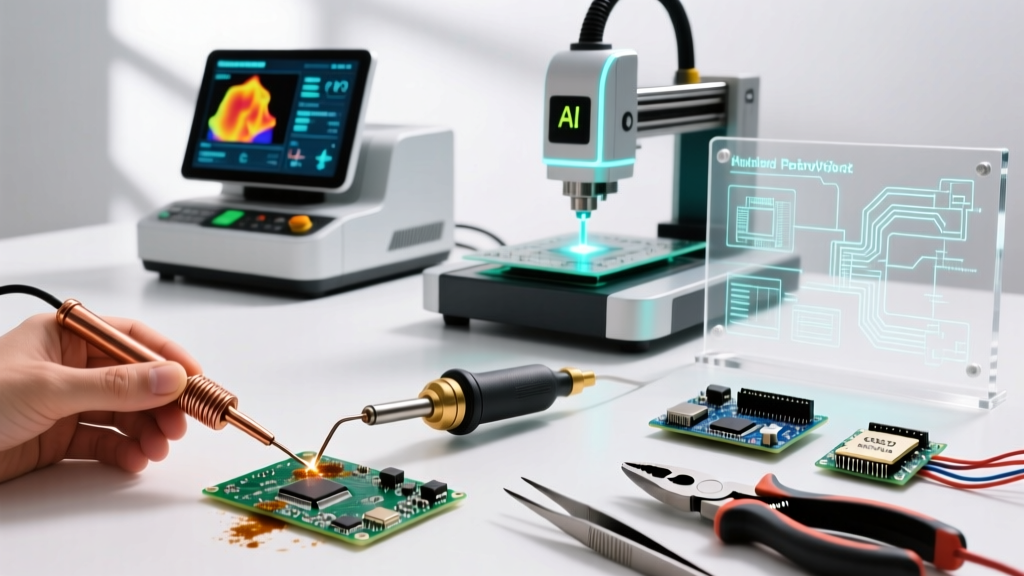
Today, in high-reliability aerospace and medical device manufacturing, even hot air is considered too imprecise. The cutting edge of soldering removal in 2026 relies on targeted laser ablation and AI-driven thermal profiling.
Systems like the Finetech FINEPLACER lambda utilize diode lasers to target individual solder joints with micrometer precision.
- Zero Thermal Spread: The laser wavelength is tuned to be absorbed by the solder alloy but reflected by the FR4 substrate and component body.
- AI Closed-Loop Monitoring: Integrated infrared micro-cameras read the emissivity of the joint in real-time. The AI cuts the laser power the exact millisecond the solder reaches its liquidus state, preventing the formation of brittle Cu6Sn5 intermetallic layers that occur when copper pads are over-exposed to molten lead-free solder.
2026 Soldering Removal Buyer's Matrix
| Era / Method | Primary Tool Type | Typical Temp Range | Avg Cost (2026) | Best Application |
|---|---|---|---|---|
| Capillary / Mechanical | Copper Wick & Manual Pump | 300°C - 380°C | $15 - $40 | Through-hole, basic wire tinning |
| Pneumatic Vacuum | Integrated Desoldering Station | 280°C - 400°C | $200 - $350 | Multi-layer PTH, heavy ground planes |
| Convection SMT | Hot Air Rework Station | 250°C - 350°C (Air) | $100 - $250 | SOIC, QFP, Passives, basic BGA |
| Thermal Profiling | IR Bottom Preheater + Hot Air | 120°C (Base) + 240°C (Top) | $800 - $1,500 | Complex BGAs, thick server boards |
| Laser / AI-Assisted | Targeted Diode Laser Rework | Variable (AI Controlled) | $30,000+ | Aerospace, micro-BGA, flex circuits |
Actionable Buyer's Guide by Budget
Choosing the right soldering removal tool in 2026 depends entirely on your board complexity and the alloys you are fighting. Here is a definitive buying framework:
Tier 1: The DIY & Hobbyist Bench (Under $75)
Skip the cheap, generic plastic solder suckers that melt after three uses. Buy the Engineer SS-02 ($28) for its high-heat silicone nozzle and powerful vacuum. Pair it with Chemtronics Soder-Wick #3 (Green) ($12) for cleaning up the residual solder in the barrel. Pro-tip: Always add fresh 63/37 leaded solder to a stubborn lead-free joint before attempting to desolder it. The lead acts as a flux and lowers the localized melting point, saving your copper pads.
Tier 2: The Prosumer & Repair Tech ($250 - $400)
If you are repairing modern consumer electronics, gaming consoles, or automotive ECUs, you need hot air and pneumatic extraction. The Quick 861DW ($120) is non-negotiable for SMD rework. For through-hole components on ground planes (like power supply capacitors), the Hakko FR-301 ($265) will pull solder out of multi-layer vias without the mechanical yank that destroys plated barrels. Always use a fume extractor; desoldering vaporizes significantly more flux than soldering.
Tier 3: The Depot & High-Reliability Lab ($1,500+)
For BGA rework and server motherboard repair, top-side heat is not enough. You must invest in a bottom preheater like the Hakko FR-830 to manage Delta-T. Furthermore, strict adherence to NASA Workmanship Standards (NASA-STD-8739.3) dictates that a PTH barrel should never be subjected to more than three distinct heating cycles. If you are working on aerospace or medical boards, invest in localized micro-nozzles and thermal profiling software to guarantee first-pass success.
Final Thoughts on Desoldering Evolution
The journey from brute-force mechanical springs to AI-monitored laser ablation highlights a core truth of electronics manufacturing: as components shrink and alloys become more thermally demanding, the margin for error in soldering removal drops to zero. Whether you are wielding a $28 manual pump or operating a $40,000 laser rework center, the underlying physics of heat transfer, capillary action, and intermetallic bonding remain the same. Master the metallurgy, respect the thermal limits of your substrate, and invest in the right extraction technology for your specific era of repair.