
The Science of Soldering Metal to Metal
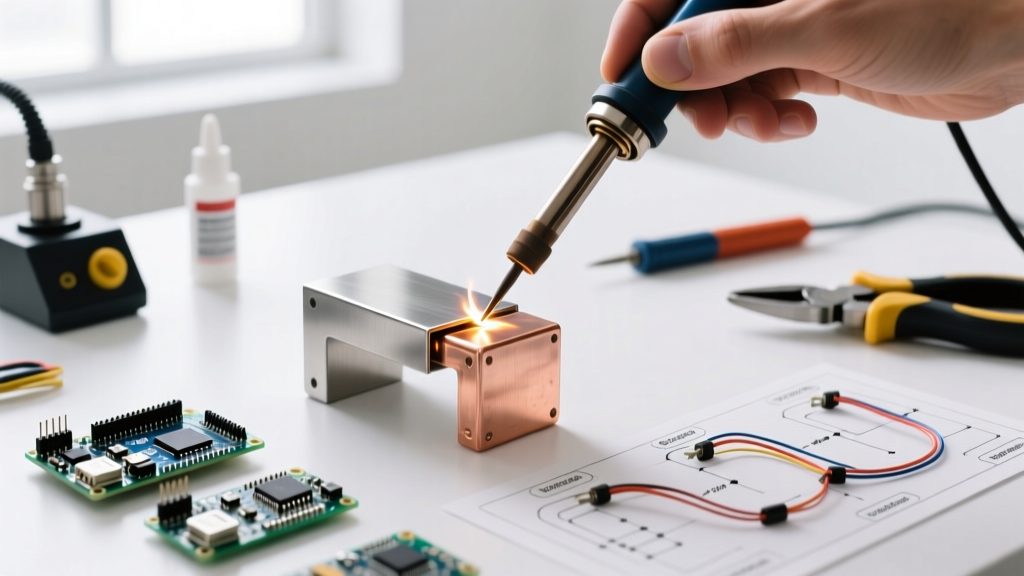
When hobbyists and technicians transition from standard printed circuit board (PCB) work to structural or chassis applications, they quickly realize that soldering metal to metal requires a completely different approach. Soldering is not merely gluing two surfaces together with molten metal; it is the creation of a metallurgical bond. For a joint to be structurally sound, the molten solder must dissolve a microscopic layer of the base metal to form an Intermetallic Compound (IMC). If this wetting process fails, the solder will simply sit on the surface, leading to catastrophic mechanical failure under stress or vibration.
In this comprehensive FAQ and troubleshooting guide, we address the most common failure modes encountered when joining dissimilar metals, thick-gauge chassis components, and difficult-to-solder alloys like steel and aluminum.
Metal Compatibility & Flux Matrix
The most frequent point of failure when soldering metal to metal is a mismatch between the base metal's oxide layer and the chemical activity of the chosen flux. Standard rosin fluxes are designed for easily reducible oxides like copper. They are entirely ineffective on the stubborn oxides of ferrous metals.
| Base Metal | Oxide Difficulty | Recommended Flux Type | Recommended Solder Alloy |
|---|---|---|---|
| Copper / Brass | Low | Rosin (RMA) or No-Clean | Sn63/Pb37 or SAC305 |
| Mild Steel | High | Organic Acid (OA) / Zinc Chloride | Sn60/Pb40 or Silver-Bearing |
| Stainless Steel | Extreme | Highly Activated Acid (e.g., Superior No. 80) | Sn62/Pb36/Ag2 (Silver-bearing) |
| Aluminum | Extreme (Instant reform) | Specialized Zinc-Based or Ultrasonic | Indalloy 157 or Zn-Al alloys |
| Galvanized Steel | Moderate | Mild Acid (Note: Toxic zinc fumes) | Standard Eutectic |
Troubleshooting Common Soldering Failures
1. Solder Beading and Non-Wetting
The Symptom: The solder melts but forms a tight, spherical bead that rolls off the metal surface instead of flowing flat (a wetting angle greater than 90 degrees).
The Root Cause: Unreduced oxidation or surface contamination (oils, silicones). In steel and stainless steel, the chromium and iron oxides form a barrier that standard rosin flux cannot penetrate.
The Fix:
- Mechanical Prep: Use a fiberglass scratch pen or 400-grit sandpaper to physically remove the oxide layer immediately before applying flux.
- Chemical Escalation: Switch to an active Organic Acid (OA) flux. Products like Superior No. 30 Acid Flux (approx. $14 per quart in 2026) contain zinc chloride and ammonium chloride, which aggressively strip ferrous oxides at soldering temperatures.
- Pre-Tinning: Apply flux and a thin layer of solder to both metal surfaces individually before attempting to join them. This is known as 'tinning', and it guarantees an IMC layer is established on both parts prior to the final sweat-solder joint.
2. Cold Joints and Crystalline Fractures
The Symptom: The solder joint looks dull, grainy, or cracked. When subjected to physical torque, the joint snaps cleanly at the boundary line.
The Root Cause: Thermal mass imbalance. When soldering a thick metal bracket to a thin wire, the bracket acts as a massive heatsink, pulling heat away from the joint faster than the soldering iron can replenish it. The solder cools through its plastic phase too slowly or is disturbed while crystallizing.
The Fix:
- Tip Geometry: Never use a conical tip for heavy metal-to-metal work. The point contact provides terrible thermal transfer. Switch to a heavy chisel tip (e.g., the Weller RT4 or Hakko T18-D24) to maximize surface area contact.
- Thermal Pre-Heating: Use a localized hot air gun or a silicone heating mat to bring the heavy metal mass up to 100°C before applying the iron. This reduces the thermal delta the iron must overcome.
- Wattage Requirements: A standard 40W iron will stall on thick steel. Upgrade to a high-thermal-recovery station like the Hakko FX-951 (70W) or Weller WEP90 (90W), which utilize active sensor feedback to push current into the heating element the millisecond the tip temperature drops.
3. Flux Charring and Acid Burn-Off
The Symptom: The flux instantly turns black, smokes heavily, and leaves a hard, crusty residue that prevents the solder from flowing.
The Root Cause: The soldering iron temperature is set too high, exceeding the activation and boiling points of the flux vehicle before it can chemically reduce the metal oxides.
The Fix: Dial back your station temperature. For standard Sn63/Pb37 eutectic solder, the tip should rarely exceed 350°C (662°F). For lead-free SAC305, do not exceed 385°C (725°F). If you need more heat transfer, increase the thermal mass of the tip, not the temperature setting.
FAQ: Advanced Metal-to-Metal Scenarios
Can I solder aluminum to copper?
Soldering aluminum to copper is notoriously difficult due to the vast difference in their galvanic potentials and the aggressive nature of aluminum oxide (Al2O3), which melts at over 2,000°C. Standard fluxes do nothing to aluminum. To achieve this joint, you must use specialized fluxes designed to penetrate the oxide layer via mechanical disruption, or utilize ultrasonic soldering equipment. According to metallurgical guidelines published by the Indium Corporation, utilizing a zinc-based solder alloy with a specialized organic flux is mandatory, and the joint must be sealed with an epoxy or heat-shrink to prevent galvanic corrosion over time.
Do I need to neutralize acid flux after soldering steel?
Absolutely. Unlike rosin fluxes, the zinc chloride and hydrochloric acid residues left behind by heavy-duty plumbing and chassis fluxes are highly hygroscopic and corrosive. If left untreated, they will rust through a steel joint within weeks.
Expert Safety Protocol: Immediately after the joint cools, scrub the area with a stiff brush and a baking soda/water solution (sodium bicarbonate) to neutralize the acid. Rinse thoroughly with isopropyl alcohol (IPA) or distilled water, and apply a dielectric grease or clear conformal coating to seal the metallurgical bond from atmospheric moisture.
2026 Essential Gear & Consumables Snapshot
For technicians frequently tackling structural metal-to-metal soldering, investing in the correct consumables is non-negotiable. Here is a snapshot of the most reliable, industry-standard materials available in the current market:
- Soldering Station: Weller WE1010NA (70W). Priced around $115, it offers the thermal recovery necessary for heavy-gauge chassis grounding and steel brackets.
- Heavy-Duty Flux: Superior No. 30 (Water-Soluble Acid). The industry standard for ferrous metals. Requires mandatory post-solder neutralization.
- Electronics/Chassis Solder: Kester 44 (Sn63/Pb37 Rosin Core). At approximately $35 to $45 per pound, its tight rosin core ensures consistent flux delivery in thick mechanical joints.
- Silver-Bearing Solder: Multicore 993 (Sn62/Pb36/Ag2). The 2% silver content prevents 'silver leaching' when soldering to silver-plated RF connectors or high-stress steel joints, providing superior fatigue resistance.
Industry Standards and Best Practices
When executing metal-to-metal soldered joints for critical applications, technicians should refer to established workmanship standards. The IPC J-STD-001 standard outlines the strict requirements for soldered electrical and electronic assemblies, including the visual criteria for proper wetting, fillet shapes, and the acceptable limits of intermetallic growth. Furthermore, when dealing with structural load-bearing joints, soldering should often be supplemented with mechanical fastening (e.g., rivets or bolts) to handle shear forces, as solder alloys possess relatively low tensile strength compared to the base metals they join.
For further reading on advanced metallurgical wetting and flux chemistry, the Superior Flux technical library provides extensive whitepapers on matching specific organic and inorganic acid formulations to exotic and ferrous alloys.