
The Thermodynamics of Silver Soldering: Fuel vs. Alloy
When fabricating jewelry, repairing heavy-gauge electronics, or assembling custom silver wire harnesses, selecting the correct heat source is just as critical as the solder alloy itself. The debate over using a butane torch for silver soldering versus traditional propane or oxy-propane setups is a common crossroads for both hobbyists and professional bench jewelers in 2026. To make an informed decision, we must first understand the metallurgical requirements of silver solder.
Unlike soft lead-free electronics solder (which melts around 430°F), silver solder—often referred to as silver brazing alloy—requires significantly higher temperatures. According to data published by the Silver Institute, sterling silver (92.5% silver, 7.5% copper) has a solidus temperature of roughly 1,475°F (802°C). Therefore, the solder must flow below this threshold to prevent melting the base metal.
Silver Solder Grade Breakdown
- Hard Grade: Melts at ~1,490°F (810°C). Used for the first joint in multi-step fabrication.
- Medium Grade: Melts at ~1,390°F (754°C). Ideal for secondary joints and general repairs.
- Easy Grade: Melts at ~1,325°F (718°C). Best for final touches, jump rings, and low-heat component attachment.
Both butane and propane torches can theoretically exceed these temperatures, but their heat delivery profiles (BTU output and flame envelope) dictate which method is superior for your specific application.
Method 1: The Butane Torch for Silver Soldering
Using a butane torch for silver soldering has surged in popularity due to the refinement of piezoelectric ignition micro-torches. Models like the Blazer Big Shot GT8000 (retailing around $65 in 2026) or the SE MT3001 Deluxe offer pinpoint precision that larger torches simply cannot match.
Performance Specifications
- Maximum Flame Temperature: ~2,400°F (1,315°C) in ambient air.
- BTU Output: Typically 1,200 to 2,500 BTUs/hr.
- Flame Profile: Extremely narrow, concentrated inner blue cone.
The primary advantage of a butane micro-torch is thermal localization. When soldering a tiny 2mm jump ring or setting a bezel near a heat-sensitive gemstone (like turquoise or opal), the narrow butane flame allows you to direct heat exclusively to the joint. This prevents the surrounding silver from acting as a heat sink and pulling thermal energy away from the solder chip.
Expert Insight: Butane (C4H10) has a slightly higher carbon-to-hydrogen ratio than propane. When adjusted to a neutral flame, butane produces a highly reducing inner cone that actively strips oxygen from the immediate joint area, minimizing localized firescale (cuprite formation) on sterling silver.
Method 2: Propane and Oxy-Propane Torches
Propane torches, such as the Bernzomatic TS8000 (approx. $50) or professional bench setups like the Smith Little Torch running on propane/oxygen mixes, represent the heavy-duty standard for silversmithing.
Performance Specifications
- Maximum Flame Temperature: ~2,530°F (1,390°C) for air-propane; up to 3,400°F for oxy-propane.
- BTU Output: 3,000 to over 20,000 BTUs/hr (depending on tank pressure and tip orifice).
- Flame Profile: Broad, bushy envelope with a softer inner cone.
Propane excels in thermal mass penetration. If you are soldering a heavy 10-gauge sterling silver cuff bracelet or sealing a thick-walled silver clay kiln-fired piece, a butane torch will fail. The low BTU output of butane means the massive silver object will dissipate the heat faster than the torch can apply it, resulting in a 'cold joint' where the solder balls up and fails to flow via capillary action. Propane's broader flame envelope heats the entire assembly evenly, bringing the massive heat sink up to the critical flow temperature simultaneously.
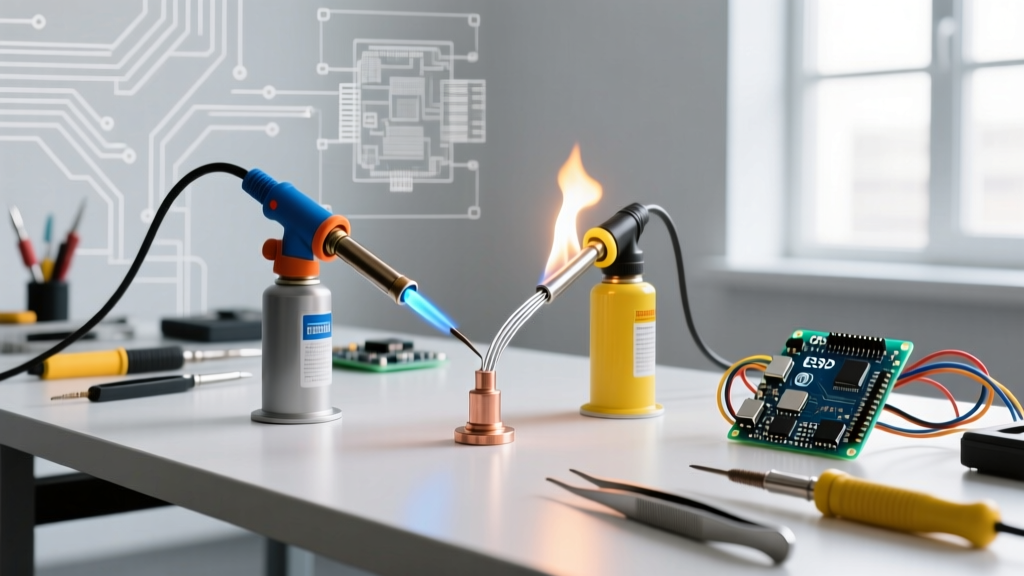
Head-to-Head Comparison Matrix
| Feature | Butane Micro-Torch | Propane / Oxy-Propane Torch |
|---|---|---|
| Max Temp (Air) | ~2,400°F (1,315°C) | ~2,530°F (1,390°C) |
| BTU Output | Low (1,200 - 2,500) | High (3,000 - 20,000+) |
| Precision | Exceptional (Pinpoint) | Moderate to Low (Broad) |
| Heat Sink Defeat | Poor (Struggles > 4g silver) | Excellent (Handles heavy stock) |
| Firescale Risk | Low (Localized heat) | High (Broad oxidation zone) |
| Fuel Cost (2026) | ~$6 per 10oz can | ~$4 per 14.1oz cylinder |
| Best Use Case |
Real-World Failure Modes and Edge Cases
Understanding where each method fails is crucial for professional-grade results. Master jewelers and electronics technicians rely on troubleshooting frameworks to avoid ruined workpieces.
Butane Failure Mode: Thermal Shock and Fuel Starvation
The most common failure when using a butane torch for silver soldering is mid-flow fuel starvation. Butane relies on the latent heat of vaporization to turn from liquid to gas inside the torch reservoir. During prolonged soldering (over 45 seconds), the reservoir freezes, causing a sudden drop in gas pressure. The flame shrinks, the joint cools rapidly, and the half-melted solder crystallizes into a brittle, porous mess. Solution: Always use high-capacity butane torches with large reservoirs for joints requiring more than 30 seconds of continuous heat, and ensure the butane fuel is at room temperature before filling.
Propane Failure Mode: Severe Firescale (Cuprite)
Propane's broad flame envelope heats a massive surface area of the sterling silver. The copper alloy within the silver reacts with ambient oxygen to form cuprite (Cu2O), a deep purple/black scale that requires hours of pickling in warm citric acid or sodium bisulfate to remove. Solution: When using propane, you must apply a commercial anti-firescale barrier like Pripps flux or a borax-alcohol suspension to the entire piece before heating, reserving the heavy paste flux (like Handy Flux) strictly for the solder joint itself.
Step-by-Step Heat Management for Butane Soldering
If you have determined that a butane torch is the correct tool for your delicate silver assembly, follow this precise thermal ramping procedure to ensure perfect capillary flow.
- Preparation: Clean the silver joints with pumice powder and apply a water-based flux (e.g., Stay-Silv or Handy Flux) using a fine sable brush. Place your silver solder chip (pallion) directly onto the fluxed joint.
- Stage 1 - The Drying Phase (Low Heat): Hold the butane torch 2 inches away. Use the soft, yellow outer tip of the flame to gently warm the piece. The flux will bubble and turn clear/glassy. Do not rush this, or the flux will spatter and blow the solder chip off the joint.
- Stage 2 - The Pre-Heat (Medium Distance): Move the torch to 1 inch away. Heat the surrounding silver, not the solder chip directly. Silver is highly thermally conductive; the heat will travel to the joint. Watch for the flux to slump into a honey-like consistency.
- Stage 3 - The Strike (Pinpoint Focus): Bring the intense, dark blue inner cone of the butane flame within 1/4 inch of the joint. Focus the heat on the silver immediately adjacent to the solder. The moment the silver reaches the liquidus temperature, the solder will flash and wick instantly into the seam via capillary action.
- Stage 4 - Quench: Remove the heat immediately to prevent the silver from pitting or melting, and quench in water or let air-cool depending on your specific alloy work-hardening requirements.
Final Verdict: Which Method Should You Choose?
The choice between a butane torch for silver soldering and a propane setup is not about which fuel is universally 'better,' but rather which thermal profile matches your physical workpiece. For intricate jewelry fabrication, micro-electronics silver-trace repair, and delicate component assembly where thermal bleed must be strictly contained, the butane micro-torch is the undisputed champion of precision. However, for structural silversmithing, heavy-gauge wire harnesses, and large-scale thermal mass joints, propane remains an absolute necessity. Many professional 2026 workshops maintain both: a Smith oxy-propane rig for heavy fabrication, and a Blazer butane micro-torch sitting permanently on the bench for detailed finishing work.
For further reading on precious metal fabrication standards and alloy properties, refer to the technical resources provided by Rio Grande and the metallurgical guidelines from the Silver Institute.