
Clarifying the Terminology: Heat Gun vs. Hot Air Rework Station
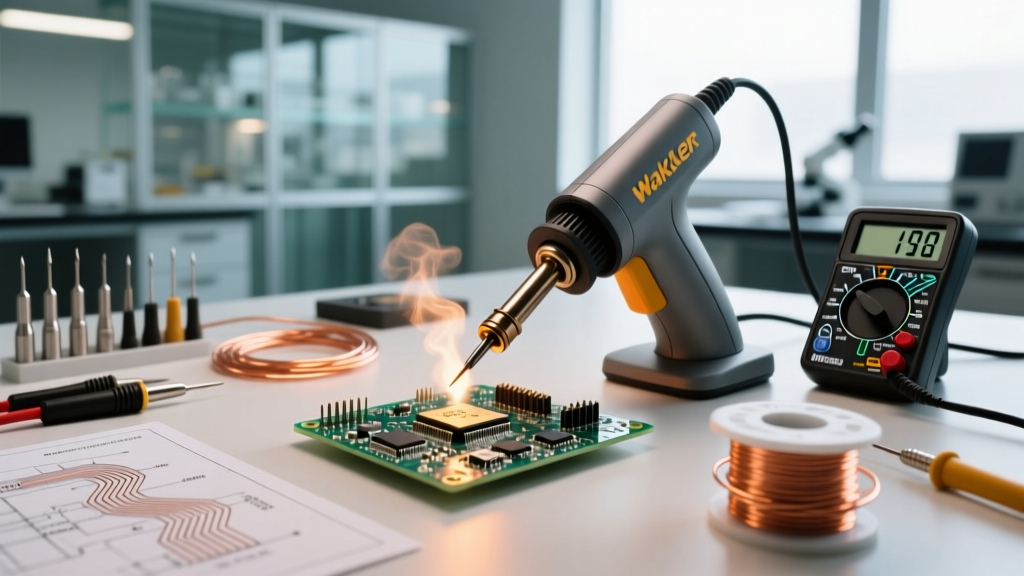
When makers, engineers, and repair technicians search for a soldering heat gun, they are almost always referring to a hot air rework station. Using a standard hardware store heat gun (like a 1500W paint stripper) for PCB work is a catastrophic mistake. Hardware heat guns produce unregulated, high-velocity airflow that will instantly blow 0402 and 0603 SMD components off the board. Furthermore, their lack of closed-loop thermal control will easily exceed the glass transition temperature (Tg) of standard FR4 fiberglass substrates, causing irreversible delamination and pad lifting.
To properly analyze the costs associated with SMD soldering and desoldering, we must evaluate precision hot air rework stations. These tools utilize specialized heating elements, PID temperature controllers, and regulated airflow mechanisms designed to follow strict thermal profiles, such as those outlined in the IPC Standards for electronic assembly rework.
The 2026 Soldering Heat Gun Market: Tiered Cost Breakdown
The market for hot air rework stations has stratified into three distinct tiers. Understanding the hardware differences between these tiers is critical for calculating your true return on investment (ROI).
| Tier | Model Example | 2026 Price Range | Heater Wattage | Airflow Mechanism | Best For |
|---|---|---|---|---|---|
| Entry-Level | Generic 858D | $45 - $65 | 700W | Diaphragm Pump (Pulsing) | Hobbyists, occasional heat shrink, large-pitch SMD. |
| Mid-Tier | Quick 861DW | $280 - $330 | 1200W | Brushless Fan (Smooth) | Independent repair shops, advanced makers, BGA rework. |
| Professional | Hakko FR-810B | $400 - $450 | 1300W | Brushless Fan w/ Digital Flow | Production environments, strict ESD/ISO compliance. |
Why the Entry-Level 858D Fails at Precision SMD Work
The generic 858D is ubiquitous on Amazon and AliExpress, but its cost-saving design introduces severe limitations. It uses a diaphragm air pump located in the base unit. This pump vibrates and pushes air in micro-pulses rather than a continuous stream. When working with components smaller than 0805, this pulsing airflow causes the solder paste to splatter and components to "dance" or tombstone. While the initial cost is under $60, the cost of ruined PCBs and wasted time makes it a poor investment for anyone doing micro-soldering.
The Mid-Tier Sweet Spot: Quick 861DW
At roughly $300 in 2026, the Quick 861DW remains the undisputed king of independent repair labs. It features a brushless fan integrated directly into the handpiece, delivering smooth, non-pulsing airflow up to 100 liters per minute. Its PID controller maintains temperature within ±2°C, allowing technicians to safely reflow large ground-plane QFP chips without pre-heating the entire board.
Hidden Costs: Beyond the Initial Purchase Price
A soldering heat gun is only the beginning of your financial commitment. To accurately forecast your budget, you must account for the consumable ecosystem required for hot air SMD soldering.
- Precision Nozzles ($15 - $35 each): Genuine Quick and Hakko nozzles are machined to exact tolerances to direct heat only to the component pads, protecting surrounding plastic connectors. Cheap $2 clone nozzles often have warped bores that leak hot air onto adjacent components, causing collateral damage.
- Solder Paste ($25 - $40 per syringe): Unlike solder wire, hot air rework requires Type 3 or Type 4 solder paste (e.g., Chip Quik SMD291AX). A 10cc syringe costs around $30 and has a strict shelf life of 6-12 months, even when refrigerated.
- Tacky Flux ($25 - $35 per syringe): High-quality tacky flux (like Amtech NC-559-V2-TF) is mandatory for BGA and QFP rework. It holds components in place while the hot air melts the solder joints. Cheap, no-clean fluxes from unverified online marketplaces often contain corrosive activators that cause dendritic growth and short circuits over time.
- Kapton Tape & Aluminum Heat Shields ($15 - $25): Essential for masking off sensitive RF shields, plastic connectors, and microphones from the 350°C+ ambient heat radiating from your work area.
Expert Insight: Never use standard liquid rosin flux (RMA) for hot air SMD soldering. The high-velocity airflow will blow the liquid across the board, creating a sticky, unmanageable mess. Always use high-viscosity tacky flux designed specifically for hot air rework profiles.
Operating Costs: Electricity and Consumables
A common myth in the DIY electronics community is that 1200W hot air stations will drastically inflate your monthly electricity bill. Let us break down the actual operating costs based on 2026 average residential and commercial electricity rates.
The PID Cycling Reality
While a station like the Quick 861DW is rated for 1200W, it does not draw that power continuously. The PID (Proportional-Integral-Derivative) controller pulses the heating element to maintain the target temperature. During a typical 2-hour SMD rework session, the heater is only actively drawing maximum power during the initial heat-up phase and when cooling heavy ground planes. The average continuous draw during active rework is closer to 350W - 450W.
2026 Operating Cost Calculation:
- Average Draw: 400W (0.4 kW)
- Session Length: 2 hours
- Total Energy: 0.8 kWh
- Average US Electricity Rate (2026): ~$0.17 per kWh
- Cost per Session: $0.136
At less than 14 cents per two-hour session, electricity is a negligible factor in your cost analysis. The true operating costs lie in your consumable throughput (flux, paste, and wick).
The 2026 Game Changer: Thermal Cameras and ROI
In 2026, the ROI calculation for soldering heat guns has been fundamentally disrupted by the commoditization of high-resolution smartphone thermal cameras (such as the Infiray P2 Pro or FLIR One Edge Pro), which now retail between $200 and $250.
Previously, achieving perfect thermal profiles on complex multi-layer boards required $800+ closed-loop stations (like JBC or Metcal) with specialized thermocouple feedback, or expensive pre-heaters. Today, an independent technician can pair a $300 Quick 861DW with a $250 thermal camera. By visually monitoring the thermal ramp rate on their phone screen, the technician can manually adjust the airflow and distance to ensure they do not exceed the IPC-recommended ramp rate of 2°C to 4°C per second. This synergy allows mid-tier setups to achieve professional-grade BGA and QFP rework results at a fraction of the historical capital expenditure.
For a deeper dive into safe thermal ramping and component clearance, refer to the excellent guidelines provided by SparkFun's Hot Air Rework Tutorial, which emphasizes the critical nature of airflow distance and angle.
Maintenance, Failure Modes, and Longevity
When calculating the 5-year Total Cost of Ownership (TCO), you must factor in the failure modes of hot air rework stations.
Heating Element Burnout
The ceramic heating cores in hot air guns are subject to extreme thermal expansion and contraction. In entry-level 858D models, the thin gauge wiring connecting the element to the PCB often fatigues and snaps within 18 to 24 months of regular use. Replacement elements cost $12, but the downtime and labor to solder the fragile wires inside the handpiece are frustrating. Mid-tier and Pro stations use heavy-duty, replaceable cartridge-style heating elements that slide in and out with a single set-screw, costing $40-$60 but lasting 5+ years.
Handpiece Hose Degradation
The silicone and rubber hoses connecting the base unit to the handpiece are constantly exposed to ambient heat radiating down from the nozzle. Over 3 to 4 years, cheap hoses become brittle, crack, and leak air pressure. Professional stations utilize high-grade, braided silicone tubing that remains flexible for a decade, further justifying the higher initial capital outlay for daily users.
Final Verdict: Which Tier Should You Buy?
Your investment in a soldering heat gun should be dictated by your component density and repair volume.
- Buy the Entry-Level ($50) if: You only need to apply heat shrink tubing, desolder large through-hole capacitors, or occasionally swap an SOIC-8 chip. Do not attempt 0402 passives or BGAs with this tier.
- Buy the Mid-Tier ($300) if: You are a right-to-repair advocate, a phone/console repair technician, or an advanced hobbyist building dense SMD prototypes. The smooth airflow and PID stability will pay for themselves the first time you successfully salvage a $50 HDMI port without lifting the pads.
- Buy the Professional ($450+) if: You operate a commercial repair depot with ISO 9001 compliance requirements, need strict ESD-safe grounding on all handpiece components, or require programmable, password-locked thermal profiles to prevent operator error on the production floor.
Ultimately, treating a hot air rework station as a precision metrology tool rather than a simple "heat blower" will shift your perspective from upfront cost to long-term value, ensuring your PCBs survive the rework process intact.