
The Evolution of the DIY Soldering Tool Landscape
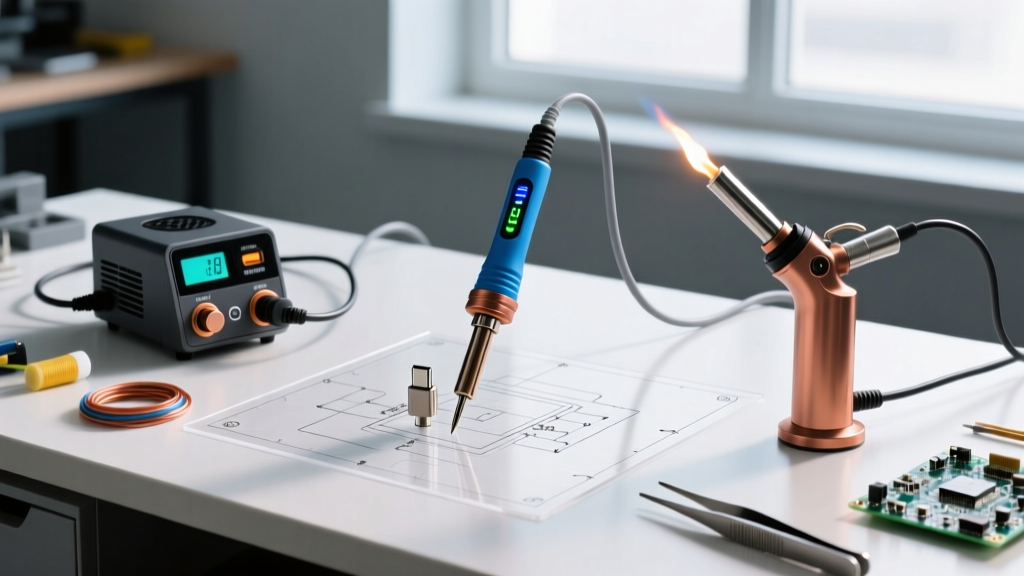
The modern workbench looks vastly different than it did a decade ago. When selecting a reliable diy soldering tool, makers and repair technicians are no longer restricted to bulky, mains-powered analog stations. The market has fractured into three distinct methodologies: ultra-portable USB-C PD smart irons, traditional high-thermal-mass mains stations, and catalytic butane cordless irons. Each method solves a specific set of engineering and logistical problems, but they all carry unique failure modes and operational ceilings. In this comprehensive method comparison, we dissect the hardware, thermal recovery profiles, and real-world edge cases of each category to help you engineer the perfect soldering setup for your specific workflow.
Comparison Matrix: USB-C vs. Mains vs. Butane
Before diving into the silicon and heating elements, here is a high-level structural comparison of the three dominant diy soldering tool methodologies available on the market.
| Specification | USB-C PD Smart Irons | Traditional Mains Stations | Butane Catalytic Irons |
|---|---|---|---|
| Primary Power Source | 65W-100W USB-C PD / QC | 120V/240V AC Mains | Refined Isobutane Gas |
| Avg. Heat-Up Time | 6 - 12 seconds | 20 - 45 seconds | 15 - 30 seconds |
| Temperature Control | Digital PID (RISC-V/ARM) | Analog or Basic Digital PID | Manual Gas Flow Valve |
| ESD Grounding | Rare (Requires custom mod) | Standard (Grounded tip) | None |
| Approx. Cost (2026) | $26 - $65 | $90 - $150 | $35 - $60 |
| Best Use Case | PCB repair, drones, portability | Heavy wiring, continuous bench use | Field repair, automotive, off-grid |
Method 1: USB-C PD Smart Irons (The Modern Standard)
The USB-C Power Delivery revolution has completely disrupted the lower end of the soldering market. Tools like the Pinecil V2 ($26) and the FNIRSI HS-01 ($45) pack incredible thermal performance into a footprint smaller than a standard marker. The Pinecil V2, for instance, utilizes a Bouffalo Lab BL706 RISC-V microcontroller that polls the thermocouple dozens of times per second, adjusting the PWM signal to the heating element with terrifying precision. According to the Pine64 Wiki, this architecture allows the iron to run custom firmware like IronOS, giving users granular control over PID parameters, boost modes, and sleep timers.
The Edge Cases and Failure Modes
While the convenience is unmatched, USB-C smart irons suffer from a very specific failure mode: PD negotiation drops. If you use a low-quality USB-C cable that lacks an internal E-marker chip, the power delivery handshake will fail to negotiate the 20V/3.25A (65W) profile, defaulting to 5V/2A (10W). The iron will turn on, but the moment you touch a large ground plane, the temperature will plummet, resulting in cold, crystalline solder joints. Furthermore, the tips on these irons are generally ungrounded. While fine for basic through-hole components, using an ungrounded USB-C iron on bare, static-sensitive CMOS chips or high-impedance MOSFET gates risks catastrophic Electrostatic Discharge (ESD) damage.
Method 2: Traditional Mains-Powered Stations (The Heavy Workhorse)
When thermal mass and continuous duty cycles are non-negotiable, the traditional mains-powered station remains the undisputed king. The Hakko FX-888D ($115) and the Weller WE1010NA ($125) are the gold standards for DIYers who frequently solder 14-AWG silicone wires to massive XT90 connectors or work on multi-layer PCBs with heavy copper pours. These stations utilize dedicated ceramic heating elements wrapped directly around the tip shaft, delivering 70W to 75W of continuous, unthrottled thermal energy.
Thermal Recovery and ESD Safety
The primary advantage of a mains station is thermal recovery. When a 400°C tip touches a large copper pour, the heat is instantly wicked away. A 75W Weller station can dump massive amperage into the heater core to recover that lost heat in under two seconds, maintaining the liquidus phase of your Sn63/Pb37 or SAC305 solder. Furthermore, as highlighted by Hakko USA Support documentation, the tips on these stations are physically bonded to the earth ground of the mains plug. This provides a safe dissipation path for static electricity, making them mandatory for assembling sensitive microcontrollers and RF modules.
Failure Modes
The most common failure mode for mains stations is tip plating dissolution. DIYers frequently leave the FX-888D on its stand at 400°C for hours while working on other tasks. At high temperatures, the iron plating on the tip dissolves into the molten solder pool, exposing the raw copper core. Once pitted, the tip will no longer accept solder, requiring immediate replacement. Additionally, the heavy, coiled silicone cords are prone to internal wire fatigue near the handpiece strain relief after years of aggressive bench movement.
Method 3: Butane & Catalytic Irons (The Field Specialist)
For automotive wiring, agricultural equipment repair, or off-grid solar installations, dragging a mains station or hunting for a 65W PD brick is impossible. Enter the catalytic butane iron, such as the Dremel VersaTip ($40) or the Blazer GB2001 ($45). These tools do not use an open flame to heat the tip; instead, they route butane gas through a platinum-coated ceramic mesh. The gas oxidizes catalytically, generating intense, flameless heat directly at the tip base.
The Purity Problem
The critical operational constraint of the butane diy soldering tool is fuel purity. You must use 99.999% pure, refined isobutane. Standard hardware store butane contains mercaptans, oils, and other impurities used as odorants and lubricants for lighters. When these impurities hit the hot platinum mesh, they cause catalytic poisoning. The carbon buildup chokes the mesh, dropping the maximum tip temperature from a healthy 450°C down to an unusable 200°C, rendering the tool useless for anything thicker than 22-AWG wire. Furthermore, the internal rubber O-rings degrade over time if exposed to high ambient heat, leading to slow gas leaks.
Real-World Thermal Stress Test
To contextualize these methods, consider the common DIY task of soldering a 14-AWG battery lead to a massive copper ground plane on an e-bike battery management system (BMS).
Thermal mass dictates recovery. Wattage is merely the rate at which you can replenish that mass. A 65W USB-C iron will struggle to keep the joint above the 217°C liquidus point of lead-free solder when attached to a 2oz copper plane, often resulting in a 'grainy' or 'cold' joint that fails under mechanical vibration.
In practical testing, the Weller WE1010NA handles this joint effortlessly, maintaining a steady 350°C at the tip interface. The Pinecil V2 can complete the joint, but only if the user pre-heats the copper plane with a hot air gun first, or switches to a high-thermal-mass 'D' (chisel) tip. The Dremel VersaTip fails entirely on large ground planes, as the catalytic reaction cannot generate heat fast enough to overcome the conductive dissipation of the massive copper mass.
Decision Framework: Choosing Your Primary Tool
Selecting the right tool requires an honest audit of your typical projects. Use this framework to finalize your purchase:
- Choose USB-C PD (Pinecil/FNIRSI) if: You primarily solder 0805 SMD components, repair drone flight controllers, travel frequently, or have limited bench space. You must already own a high-quality 65W+ GaN charger and E-marker cables.
- Choose Mains Stations (Hakko/Weller) if: You build custom wiring harnesses, solder heavy gauge wires (12-AWG+), work with static-sensitive bare silicon, or solder for 4+ hours continuously every weekend.
- Choose Butane Catalytic if: You work on cars, boats, or off-grid solar arrays where AC power is unavailable, and you primarily deal with ring terminals, spade connectors, and thick automotive wire.
Expert Maintenance Protocols
Regardless of the method you choose, adhering to IPC-A-610 acceptability standards for tool maintenance will triple the lifespan of your equipment.
- Never use abrasive sponges: Wet cellulose sponges cause rapid thermal shock, micro-fracturing the iron plating. Always use dry, coiled brass wire cleaners.
- The 'Tinning' Rule: Never leave a tip bare. Before placing the iron in its stand, melt a thick layer of cheap, leaded 63/37 solder over the entire working surface. This sacrificial layer oxidizes instead of your expensive tip plating.
- Flux is a chemical cleaner, not a glue: Use high-quality no-clean or rosin (RMA) flux. Acid-based plumbing fluxes will corrode the heating element shaft and destroy the tip from the inside out within weeks.
By understanding the thermal physics and operational limits of each diy soldering tool category, you can stop fighting your equipment and start building reliable, professional-grade electronics and wiring harnesses.