
The Critical Role of Fume Extraction in Electronics Assembly
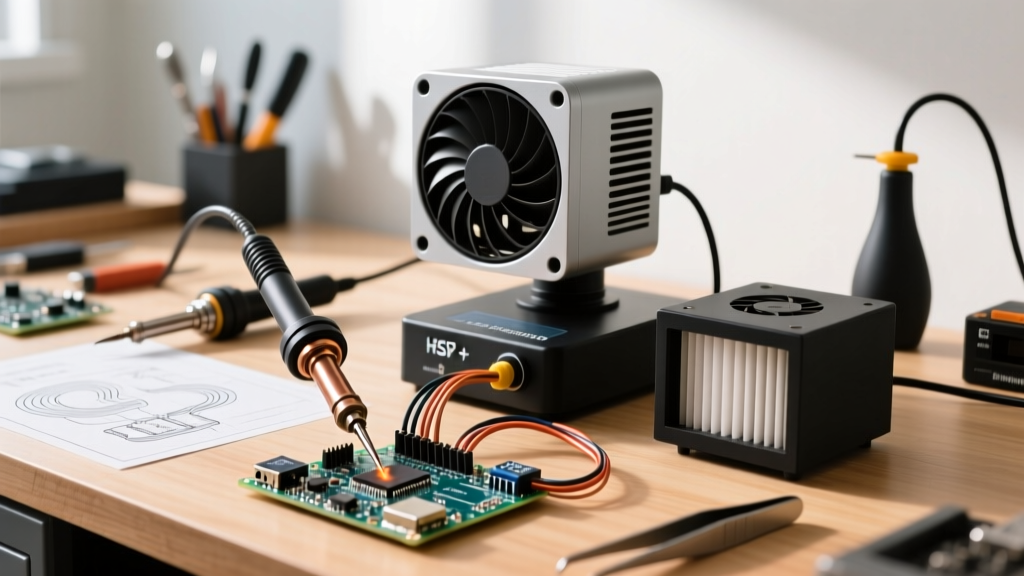
Working with leaded or lead-free solder pastes and flux-cored wires exposes technicians to colophony (rosin) fumes and volatile organic compounds (VOCs). According to the UK Health and Safety Executive (HSE), prolonged exposure to rosin-based flux fumes is a leading cause of occupational asthma in electronics manufacturing. A high-quality soldering exhaust fan is not merely a comfort accessory; it is a critical health and safety requirement. However, purchasing the right unit is only the first step. Improper placement, filter saturation, and mechanical failures can render even the most expensive fume extractor useless. This comprehensive FAQ and troubleshooting guide addresses the most common setup errors, mechanical failures, and maintenance protocols for benchtop fume extraction systems.
Core Setup & Sizing FAQs
Q: How much CFM do I actually need for a soldering exhaust fan?
The most common trap buyers fall into is chasing high Cubic Feet per Minute (CFM) ratings on budget units. A $40 desktop fan might advertise 300 CFM, but this is a free-air measurement. Once you introduce a dense activated carbon or HEPA filter, the static pressure (measured in inches of water, or inH2O) spikes dramatically. Under high static pressure, that 300 CFM fan will drop to a negligible 15-20 CFM, failing to capture fumes. For professional benchtop soldering, you need a blower designed for high static pressure. A unit delivering a sustained 60 to 100 CFM through the filter media (like the Weller WSA3500) is vastly superior to a high-CFM, low-pressure propeller fan.
Q: What is the optimal capture distance for the extraction nozzle?
The capture velocity of a soldering exhaust fan obeys the inverse square law. If you double the distance from the soldering iron tip to the hood, the capture velocity drops to 25%. The optimal capture zone is 6 to 12 inches from the point of fume generation. Furthermore, utilizing a flanged hood (a hood with a flat lip or flange around the opening) reduces the entrainment of surrounding room air by up to 25%, focusing the suction directly on the workpiece.
Filter Technology Matrix: HEPA vs. Activated Carbon
Understanding what your filters actually capture is vital for troubleshooting 'smell' issues. If your exhaust fan is running but you still smell flux, your carbon filter is likely saturated, even if the HEPA filter is pristine.
| Filter Stage | Target Contaminant | Efficiency / Rating | Failure Symptom When Saturated |
|---|---|---|---|
| Pre-Filter (Mesh/Foam) | Large particulates, flux spatter, dust | Varies (Washable or MERV 8) | Visible clogging, loud motor whining, sudden suction drop. |
| HEPA Filter | Sub-micron particulates, rosin smoke | 99.97% at 0.3 microns | Motor overheating, thermal shutdown, reduced airflow. |
| Activated Carbon | VOCs, aldehydes, rosin odors, isocyanates | Adsorption capacity (lbs of carbon) | Fume odor escapes the unit despite strong airflow. |
Troubleshooting Common Soldering Exhaust Fan Failures
When your fume extractor stops performing, the issue is rarely a dead motor. Use this diagnostic flowchart to identify and resolve the most frequent hardware and airflow anomalies.
Symptom 1: Motor Hums but Impeller Does Not Spin
- Root Cause: Degradation of the motor's start capacitor. In AC-powered centrifugal blowers, the electrolytic capacitor dries out over 3-5 years, losing its ability to provide the phase shift needed to start the motor.
- The Fix: Unplug the unit, open the motor housing, and locate the cylindrical capacitor (usually rated between 1.5µF and 3.0µF). Desolder or unclip it and replace it with an identical specification part (typically a $3 to $5 component). Warning: Always discharge the capacitor with an insulated resistor before handling.
Symptom 2: Suction Drops Drastically After 10-20 Hours of Use
- Root Cause: Pre-filter saturation from microscopic flux spatter, not carbon bed exhaustion. When soldering with highly active rosin fluxes (like RMA or RA), tiny droplets of molten flux are ejected. These coat the pre-filter mesh, creating an airtight seal that chokes the blower.
- The Fix: Remove the pre-filter. If it is a metal or nylon mesh, wash it with isopropyl alcohol (IPA) and a stiff brush. If it is a polyurethane foam pad, it must be replaced. Never run a soldering exhaust fan without a pre-filter, or the expensive HEPA media will be ruined in days.
Symptom 3: High-Pitch Whining or Rattling Noise
- Root Cause: Impeller imbalance or bearing wear. Over time, flux residue builds up unevenly on the blades of the centrifugal impeller. This creates a micro-imbalance that causes severe vibration at 2,000+ RPM, leading to premature bearing failure.
- The Fix: Disassemble the blower housing and remove the impeller. Soak it in a warm bath of distilled water and mild degreaser, then scrub the blades with a soft brass brush to remove hardened flux. Rebalance is usually restored once the debris is cleared. If the noise persists after cleaning, the sealed sleeve bearings are scored and the blower assembly must be replaced.
Symptom 4: Fumes Bypassing the Hood Entirely
- Root Cause: Cross-drafts from ambient HVAC systems. A benchtop extractor pulling 70 CFM cannot compete with an overhead AC vent pushing air downward at 300 FPM (feet per minute).
- The Fix: Reroute overhead HVAC diffusers away from the soldering station. Alternatively, upgrade to an articulated extraction arm with a slotted hood, which provides higher directional capture velocity and can be positioned between the draft and the workpiece.
Maintenance & Filter Replacement Schedules
Adhering to a strict maintenance schedule prevents motor burnout and ensures compliance with IPC International Standards for workplace safety. Filter life is dictated by the volume of flux used, not just calendar time.
| Component | Heavy Use (40 hrs/week) | Light/Hobby Use (5 hrs/week) | Estimated Replacement Cost |
|---|---|---|---|
| Pre-Filter Mesh | Clean weekly / Replace monthly | Clean every 3 months | $5 - $12 |
| HEPA Media | Replace every 6 months | Replace every 18-24 months | $40 - $85 |
| Activated Carbon Bed | Replace every 3-4 months | Replace every 12 months | $60 - $120 |
| Impeller Cleaning | Annually | Every 3 years | $0 (Labor only) |
Safety Warning: Never attempt to clean and reuse a saturated HEPA or Activated Carbon filter with compressed air. Blowing compressed air through a carbon bed will fracture the carbon granules, releasing trapped VOCs and fine particulate matter directly back into your breathing zone.
Expert Picks: Benchmarking Top Fume Extractors
When troubleshooting reveals that your current hardware is fundamentally underpowered for your workload, it is time to upgrade. Here is how the industry benchmarks stack up for different user profiles.
1. The Budget Hobbyist: Hakko FA-400
Price: ~$65 | Airflow: 304 CFM (Free Air) / ~25 CFM (Filtered) | Noise: 58 dBA
The Hakko FA-400 is ubiquitous in maker spaces. It uses a simple propeller fan and a thin carbon-foam filter. While it captures visible smoke well at close range (under 6 inches), it lacks the static pressure to pull fumes through dense media. It is an acceptable entry-level soldering exhaust fan for occasional through-hole work, but it will struggle with heavy SMD rework or continuous production environments.
2. The Professional Standard: Weller WSA3500
Price: ~$380 | Airflow: 70 CFM (Sustained under load) | Noise: 55 dBA
The WSA3500 utilizes a true centrifugal blower, meaning its airflow remains stable even as the HEPA and carbon filters load up with debris. It features a multi-stage filtration system that easily handles the heavy outgassing of no-clean and water-soluble fluxes. The articulating arm holds its position rigidly, preventing the 'droop' common in cheaper flexible hoses.
3. High-Volume Production: Metcal MX-AH500
Price: ~$650 | Airflow: 100 CFM per arm (Dual arm capable) | Noise: 52 dBA
For labs running multiple rework stations or requiring dual extraction points, the Metcal MX-AH500 offers unparalleled static pressure and a massive carbon bed capacity. Its brushless DC motor ensures a lifespan exceeding 50,000 hours, effectively eliminating the start-capacitor failures that plague cheaper AC units.
Final Thoughts on Fume Management
A soldering exhaust fan is a dynamic system that requires active management. By understanding the relationship between static pressure and CFM, adhering to strict pre-filter maintenance, and recognizing the early acoustic and olfactory signs of filter saturation, you can maintain a pristine, safe breathing zone. Always prioritize high-static-pressure blowers over high-CFM propeller fans, and remember that local exhaust ventilation (LEV) must be paired with good general room ventilation to meet modern occupational health standards.