
The Thermal Paradox of Battery Terminal Soldering
In the rapidly evolving landscape of 2026 electric vehicle (EV) manufacturing, medical device assembly, and aerospace energy storage, soldering battery terminals presents a unique engineering paradox. To create a reliable, low-resistance electrical joint, you must introduce enough heat to melt solder alloys (typically between 183°C and 220°C). However, the internal chemistry of lithium-ion and lithium-polymer cells is catastrophically sensitive to heat. The polyethylene (PE) and polypropylene (PP) separators inside modern high-density cells begin to shrink and degrade at temperatures as low as 130°C to 165°C. If the heat from the terminal soaks into the cell's jellyroll, it can trigger internal short circuits, venting, or thermal runaway.
CRITICAL SAFETY DIRECTIVE: Never use a low-wattage soldering iron to compensate for heat sensitivity. A 40W iron will drop in temperature upon contacting the massive copper terminal, forcing the operator to hold the iron in place for 10+ seconds. This prolonged dwell time guarantees lethal heat soak into the cell. High-wattage, active-tip technology is mandatory to complete the joint in under 3 seconds.Successfully soldering battery terminals at an industrial scale requires a deep understanding of thermal mass, intermetallic compound (IMC) formation, and strict adherence to reliability standards. This guide breaks down the equipment, metallurgy, and protocols required for high-volume, high-reliability battery pack assembly.
Separator Shrinkage and IPC-A-620 Compliance
When building battery packs for commercial or industrial use, compliance with IPC standards is non-negotiable. Specifically, IPC-A-620 (Requirements and Acceptance for Cable and Wire Harness Assemblies) and IPC J-STD-001 dictate the acceptability of soldered electrical connections. For battery terminals, the primary concern is avoiding 'disturbed joints' and ensuring proper wetting without damaging the component.
According to research on lithium-ion thermal abuse published by the National Renewable Energy Laboratory (NREL), the onset of thermal runaway is often preceded by separator collapse. When soldering heavy-gauge wires (e.g., 8 AWG to 2 AWG) to 18650, 21700, or prismatic cell terminals, the terminal itself acts as a massive heat sink. The goal is to localize the thermal profile. By utilizing high-thermal-capacity soldering tips and aggressive fluxes, operators can achieve a metallurgical bond on the surface of the terminal while keeping the temperature at the base of the terminal (where it interfaces with the cell casing and internal separator) well below the 130°C threshold.
Industrial Equipment Selection: Overcoming Thermal Mass
Standard hobbyist or light-commercial soldering stations (e.g., 60W to 90W ceramic heater models) are fundamentally incapable of soldering battery terminals reliably. The moment the tip touches the copper or nickel-plated terminal, the tip temperature plummets, and the heater struggles to recover. This results in cold, grainy joints with excessive IMC growth due to prolonged heating.
Industrial production lines require stations with active tip technology, where the heating element is integrated directly into the tip cartridge, paired with high-wattage power supplies (130W to 250W+). JBC Tools and Weller are the industry benchmarks for this application.
Recommended High-Power Stations for Production Lines
- JBC DDSE-2S / CD-2S with C470 Handles: The C470 series is designed for heavy thermal loads. Using a C470-K (Knife) or C470-115 (Heavy Chisel) tip, the station delivers up to 200W of instantaneous power. The tip recovers to 380°C in under a second, allowing for a 2-to-3-second dwell time on a 21700 cell terminal. Estimated Cost: $750 - $900 per station.
- Weller WXD 2 with WP120 Iron: The WP120 features a 120W heating element with rapid response times. Paired with Weller's RTW series heavy-duty tips, it provides excellent thermal transfer for soldering 10 AWG wires to prismatic cell busbars. Estimated Cost: $600 - $750.
- Hakko FX-952 with HAKKO T18 Heavy Duty Tips: A more budget-friendly industrial option. While slightly slower to recover than JBC's C470, the 70W output with high-mass T18-D52 chisel tips is sufficient for lighter battery assembly tasks, such as soldering sense wires to BMS pads. Estimated Cost: $350 - $450.
Interconnect Methods: Soldering vs. Welding
While soldering battery terminals is highly effective for prototyping, low-to-medium volume production, and specialized high-reliability sectors (like aerospace and medical), high-volume EV manufacturing often leans toward welding. Below is a comparison matrix to help engineering teams decide on the right interconnect method for their specific application.
| Method | CapEx (Equipment Cost) | Thermal Impact on Cell | Best Industry Application |
|---|---|---|---|
| Manual Soldering | Low ($500 - $1,500) | High (Risk of heat soak if poorly executed) | Prototyping, Medical, Aerospace, Repair |
| Laser Welding | Very High ($25,000 - $100,000+) | Extremely Low (Highly localized) | High-Volume EV, Grid-Scale Storage |
| Ultrasonic Welding | High ($15,000 - $40,000) | Low (Friction-based, minimal heat) | Consumer Electronics, Pouch Cells |
| Resistance Spot Welding | Medium ($2,000 - $10,000) | Moderate (Brief localized spike) | 18650/21700 Cylindrical Pack Assembly |
Step-by-Step Protocol for High-Reliability Joints
To mitigate the risks of thermal damage and ensure IPC-compliant joints, production teams must enforce a strict standard operating procedure (SOP) for soldering battery terminals.
- Mechanical Preparation: Battery terminals are often nickel-plated to prevent corrosion. Nickel oxidizes rapidly and is difficult to wet. Lightly abrade the terminal surface with a fiberglass scratch pen or 400-grit sandpaper to expose fresh metal. Immediately clean with 99% isopropyl alcohol (IPA) to remove particulates and oils.
- Flux Application: Apply a high-activity, no-clean flux. For industrial reliability, use a flux rated ROL0 or ROL1 per J-STD-004. Liquid or tacky fluxes (like Kester 951 or Amtech NC-559) are preferred over flux-core wire alone, as they pre-coat the terminal and lower the surface tension before the iron makes contact.
- Pre-Tinning the Wire: Never attempt to solder a bare wire directly to the battery terminal. Strip the wire (e.g., 8 AWG silicone jacket), twist the strands, and pre-tin the wire with a generous amount of solder so it forms a solid, uniform cylinder.
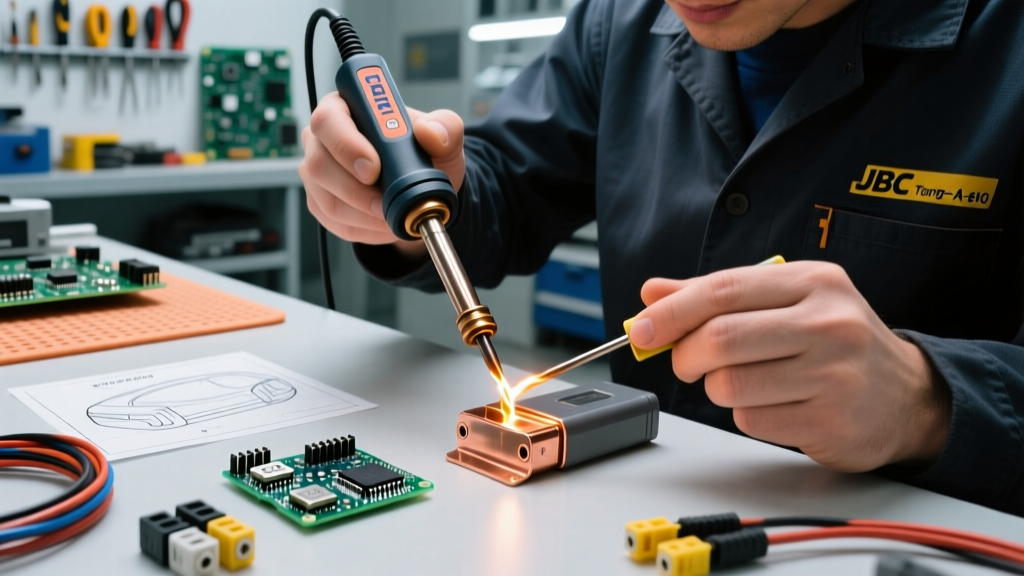
- The 3-Second Transfer Rule: Set the JBC or Weller station to 380°C - 400°C. Apply fresh solder to the tip to create a liquid thermal bridge. Place the pre-tinned wire against the fluxed terminal, and apply the iron tip to the wire/terminal junction. The heat should transfer through the pre-tinned wire and melt the joint in 1.5 to 3 seconds. Remove the iron immediately.
- Thermal Dissipation: Do not blow on the joint or use compressed air to cool it, as this can cause micro-fractures in the crystallizing solder (a disturbed joint). Allow it to cool naturally. If thermal soak is a major concern, operators can use specialized aluminum heat-sink clips placed at the base of the terminal to draw heat away from the cell casing.
Metallurgy and Consumables: Choosing the Right Alloy
The choice of solder alloy dictates both the mechanical strength and the thermal profile of the joint. In 2026, the industry is split between RoHS-compliant lead-free alloys and high-reliability leaded alloys (which often fall under specific RoHS exemptions for aerospace, medical, and critical infrastructure).
- SAC305 (Sn96.5/Ag3.0/Cu0.5): The standard lead-free alloy. It melts at 217°C - 220°C. Because of the higher melting point, it requires higher tip temperatures (400°C+), increasing the risk of thermal damage to the battery cell. However, it provides excellent shear strength and is mandatory for commercial consumer and automotive electronics.
- Sn63/Pb37 (Eutectic): Melts at a precise 183°C with no plastic phase. This lower melting point allows for faster wetting and lower tip temperatures (350°C), significantly reducing the risk of separator shrinkage. It is heavily favored in high-reliability sectors where thermal shock resistance and vibration survivability are paramount.
- Indium-Based Alloys (e.g., Sn90/In10): Used in extreme environments or when soldering to specialized terminal metallizations. Indium offers superior fatigue resistance and remains ductile at cryogenic temperatures, making it ideal for aerospace battery packs operating in low-earth orbit.
Ultimately, soldering battery terminals is an exercise in thermal management. By investing in high-capacity active-tip equipment, utilizing aggressive fluxes, and strictly limiting dwell time to under three seconds, manufacturers can produce battery interconnects that rival the mechanical strength of welded joints while maintaining the flexibility and repairability that soldering provides.