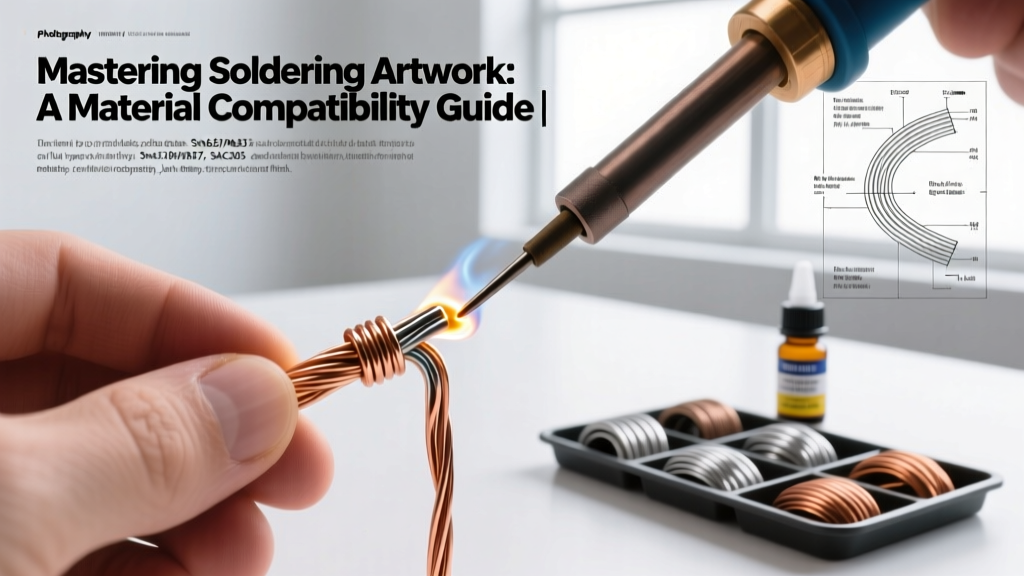

The Metallurgical Reality of Soldering Artwork
Creating metal sculptures, wire-wrapped jewelry, and stained glass assemblies requires more than just a steady hand; it demands a deep understanding of metallurgy. When artists approach soldering artwork, the most common point of failure is not poor technique, but material incompatibility. Differential thermal expansion, improper flux chemistry, and alloy melting point mismatches can result in brittle joints, ruined chemical patinas, and catastrophic base-metal burn-through.
Unlike electronics manufacturing, where substrates are uniform and flat, artistic soldering involves uneven thermal masses, complex 3D geometries, and mixed-metal joins. This guide provides a comprehensive material compatibility matrix and actionable chemical insights to ensure your artistic solder joints are both structurally sound and aesthetically flawless.
Base Metal & Solder Alloy Compatibility Matrix
Selecting the correct filler metal is dictated by the base metal’s melting point and its coefficient of thermal expansion. Below is a quick-reference matrix for the most common metals used in sculptural and jewelry applications.
| Base Metal | Melting Point (°C) | Recommended Solder Alloy | Compatible Flux Type | Primary Artistic Use |
|---|---|---|---|---|
| Sterling Silver (925) | 893°C | Easy/Medium Silver Solder (e.g., Harris Stay-Silv) | Borax Cone / Fluoride Paste | Fine jewelry, precious metal sculpture |
| Copper (Wire/Sheet) | 1085°C | 95% Tin / 5% Antimony or Silver-Bearing Tin | Rosin or Mild Organic Acid | Stained glass foil, wire wrapping |
| Brass (Yellow) | 900-940°C | Tin-Silver (e.g., Stay-Brite 8) | Water-Soluble Paste | Steampunk art, brass instruments |
| Nickel Silver | 900°C+ | High-Silver Brazing Alloy (30-45% Ag) | Fluoride-based Paste | Sculptural armatures, springs |
Selecting the Right Solder Alloy for Artistic Applications
The transition away from leaded solders in consumer goods has heavily influenced the art world. As of 2026, most professional studios strictly adhere to lead-free alloys, not just for health and safety, but because modern silver-bearing lead-free alloys offer superior tensile strength and brighter, more polishable finishes.
Silver-Bearing Tin Alloys (The Sculptor’s Choice)
For mixed-metal sculptures and heavy brass/copper joins, Harris Stay-Brite 8 remains the industry gold standard. Containing 8% silver and 92% tin, it melts at a manageable 535°F (279°C). The addition of silver drastically improves the alloy’s wetting action on brass and nickel silver, which are notoriously difficult to solder with standard tin-copper alloys. In the current 2026 market, expect to pay between $55 and $65 for a 1/2 lb spool, a premium justified by its exceptional capillary flow and bright, chrome-like finish that requires minimal polishing.
Eutectic vs. Non-Eutectic: Why the "Pasty Range" Matters
According to metallurgical guidelines from Lucas Milhaupt, understanding the solidus and liquidus temperatures of your solder is critical for art.
- Eutectic Alloys (e.g., Sn63/Pb37 or SAC305): Melt and freeze instantly at a single temperature. Ideal for stained glass copper-foil work where you need immediate structural rigidity to prevent the glass from shifting.
- Non-Eutectic Alloys (e.g., Stay-Brite 8): Feature a "pasty range" where the solder is semi-solid. This is highly advantageous for 3D wire sculptures, allowing the artist to build up fillets, bridge large gaps, and sculpt the solder bead with a pick before it fully solidifies.
Flux Chemistry: The Hidden Destroyer of Art
Flux is designed to strip oxides from the base metal, allowing the solder to wet the surface. However, the wrong flux will permanently ruin an art piece through a phenomenon known as "flux rot."
The Danger of Chloride-Based Acid Fluxes
Many beginners mistakenly use plumbing-grade acid fluxes (zinc chloride or ammonium chloride) for copper and brass artwork. While these fluxes clean metal aggressively, the chloride salts become trapped in microscopic pores. Over time, ambient humidity activates these salts, causing severe localized corrosion that manifests as a white, powdery crust. This corrosion will completely destroy chemical patinas (like liver of sulfur or cupric nitrate) and eventually eat through the joint.
Recommended Flux Pairings
- For Copper & Brass (Sculptures/Stained Glass): Use a high-quality water-soluble organic paste or a mild rosin-based flux. Rubyfluid or Stay-Clean liquid fluxes are excellent, but must be neutralized and scrubbed with a baking soda solution post-solder.
- For Precious Metals (Silver/Gold): Traditional borax cones mixed with distilled water, or commercial potassium fluoroborate pastes (like Stay-Silv White Flux). Fluoride fluxes are mandatory for dissolving the stubborn refractory oxides that form on silver alloys at high temperatures. For deeper insights into precious metal joins, refer to Ganoksin’s soldering fundamentals.
- For Electronics-Integrated Art (Wire Wrapping): Use No-Clean fluxes (e.g., Kester 245). These leave a benign, non-conductive, non-corrosive residue that will not interfere with integrated LEDs or microcontrollers embedded in the sculpture.
Thermal Mass & Heat Source Selection
Artistic pieces rarely have uniform thermal mass. Soldering a thick 10-gauge copper wire to a thin 24-gauge silver sheet requires a heat source that can overcome the thermal sink of the heavy wire without instantly melting the thin sheet.
Expert Tip: When joining disparate thermal masses, always apply the primary heat source to the heavier component. Use the solder wire itself to transfer conductive heat to the lighter component. Never touch the flame directly to thin artistic foils or wires.
Recommended Equipment for 2026:
- Precision Wire Art: Hakko FX-951 ($300-$350). With its rapid thermal recovery and interchangeable micro-tips, it is perfect for integrating electronic components into metal art without causing heat damage to sensitive ICs.
- Jewelry & Small Sculptures: Smith Little Torch ($450-$500). The standard for jewelry. Its pin-point flame allows artists to heat a specific 2mm area on a complex silver ring without melting adjacent details.
- Heavy Brass/Copper Assemblies: Blazer Big Shot GT8000 ($50-$60). A high-output butane torch capable of delivering the sustained BTUs required to bring heavy gauge copper armatures up to the 535°F flow point of silver-bearing solders.
Edge Cases: Patinas, Fire Scale, and Post-Solder Finishing
The final step in soldering artwork is often applying a chemical patina to age or color the metal. However, the heat from soldering creates "fire scale" (a layer of copper oxide that migrates to the surface of silver and copper alloys). If you apply liver of sulfur over fire scale, the patina will adhere unevenly, resulting in a splotchy, unprofessional finish that flakes off.
Step-by-Step Fire Scale Prevention (The Boric Acid Dip)
To prevent fire scale on copper and silver artwork before soldering, professional jewelers and sculptors use a boric acid and alcohol barrier. This technique is detailed extensively in resources like the Delphi Glass Learning Center for mixed-media artists.
- Prepare the Solution: Saturate denatured alcohol with boric acid powder in a heat-safe glass jar until no more powder dissolves.
- Dip the Artwork: Submerge the clean, bare metal piece into the solution using copper tweezers.
- Ignite: Remove the piece and light the alcohol on fire. As the alcohol burns off, it leaves a microscopic, glassy coating of borax over the entire surface.
- Solder: Proceed with soldering. The borax glass prevents oxygen from reaching the base metal, entirely eliminating fire scale.
- Quench: After soldering, quench the piece in water. The thermal shock pops the glassy borax coating off, leaving pristine, oxide-free metal ready for a flawless chemical patina.
Final Thoughts on Material Synergy
Mastering the material compatibility required for soldering artwork bridges the gap between amateur crafting and professional metalworking. By respecting the melting points of your base metals, choosing silver-bearing alloys for their structural and aesthetic superiority, and strictly avoiding chloride-based fluxes, your sculptures and jewelry will withstand the test of time. Always test your specific metal-flux-solder combination on scrap pieces before applying heat to your final masterpiece.