
Defining the Scope: What is Chain Soldering in Electronics?
In the realm of electronics prototyping and small-batch manufacturing, chain soldering refers to the manual process of linking discrete PCB modules or components together in a daisy-chain configuration using insulated wire. This technique is most commonly employed when building addressable LED arrays (such as WS2812B or SK6812 NeoPixel nodes), sensor networks (like 1-Wire or I2C buses), and modular wearable electronics. Instead of designing a single, unified printed circuit board that houses all components, the maker or technician solders individual wires between the VCC, GND, and DATA pads of each separate module.
While chain soldering offers immense flexibility for non-standard geometries, it introduces significant variables in labor, material waste, and joint reliability. As we move through 2026, the economics of PCB fabrication and surface-mount technology (SMT) assembly have shifted dramatically. This cost analysis breaks down the true financial and temporal expenditure of manual chain soldering versus ordering a custom unified PCB, using a 50-node addressable LED array as our baseline model.
The 2026 Cost Matrix: Chain Soldering vs. Custom Unified PCBs
To provide an apples-to-apples comparison, we are evaluating a 50-node WS2812B-5050 LED array. Below is the estimated cost breakdown for producing a single 50-node prototype or small-batch run in 2026.
| Cost Category | Manual Chain Soldering | Custom PCB (SMT Assembled) |
|---|---|---|
| Base Components (LEDs, Caps, Resistors) | $12.50 (Pre-assembled modules) | $4.20 (Raw SMD components) |
| PCB Fabrication | $0.00 (Using existing module PCBs) | $5.50 (JLCPCB/PCBWay 2-layer) |
| Interconnects (Wire / Traces) | $8.00 (22 AWG Silicone Wire) | $0.00 (Copper traces) |
| Consumables (Solder, Flux, Heat Shrink) | $4.50 | $2.00 (Solder paste for stencil) |
| Labor / Assembly Time | $35.00 (2.5 hours @ $14/hr valuation) | $18.00 (SMT setup & reflow) |
| Total Estimated Cost (1 Unit) | $60.00 | $29.70 |
Material Cost Breakdown and Sourcing
When chain soldering, you are typically purchasing pre-assembled modules (e.g., individual WS2812B breakout boards or pre-cut LED strips). In 2026, a high-quality, individually addressable LED module with integrated decoupling capacitors costs roughly $0.25 per unit. For 50 nodes, that is $12.50. Furthermore, you must purchase high-strand-count silicone wire. Standard PVC wire melts under a soldering iron and causes frustrating rework; therefore, 22 AWG silicone stranded wire (typically 30/0.12mm construction) is mandatory, costing about $8.00 for a sufficient spool.
Conversely, sourcing raw SMD components from distributors like DigiKey or Mouser for a custom PCB drops the component cost to under $0.10 per node. According to the Adafruit NeoPixel Überguide, integrating the LED, a 0.1µF decoupling capacitor, and a 470Ω data-line resistor directly onto a custom board eliminates the markup of pre-assembled breakout boards entirely.
Labor and Time Valuation: The Hidden Expense
The most severe penalty of chain soldering is labor. Let us calculate the exact number of solder joints required for a 50-node daisy chain. Each node requires three connections (VCC, GND, DATA). A 50-node chain requires 51 wire segments (including the pigtail to the microcontroller). Multiplying 51 segments by 2 ends, and then by 3 wires per end, yields 306 individual solder joints.
Even for an experienced technician averaging 15 seconds per joint (accounting for stripping, tinning, soldering, and sliding heat-shrink tubing into place), the raw soldering time is 76 minutes. Add 30 minutes for wire cutting, stripping, and continuity testing, and you are looking at nearly two hours of intensive bench work. If your time is valued at even a modest $14/hour, labor adds $25+ to the project. Custom PCB assembly, whether done via a professional SMT line or manually with a stencil and hotplate, reduces this hands-on labor to under 30 minutes.
Hidden Costs and Failure Modes in Chain Soldering
Beyond the immediate costs of wire and time, chain soldering introduces several failure modes that can inflate the total cost of ownership. Adhering to the IPC-A-610 Standard for electronic assemblies, wire-to-board joints are highly susceptible to mechanical stress.
- Wire Fatigue and Cold Joints: If standard 60/40 Sn/Pb solder is used without adequate strain relief, the rigid solder wick up into the wire strand creates a fulcrum point. Repeated bending causes copper fatigue and eventual open circuits.
- Voltage Drop Inefficiencies: Daisy-chaining 50 LEDs draws significant current (up to 3A at full white). Thin chain-soldering wires introduce resistance, necessitating parallel power injection wires every 10-15 nodes. This doubles the wire cost and adds another 60+ solder joints.
- Flux Residue and Corrosion: Manual chain soldering often leaves no-clean or rosin flux residue trapped under heat shrink tubing. In humid environments, this can lead to dendritic growth and short circuits between the tightly packed DATA and GND wires.
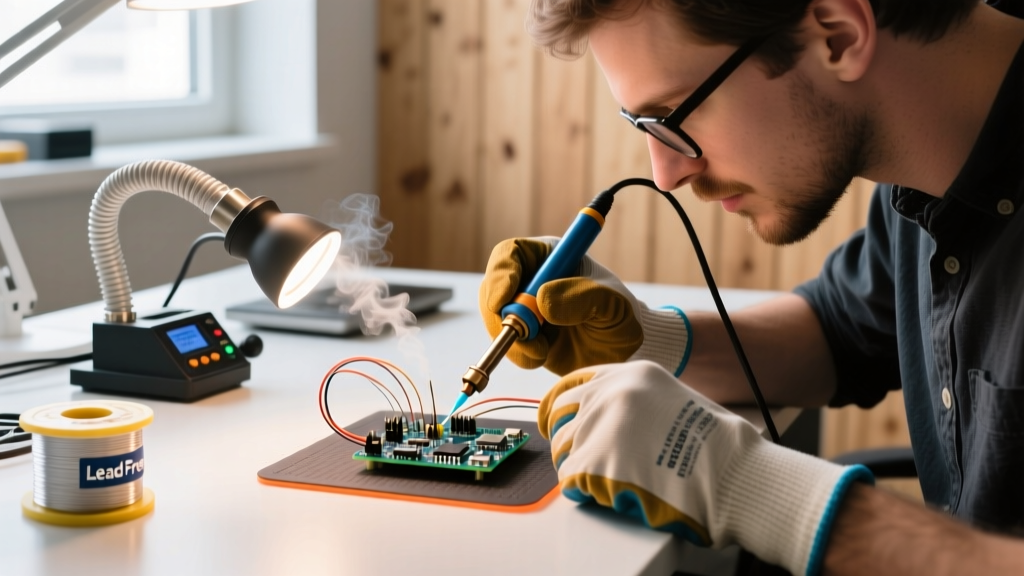
Expert Tip: If you must use chain soldering for high-current LED arrays, use eutectic Sn63/Pb37 solder (like Kester 245) rather than lead-free SAC305. Eutectic solder transitions instantly from liquid to solid without a plastic phase, drastically reducing the chance of cold joints caused by micro-movements of the wire during cooling.
When Does Chain Soldering Make Financial Sense?
Given the cost advantages of custom PCBs, is chain soldering dead? Absolutely not. There are specific scenarios where chain soldering remains the superior, and more cost-effective, choice.
1. Non-Planar Geometries and 3D Installations
Custom PCBs are inherently rigid (or limited to expensive flex-PCB substrates). If your project involves wrapping LEDs around a cylindrical column, embedding them into a silicone cosplay prop, or creating a 3D suspended matrix, chain soldering with flexible silicone wire is mandatory. The cost of designing, testing, and ordering multi-layer flex PCBs for a one-off 3D installation will easily exceed $200, making manual chain soldering the clear financial winner.
2. Rapid Prototyping and Iteration
If you are testing a concept and do not yet know the optimal spacing between your nodes, committing to a custom PCB is a financial risk. Chain soldering allows you to cut wires to variable lengths on the fly, test the optical diffusion, and adjust the physical layout before locking in a PCB design.
3. Ultra-Low Volume (Under 5 Units)
For a single prototype, the NRE (Non-Recurring Engineering) costs of CAD design, Gerber file generation, and SMT stencil ordering can outweigh the manual labor of chain soldering. If you only need two 50-node arrays, the 5 hours of total labor is cheaper than the 15 hours of PCB design and supply chain management required for a custom board.
Sourcing and Component Pricing Trends for 2026
The global supply chain for optoelectronics has stabilized significantly since the shortages of the early 2020s. In 2026, the Worldsemi WS2812B-2020 (a miniature 2.0x2.0mm package) has largely replaced the bulky 5050 package for high-density projects. Sourcing these raw ICs for custom PCBs is highly economical, with reels of 1,000 available on DigiKey and Mouser for under $40. However, if you are chain soldering, finding pre-assembled breakout boards for the 2020 package is difficult, as most commercial breakout boards still use the 5050 or 3535 footprints. This forces makers into a hybrid approach: chain soldering larger modules where space permits, or designing custom PCBs to take advantage of the smaller, cheaper 2020 SMD LEDs.
Final Verdict: Which Method Wins?
If your project is a flat, 2D array (such as an LED matrix display, an under-cabinet lighting run, or a modular sensor grid) and you plan to build more than five units, custom PCBs are the undisputed winner in 2026. The material savings, elimination of wire fatigue, and massive reduction in labor costs result in a superior, more reliable product at roughly half the cost of manual chain soldering.
However, if your project demands 3D flexibility, rapid physical iteration, or consists of a single, low-node-count prototype, chain soldering remains an essential, cost-effective skill. By investing in high-quality silicone wire, eutectic solder, and proper strain-relief techniques like hot glue or heat shrink, you can mitigate the inherent failure modes and build robust daisy-chained systems that stand the test of time.