
The Hidden Hazards of Surface Mount Rework
Transitioning from through-hole components to soldering surface mount parts introduces a new tier of precision—and a new tier of occupational hazards. While hobbyists often focus on the mechanical difficulty of handling 0402 resistors or aligning QFN-48 ICs, the invisible risks of micro-soldering are frequently ignored. In 2026, with the industry fully standardized on lead-free SAC305 (Tin-Silver-Copper) alloys, rework temperatures routinely exceed 350°C. This extreme thermal load drastically accelerates the vaporization of flux activators, creating dense plumes of hazardous aerosols.
Furthermore, the silicon dies inside modern surface mount devices (SMDs) are exponentially more sensitive to electrostatic discharge (ESD) and thermal shock than their predecessors. A single ungrounded touch can rupture the gate oxide of a $15 FPGA, and improper heat shielding can delaminate the microscopic copper pads on a high-density PCB. This guide breaks down the essential safety equipment and protocols required to protect both your respiratory system and your micro-scale components.
Fume Extraction: Neutralizing Flux Vapors
When rosin-based or synthetic fluxes are heated past 250°C, they undergo thermal decomposition, releasing aliphatic aldehydes, isocyanates, and hydrochloric acid gas. According to the National Institute for Occupational Safety and Health (NIOSH), chronic exposure to colophony rosin fumes is a leading cause of occupational asthma and severe respiratory sensitization. A standard desk fan merely blows these carcinogens across your face; true safety requires active source capture.
Buyer Matrix: Fume Extractors for the SMD Bench
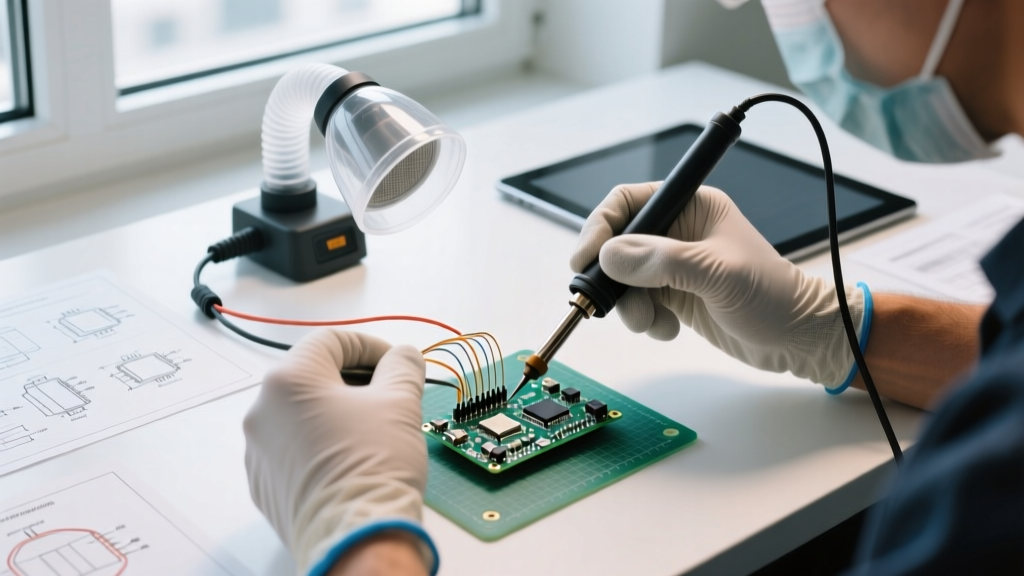
When selecting a fume extractor for SMD rework, you must look for a dual-stage filtration system: a HEPA filter for particulate matter and an activated carbon bed for volatile organic compounds (VOCs).
- Hakko FA-400 (Approx. $78): The entry-level standard. It utilizes a replaceable activated carbon filter. Drawback: It lacks a true HEPA stage and the carbon filter saturates quickly under heavy SAC305 rework loads. Best for light, occasional hobbyist use.
- Weller WSA350DN (Approx. $395): A professional-grade benchtop unit featuring an H13 HEPA filter combined with a massive gas filter cartridge. Its variable speed blower allows you to maintain high capture velocity without blowing lightweight 0201 components off the board.
- Metcal MX-A350 (Approx. $450): Features advanced airflow sensing and ultra-quiet operation. Ideal for shared lab environments where noise pollution is a concern.
Expert Tip: Position your extraction nozzle no more than 2 inches (5 cm) from the solder joint. Capture velocity drops off exponentially with distance; at 6 inches away, even a $400 Weller unit will fail to capture the initial flux plume.
ESD Protection: Safeguarding Micro-Scale Silicon
Surface mount integrated circuits, particularly MOSFETs, RF transceivers, and modern microcontrollers, feature incredibly thin gate oxides. While older through-hole components could withstand thousands of volts, modern SMD silicon can suffer catastrophic dielectric breakdown from ESD events as low as 30V. The Human Body Model (HBM) can easily generate 3,000V simply by sliding out of a fabric desk chair.
Adhering to the ESD Association standards (specifically ANSI/ESD S20.20) is not optional when handling bare SMDs outside of their anti-static shielding bags.
Essential ESD Gear for SMD Assembly
- Continuous Grounding Wrist Strap: The Desco 19232 (approx. $18) features a built-in 1-megohm safety resistor to prevent lethal shock if you accidentally touch mains voltage, while safely bleeding off static charge to earth ground.
- Static-Dissipative Work Surface: Do not solder SMDs on bare wood or plastic laminate. Invest in a 3M Static Dissipative Table Mat (approx. $45 for a 24"x48" roll). These mats have a surface resistance of 10^6 to 10^9 ohms, allowing static to dissipate slowly and safely without causing a rapid discharge event (CDM) that could fry the chip.
- Ionizers for Insulators: If you must use plastic tweezers or Kapton tape (which are insulators and cannot be grounded), an AmScope benchtop ionizer (approx. $120) floods the work area with balanced positive and negative ions to neutralize trapped surface charges.
Thermal Masking and Optical Safety
Soldering surface mount parts requires intense, localized heat. However, stray thermal radiation can easily damage adjacent plastic connectors, melt wire insulation, or cause the FR4 fiberglass substrate to undergo glass transition, leading to pad lift. Furthermore, the physical proximity required to see 0.5mm pitch QFP pins puts your eyes at severe risk from microscopic solder splatter and boiling flux.
Thermal Shielding Materials
Polyimide tape, commonly known as Kapton, is the undisputed champion of SMD thermal masking. Rated for continuous use up to 260°C and short spikes to 400°C, a 3-mil thick roll of DuPont Kapton tape (approx. $14) acts as an insulating barrier. Apply it over adjacent BGA chips and plastic FPC connectors before applying hot air rework.
Optical Distancing via Digital Microscopes
Leaning in with a magnifying visor places your corneas just inches from the rework zone. Digital microscopes allow you to maintain a safe 12-to-18-inch standoff distance while providing superior magnification and integrated ring lighting.
- Andonstar AD206 Pro (Approx. $230): Offers a 10.1-inch display, 1080p HDMI output, and a polarizing filter to eliminate glare from shiny solder joints. The physical distance keeps your face entirely out of the flux plume trajectory.
- AmScope SE400-Z (Approx. $380): A trinocular stereo zoom microscope. While optical, its high working distance (up to 8 inches) provides excellent depth perception for drag-soldering fine-pitch SMD pins without eye strain.
SMD Safety Equipment Buyer Matrix
| Equipment Category | Recommended Model | Est. Price (2026) | Primary Safety Function |
|---|---|---|---|
| Fume Extraction | Weller WSA350DN | $395 | HEPA/Carbon capture of rosin aldehydes |
| ESD Wrist Strap | Desco 19232 | $18 | Prevents HBM gate oxide rupture |
| Work Surface | 3M Statfree Mat | $45 | Dissipates static safely (10^8 ohms) |
| Thermal Masking | DuPont Kapton (3-mil) | $14 | Protects adjacent SMDs from hot air |
| Optical Shielding | Andonstar AD206 Pro | $230 | Increases standoff distance from splatter |
Step-by-Step Safe SMD Workflow
Integrating safety into your muscle memory ensures you never compromise your health or your hardware. Follow this standardized sequence for every SMD rework session:
- Environment Prep: Power on the fume extractor 2 minutes before heating the iron to establish baseline negative pressure. Verify the HEPA filter indicator light is green.
- ESD Grounding: Don the wrist strap. Use a multimeter to verify continuity (less than 10 ohms) between the strap's banana plug and your earth ground terminal.
- Thermal Masking: Apply Kapton tape to any plastic connectors, test points, or adjacent ICs within a 10mm radius of the target SMD.
- Flux Application: Apply a minimal amount of no-clean or water-soluble tacky flux. Excessive flux creates violent boiling and micro-splatter when hit with a 360°C iron.
- Rework Execution: View the joint through your digital microscope. Keep your face behind the monitor. Use a soldering iron with a micro-pencil tip (e.g., Weller RT1) for precise thermal transfer, minimizing the time the board is exposed to high heat.
- Post-Solder Cleaning: If using rosin flux, clean the board with 99% Isopropyl Alcohol (IPA) in a well-ventilated area, as dried flux residues can cause electrochemical migration (dendrite growth) over time.
Frequently Asked Questions
Is lead-free solder fumes more dangerous than leaded solder?
The danger in soldering fumes comes almost entirely from the flux, not the metal alloy. However, because lead-free SAC305 requires higher melting temperatures (217°C vs 183°C for Sn63/Pb37), your iron must run hotter. This higher heat causes the flux to vaporize more aggressively, producing a higher volume of hazardous rosin fumes in a shorter amount of time. Therefore, fume extraction is actually more critical when soldering surface mount parts with lead-free alloys.
Can I use a standard computer desk fan to blow solder smoke away?
No. A desk fan simply dilutes and redirects the plume, forcing you to breathe in the secondary dispersion of aliphatic aldehydes and isocyanates. Furthermore, uncontrolled airflow across an SMD workbench can cause rapid, uneven cooling of the solder joint, leading to cold solder joints, micro-cracking, and tombstoning of passive components. Always use a dedicated, filtered extraction unit with a localized capture nozzle.
Do I really need an ESD mat if I am only soldering basic resistors and capacitors?
Passive SMDs like ceramic capacitors and thick-film resistors are generally robust against ESD. However, if your board includes any active surface mount parts—such as diodes, transistors, voltage regulators, or microcontrollers—ESD protection is mandatory. Furthermore, an ESD mat provides a heat-resistant, non-slip surface that prevents your PCB from sliding while you are manipulating microscopic components with fine-point tweezers.
For comprehensive regulatory guidelines on managing chemical hazards in electronics assembly, refer to the UK Health and Safety Executive (HSE) documentation on occupational asthma triggers, which extensively covers the risks of colophony rosin exposure in soldering environments.