
The Evolution of Soldering Arms on the Modern Workbench
As surface-mount density increases and lead-free alloys like SAC305 demand stricter thermal profiles, the humble workbench has had to evolve. In 2026, the term soldering arms encompasses two vastly different categories of equipment: manual articulated arms (used for holding tools, PCBs, and fume extractors) and fully automated desktop robotic soldering arms (Cartesian and SCARA systems designed for high-volume production). Choosing between these methods is not merely a matter of budget; it fundamentally dictates your production throughput, joint consistency, and adherence to IPC standards like the IPC-A-610 for electronic assemblies.
This buyer's comparison breaks down the physics, economics, and failure modes of both manual and robotic soldering arms, providing a definitive decision framework for DIY enthusiasts, prototyping labs, and small-to-medium manufacturing floors.
Method 1: Manual Articulated Soldering Arms (The Prototyper's Choice)
Manual soldering arms are passive, multi-axis mechanical linkages. They are primarily used as "helping hands" to hold PCBs at optimal angles, or as flexible fume extraction ducts that position suction nozzles millimeters away from the soldering iron tip. While they do not solder autonomously, they are critical for ergonomic efficiency and respiratory safety during manual rework.
Top Models and Real-World Pricing
- Hakko FA-400 Fume Extractor Arm (~$68): The industry standard for manual fume management. It features a flexible aluminum and silicone duct that holds its shape while capturing rosin-based flux fumes. According to Hakko USA, pairing this arm with a HEPA/Carbon filter unit reduces airborne particulate matter by up to 95%.
- QuadHands Workbench Articulated Arms (~$85 - $120): Heavy-duty, all-metal arms with locking ball joints. Unlike cheap silicone-tube alternatives, these do not sag under the weight of heavy wire harnesses or large PCBs.
- Generic Silicone Tube Arms (~$15 - $25): Widely available but prone to thermal degradation. The silicone tubing softens when exposed to ambient temperatures above 60°C, causing the arm to droop mid-solder.
Ergonomics and Fume Extraction Integration
The primary advantage of manual soldering arms is the localized capture of hazardous fumes. OSHA chemical hazard guidelines emphasize that rosin-based flux fumes can cause occupational asthma if not properly ventilated. A well-positioned manual extraction arm, kept exactly 2 to 3 inches from the solder joint, captures the plume before it reaches the operator's breathing zone. However, the operator must constantly adjust the arm as they move across the board, which introduces micro-interruptions and increases overall cycle time.
Method 2: Desktop Robotic Soldering Arms (The Production Powerhouse)
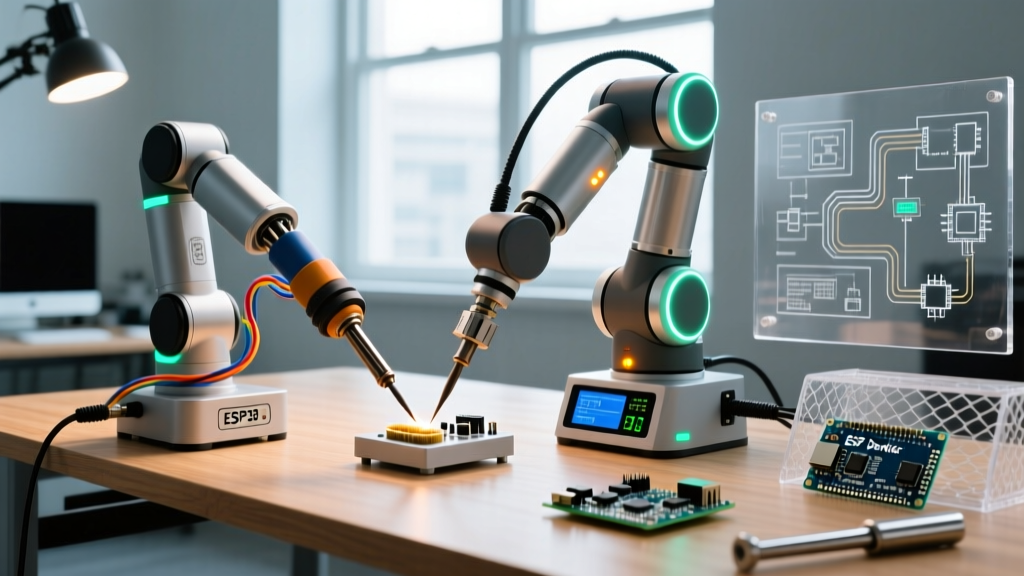
Desktop robotic soldering arms are active, programmable Cartesian or SCARA (Selective Compliance Articulated Robot Arm) systems. Equipped with high-precision stepper motors, automated flux dispensers, and nitrogen-assisted soldering irons, these machines execute identical solder joints with sub-millimeter repeatability.
Top Models and Real-World Pricing
- Quick 937+ Desktop Soldering Robot (~$2,800 - $3,500): A 4-axis Cartesian system featuring a closed-loop temperature controller. It utilizes NEMA 17 stepper motors with 1/16 microstepping, achieving a Z-axis repeatability of ±0.05mm. This precision is vital for preventing pad cratering on delicate multilayer PCBs.
- Weller WR Series Automated Arms (~$5,000+): Premium systems that integrate seamlessly with MES (Manufacturing Execution Systems). These arms feature active tip-wear monitoring and automated tip cleaning stations, ensuring the iron's thermal transfer rate remains constant over 10,000+ cycles.
- DIY Arduino-Based SCARA Kits (~$400 - $800): Popular in the maker community, these require extensive calibration. While they offer a low barrier to entry for automation, they often lack the rigid Z-axis downforce control required for consistent through-hole component seating.
The Automation Advantage: Thermal Profiling
Lead-free SAC305 solder melts at 217°C, but requires a tip temperature of 350°C to 380°C to ensure proper wetting within a 1.5 to 3-second dwell time. Robotic soldering arms eliminate the human variable of "hovering" or "iron hesitation." The robot applies the exact programmed downforce (typically 200g to 500g), feeds the precise length of solder wire (e.g., 1.2mm of 0.8mm diameter wire), and retracts at a calculated angle to prevent solder bridging.
Expert Insight: When programming a robotic soldering arm for large ground planes, always implement a "pre-heat dwell" of 0.5 seconds before feeding the solder wire. This allows the thermal mass of the copper pour to reach the activation temperature of the flux core, preventing the dreaded "cold joint" failure mode.
Head-to-Head Comparison Matrix
| Feature | Manual Articulated Arms | Desktop Robotic Soldering Arms |
|---|---|---|
| Capital Cost | $15 - $150 | $2,500 - $6,000+ |
| Setup / Programming Time | Zero (Instant physical adjustment) | 15 - 45 minutes per unique PCB design |
| Joint Consistency (IPC Class 3) | Highly variable (Operator dependent) | Near 100% repeatability |
| Cycle Time (per joint) | 3 - 6 seconds (Includes human movement) | 1.5 - 2.5 seconds (Automated sequence) |
| Maintenance Requirements | Tightening ball joints, replacing filters | Stepper motor calibration, belt tensioning, tip replacement |
| Best Use Case | Prototyping, rework, low-volume DIY | Batch production, high-density SMT/THM mixing |
Critical Failure Modes: Manual vs. Robotic
Understanding how each method fails is crucial for quality control. Both manual and robotic soldering arms are susceptible to distinct edge cases that can compromise PCB reliability.
Manual Arm Failure Modes
- Thermal Fatigue & Cold Joints: As the human operator tires, the angle of the soldering iron changes. If the flat of the tip does not maintain simultaneous contact with the component lead and the PCB pad, the flux activates but the solder fails to alloy properly, resulting in a dull, grainy cold joint.
- Solder Wicking: When using manual helping hands to hold wires, operators often apply the iron directly to the wire rather than the pad. Capillary action wicks the molten solder up the wire insulation, creating a stiff, brittle connection point that will snap under vibration.
Robotic Arm Failure Modes
- Pad Cratering (Z-Axis Overload): If the robotic arm's Z-axis downforce is calibrated too high, or if the PCB is slightly warped, the iron tip will crush the fiberglass substrate beneath the copper pad. This causes micro-fractures (pad cratering) that may pass initial electrical testing but will fail in the field due to thermal expansion.
- Flux Starvation: Automated arms rely on precise wire-feed mechanisms. If the solder wire spool experiences tension drag, the wire feed falls short of the programmed length. The joint will have sufficient heat but lack the necessary flux volume to clear oxidation, leading to incomplete wetting and "icicle" formations.
Health, Safety, and Fume Management
Regardless of whether you use manual or robotic soldering arms, fume extraction is non-negotiable. Manual arms excel at localized, point-of-source extraction because the operator can visually track the smoke plume and adjust the duct. Robotic arms, however, generate fumes at high speeds and in enclosed acrylic safety boxes. For robotic setups, you must invest in a plenum-style extraction base or a top-down HEPA vacuum system integrated directly into the robot's chassis to prevent flux residue from settling on the machine's linear rails and optical sensors.
Decision Framework: Which Arm Belongs on Your Bench?
Do not fall into the trap of automating a process that hasn't been optimized. If you are running a contract manufacturing setup producing fewer than 50 identical boards per month, the ROI on a $3,000 robotic soldering arm is negative. The time spent writing the G-code or teaching the pendant coordinates will eclipse the time saved in actual soldering. Instead, invest in premium manual articulating arms, high-quality ESD-safe helping hands, and a top-tier fume extractor.
Conversely, if your 2026 production roadmap includes batch runs of 500+ units, or if you are soldering complex mixed-technology boards (e.g., large thermal pads alongside 0402 surface-mount components), a desktop robotic soldering arm is mandatory. The machine's ability to execute a perfect, IPC-compliant fillet on a 14-pin DIP connector while simultaneously managing thermal soak times for adjacent components will drastically reduce your scrap rate and rework costs.