
The True Economics of Soldering Clips in 2026
In the electronics workbench ecosystem, the term "soldering clips" encompasses two distinct but equally critical tool categories: thermal heat sink clips (used to shunt heat away from sensitive component leads during manual soldering) and mechanical holding clips (used to secure PCBs, wires, and connectors during assembly). While it is tempting to bulk-buy generic assortments from overseas marketplaces for pennies, a rigorous cost analysis reveals that substandard soldering clips introduce severe hidden costs. These costs manifest as damaged semiconductor junctions, scratched impedance traces, and catastrophic board slips during precision rework.
This guide deconstructs the metallurgy, mechanical tolerances, and long-term ROI of soldering clips, providing a data-driven framework for hobbyists and professional rework labs alike.
Category 1: Thermal Heat Sink Clips (Component Protection)
Thermal soldering clips are designed to clamp onto component leads between the solder joint and the component body. Their primary function is to absorb and dissipate the thermal wave traveling up the lead frame, preventing the internal silicon die from exceeding its maximum junction temperature (typically 150°C to 175°C for standard ICs).
The Metallurgy: Stamped Steel vs. Beryllium Copper
The fundamental cost driver in thermal soldering clips is the base alloy. Budget clips are stamped from low-carbon steel or cheap brass alloys. Premium clips are machined or precision-stamped from Beryllium Copper (BeCu, Alloy C17200).
- Thermal Conductivity: BeCu offers a thermal conductivity of approximately 115 W/m·K, allowing it to rapidly pull heat away from the lead. Stamped steel hovers around 50 W/m·K, acting more as a thermal barrier than a heat sink.
- Spring Fatigue and Annealing: This is where budget clips fail catastrophically. When exposed to the repeated 350°C+ thermal shock of a soldering iron tip, low-carbon steel loses its temper (anneals). After 10 to 15 heat cycles, a steel clip loses its clamping force, falling off the lead mid-solder and risking thermal shock to the component. BeCu retains its spring properties and clamping tension at temperatures up to 315°C, lasting for thousands of cycles.
- Edge Burrs: Cheap stamped steel clips often retain microscopic edge burrs. When clamped onto a flexible printed circuit (FPC) or a densely routed PCB, these burrs can scratch through solder mask and sever delicate 4-mil traces.
Thermal Clip Cost & Performance Matrix
| Material / Grade | Unit Cost (2026 Bulk) | Thermal Conductivity | Clamping Lifespan | Best Use Case |
|---|---|---|---|---|
| Generic Stamped Steel | $0.08 - $0.12 | ~50 W/m·K | 10 - 20 Cycles | Single-use DIY wire tinning |
| Nickel-Plated Brass | $0.25 - $0.40 | ~120 W/m·K | 50 - 100 Cycles | Low-volume hobbyist through-hole |
| Precision BeCu (e.g., E-Z-Hook) | $1.35 - $1.95 | ~115 W/m·K | 3,000+ Cycles | Professional SMD rework, MIL-SPEC |
Industry Standard Note: According to the NASA-HDBK-8739.3 Workmanship Manual, heat sinking is strictly required for heat-sensitive components during soldering. The standard mandates that heat sink clips must make firm, intimate contact with the lead without causing mechanical stress to the component body or glass seals—a requirement that cheap, burr-laden steel clips routinely fail.
Category 2: Mechanical Holding Clips (PCB Fixturing)
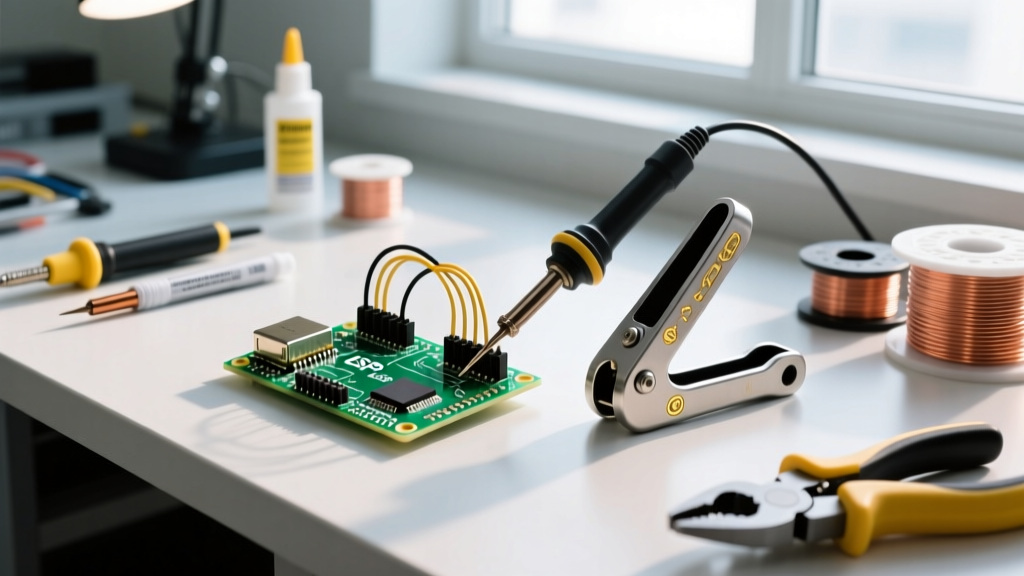
Mechanical soldering clips—often referred to as "helping hands," PCB holders, or third-hand tools—are responsible for immobilizing the workpiece. In 2026, the market is saturated with $15 flexible gooseneck clip holders and $85+ CNC-machined modular magnetic systems.
The "Gooseneck" Trap vs. Modular Magnetic Systems
The classic flexible gooseneck holder features a heavy cast-iron base, a bendable metal snake-arm, and two toothy alligator clips. While the upfront cost is incredibly low ($12 to $18), the hidden costs are substantial:
- Vibration Transfer: Gooseneck arms act as tuning forks. When you drag a soldering iron across a 0.5mm pitch TQFP microcontroller, the mechanical friction transfers kinetic energy down the arm, causing the board to oscillate. This leads to solder bridges and cold joints.
- PCB Edge Damage: The teeth on budget alligator clips are aggressively serrated. Clamping a modern 1.0mm thin PCB will inevitably crack the fiberglass substrate or shatter edge-mounted Multi-Layer Ceramic Capacitors (MLCCs) due to localized mechanical stress.
- Thermal Mass Issues: Heavy steel alligator clips act as massive, unintended heat sinks, pulling thermal energy away from the pad and causing cold solder joints on large ground planes.
Conversely, premium modular systems (such as those utilizing CNC aluminum bases and high-temperature silicone-tipped magnetic clips) cost between $65 and $130. They use high-strength neodymium magnets to lock heavy aluminum PCB plates directly to the workbench, reducing the Z-axis height to mere millimeters and eliminating vibration entirely.
Mechanical Fixturing Cost Analysis
| Fixturing System Type | Average 2026 Price | Vibration Dampening | ROI Break-Even Point | |
|---|---|---|---|---|
| Cast-Iron Gooseneck w/ Alligator Clips | $15.00 | Poor (High Resonance) | High (Serrated Teeth) | N/A (Constant replacement) |
| PanaVise Model 201 (Junior Vise) | $32.00 | Good (Rigid Clamping) | Medium (Requires padding) | 6 months (Hobbyist) |
| CNC Magnetic Modular System (e.g., QuadHands) | $89.00 - $125.00 | Excellent (Zero Z-Axis Play) | Low (Silicone/Brass tips) | 1-2 saved PCBs (Professional) |
Calculating the Hidden Cost of Failure
To truly understand the cost analysis of soldering clips, we must quantify the cost of failure. Consider a professional technician performing rework on a 6-layer impedance-controlled motherboard.
- The Component: A custom FPGA costing $85.
- The PCB: A 6-layer board with a fabrication cost of $45 and a 3-week lead time.
- The Incident: A budget gooseneck clip slips due to worn-out spring tension. The board drops 2 inches onto the workbench. The kinetic shock fractures a microscopic internal via beneath a BGA pad, or a steel heat sink clip falls onto the hot PCB, melting a polymer connector housing.
The total cost of this single failure is $130 in materials + 3 weeks of project delay. In this scenario, investing in a $90 premium magnetic fixturing system and a $25 set of BeCu thermal clips pays for itself on the very first day of use by eliminating slip-induced catastrophic failures.
Compliance and IPC Standards
For commercial electronics manufacturing, fixturing is not just a preference; it is a compliance requirement. The IPC J-STD-001 standard for soldered electrical and electronic assemblies dictates strict requirements for workpiece stability and thermal management. Auditors will routinely flag workbenches that rely on degraded, loose-tension alligator clips, as they introduce unacceptable variables into the rework process. Upgrading to precision-machined, ESD-safe (electrostatic dissipative) holding clips is a mandatory capital expenditure for any ISO-certified repair facility.
The 2026 Actionable Buying Framework
Based on your operational profile, allocate your soldering clip budget as follows:
1. The Weekend Hobbyist (Budget: $25)
Skip the cheap gooseneck arms. Purchase a basic silicone-tipped PCB holder ($18) and a small 10-pack of nickel-plated brass thermal clips ($7). This provides adequate stability for through-hole kits and basic 0805 SMD soldering without risking scratched traces.
2. The Advanced Maker / Drone Builder (Budget: $60)
Invest in a rigid bench vise with ESD-safe nylon jaws ($35) and a dedicated set of E-Z-Hook Beryllium Copper heat sink clips ($25). The BeCu clips will protect the sensitive voltage regulators and MOSFETs commonly found in drone ESCs and custom flight controllers during manual wiring.
3. The Professional Rework Lab (Budget: $150+)
Standardize on modular magnetic fixturing blocks ($100) equipped with interchangeable high-temp silicone and titanium tips. Stock your ESD-safe bins with precision BeCu thermal clips in multiple widths (0.050" to 0.150") to accommodate everything from 0402 passives to large TO-220 power transistors. Ensure all clips are regularly cleaned with isopropyl alcohol to maintain optimal thermal transfer.
Final Verdict
In 2026, the price gap between budget and premium soldering clips remains wide, but the technological gap in PCB complexity has never been larger. As trace widths shrink to 3-mil and components become increasingly thermally sensitive, the margin for error has vanished. Budget soldering clips are a false economy that subsidize their low upfront cost with high rates of mechanical and thermal failure. By investing in Beryllium Copper thermal clips and rigid, low-profile magnetic fixturing systems, you are not just buying tools; you are purchasing an insurance policy for your components, your PCBs, and your time.