
The Tactile Legacy: Why Old Soldering Tools Still Matter in 2026
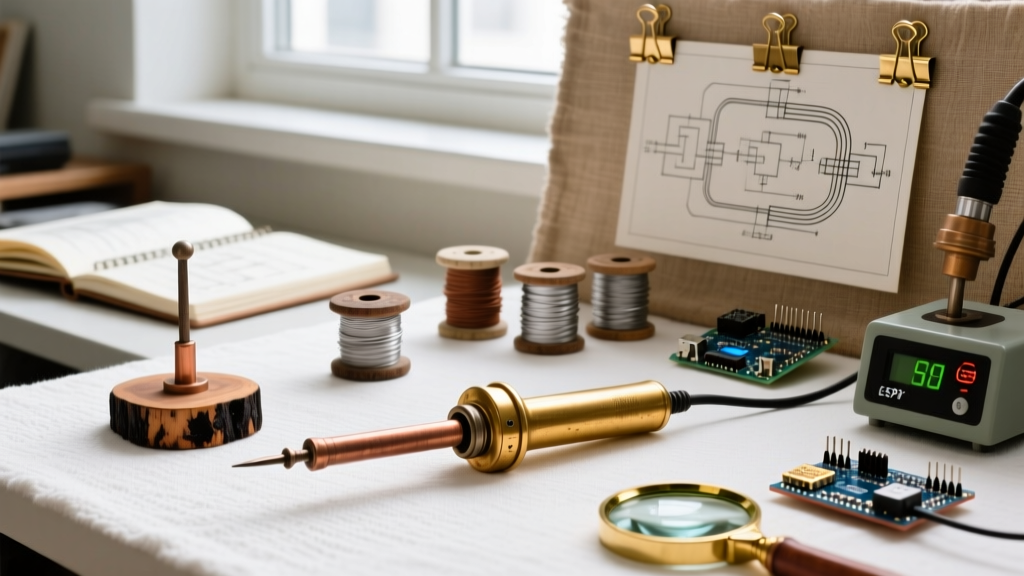
Before the advent of RISC-V powered PID controllers and USB-C heated tips, the art of joining metals relied on massive thermal mass, mechanical switches, and raw electrical resistance. For electronics restorers, plumbing professionals, and DIY historians, collecting and using old soldering tools is more than a nostalgic hobby—it is a masterclass in foundational thermal engineering. While modern stations like the Hakko FX-951 or the Pinecil V2 dominate the 2026 market with instant thermal recovery and digital precision, vintage tools offer unparalleled durability, massive thermal reservoirs, and a mechanical simplicity that allows for complete user-level repair.
This guide explores the chronological evolution of soldering hardware, provides a technical framework for identifying valuable vintage pieces, and delivers a step-by-step restoration protocol to safely bring these historical tools back to the workbench.
The Chronological Evolution of Soldering Hardware
1. The Era of Fire-Heated Copper Irons (Pre-1900s)
The earliest soldering tools were not irons at all, but solid copper 'bits' or 'hatchets' forged by blacksmiths. Weighing anywhere from 0.5 to 2.5 lbs, these tools were heated directly in a charcoal forge or over a blowtorch. The primary failure mode of fire-heated coppers was rapid oxidation; if left in the forge too long, the copper would scale and become impossible to tin. Tinsmiths and stained-glass artisans had to constantly file the copper back to bright metal and re-tin it with a block of rosin and solder. According to historical archives documented by Electronics Notes, these primitive tools required immense skill to judge the exact heat color of the copper, as overheating would instantly burn the flux and ruin the joint.
2. The Birth of the Electric Soldering Iron (1900s–1940s)
The transition to electricity began in the early 20th century. Companies like the American Electrical Heater Company introduced irons that passed current through nichrome resistance wire wrapped around a mica insulating core. While revolutionary, these early electric irons lacked temperature regulation. They would heat continuously until they reached a thermal equilibrium dictated by their surface area and ambient air. The common failure mode was mica cracking due to thermal shock or the internal resistance wire shorting against the outer steel casing, creating a severe shock hazard.
3. The Golden Age of Analog Stations (1950s–1980s)
The true golden age of analog soldering was defined by the invention of closed-loop temperature control without the need for fragile thermocouples or early solid-state electronics. The undisputed king of this era was the Weller Magnastat (TCP series), introduced in the late 1960s. As detailed in the official Weller history archives, the Magnastat system utilized a brilliant application of physics: the Curie point. The soldering tip contained a ferromagnetic core. When the tip reached its specific design temperature (e.g., 700°F / 371°C), the core lost its magnetic properties, causing a spring-loaded switch to open and cut power to the heater. This purely mechanical thermostat was virtually indestructible and remains highly sought after by analog audio technicians today.
Identification Guide: Valuable Vintage Soldering Tools
If you are scouring estate sales, eBay, or surplus auctions, knowing which old soldering tools hold functional and collector value is critical. Below is a 2026 market matrix for the most desirable vintage units.
| Era | Brand / Model | Heating Technology | 2026 Collector Value | Best Modern Application |
|---|---|---|---|---|
| 1920s-1940s | American Beauty (Hexagon) | Direct Resistance / Mica | $60 - $120 | Heavy plumbing, stained glass, thick gauge wire |
| 1950s | Ungar 7700 Series | Thermistor / Ceramic Core | $40 - $80 | General purpose through-hole PCB work |
| 1960s-1980s | Weller Magnastat (TCP1) | Curie Point Magnetic Switch | $120 - $180 | Analog audio repair, heavy ground planes |
| 1970s | Hakko 926 / 927 | Triac Phase-Angle Control | $90 - $140 | Precision through-hole and early SMD |
Restoring and Safely Using Old Soldering Tools
Buying a vintage soldering iron is only the first step. Plugging a 60-year-old tool directly into a modern 120V/240V wall outlet without inspection is a guaranteed way to trip your GFCI breaker or, worse, suffer a lethal electrical shock. Follow this rigorous restoration protocol.
Step 1: Teardown and the Asbestos Check
Critical Safety Warning: Many old soldering tools manufactured before the 1980s utilized asbestos braiding as an internal thermal insulator for the power cord and heating element chamber. Before sanding, cutting, or aggressively cleaning the interior of a vintage iron, consult the CPSC guidelines on asbestos. If you suspect the presence of friable asbestos, encapsulate it with high-temperature silicone sealant or safely dispose of the unit.
Step 2: Testing the Heating Element
Do not rely on a simple continuity beep test. You must verify the exact resistance of the nichrome element to ensure it has not degraded or shorted. Set your digital multimeter to Ohms (Ω) and use the following physics formula to calculate the expected resistance:
Resistance (R) = Voltage² / Wattage
- Example for a 50W, 120V Weller Iron: 120² / 50 = 14,400 / 50 = 288 Ω.
- Example for a 100W, 240V European Iron: 240² / 100 = 57,600 / 100 = 576 Ω.
If your multimeter reads infinite (OL), the element is broken and must be replaced. If it reads significantly lower than the calculated value, the internal windings have shorted, and the iron will draw excessive current and overheat dangerously.
Step 3: Rewiring with Modern Materials
Never reuse the original cloth-rubber or early PVC cords found on old soldering tools; the insulation becomes brittle and cracks near the strain relief. Strip the old cord and replace it with an 18 AWG, 300V silicone-jacketed cable. Silicone wire withstands temperatures up to 200°C and remains highly flexible, mimicking the drape of vintage cloth cords while providing modern dielectric safety. Always ensure the chassis of the iron is tied to a proper earth ground pin.
Step 4: Tip Reconditioning
Vintage solid copper or early iron-plated tips are often covered in black copper oxide. Do not use steel wool, which can leave embedded iron particles that will rust and ruin the tinning. Instead, use a brass wire sponge and a generous application of Kester 44 (63/37 Sn/Pb) rosin-core solder. Heat the iron to 650°F, apply the solder directly to the tip to create a molten puddle, and wipe it on a damp cellulose sponge to reveal a pristine, silver-tinned working surface.
Modern Equivalents vs. Vintage Performance
How do these historical artifacts stack up against modern technology? The answer depends entirely on the thermal mass of your workpiece.
- Thermal Recovery: A 2026 Pinecil V2 (65W) can recover from a 50°F temperature drop in under 1.5 seconds due to its ultra-low mass tip and aggressive PID tuning. A vintage 50W Weller Magnastat takes roughly 4 to 6 seconds to recover the same drop because the mechanical switch has inherent hysteresis and the tip mass is much larger.
- Heavy Ground Planes: Where old soldering tools still shine is in massive thermal transfer. When soldering a 12-gauge wire to a heavy brass lug or a multi-layer PCB ground plane, the dense, heavy copper core of a vintage American Beauty or a thick Weller MT-series tip acts as a massive thermal battery. Modern micro-tips often stall and trigger 'cold joint' errors on heavy mass joints because their physical volume cannot store enough Joules to overcome the heat sink effect of the workpiece.
Sourcing and Pricing in the Current Market
The market for old soldering tools has stabilized, shifting from 'cheap used tools' to 'curated vintage electronics.' In 2026, you can expect the following pricing tiers:
- The 'Junker' Tier ($10 - $25): Found at local flea markets or uncurated eBay lots. These typically require full teardowns, cord replacements, and element testing. Ideal for DIYers who want to practice tool restoration.
- The 'Working Surplus' Tier ($40 - $90): Usually sourced from closing industrial facilities or university lab cleanouts. These irons (often Hakko 926s or Ungar 7700s) are functional but may need a new tip and a fresh cleaning.
- The 'Restored Collector' Tier ($120 - $200+): Sold by specialized vintage tool restorers on platforms like Etsy or specialized electronics forums. These Weller Magnastat stations have been retrofitted with modern grounded silicone cords, polished housings, and calibrated magnetic switches, ready for immediate professional use.
Preserving the Craft
Understanding the history and mechanics of old soldering tools provides a profound appreciation for the modern electronics we build today. Whether you are keeping a pristine Weller TCP station on your bench as a reliable backup for heavy-duty joints, or simply marveling at the ingenuity of a 1930s mica-wrapped heater, preserving these tools ensures that the foundational engineering of the electrical age is never forgotten.