
The Evolution of the Soldering Wand: 2026 Expert Roundup
In the realm of precision electronics repair and PCB fabrication, the soldering station is only as good as its primary interface: the soldering wand. While heating elements and digital displays get the marketing spotlight, it is the wand (or handpiece) that dictates thermal transfer efficiency, ergonomic fatigue, and micro-soldering accuracy. As we move through 2026, the market has bifurcated into two distinct camps: proprietary active-tip ecosystems and open-source USB-C Power Delivery (PD) disruptors.
To cut through the marketing noise, we convened a panel of three industry veterans to evaluate the best soldering wand options on the market today. Our panel includes Marcus Thorne (IPC-Certified Master Trainer for aerospace electronics), Elena Rostova (Lead Micro-Soldering Technician specializing in 01005 components and BGA rework), and David Chen (Hardware Hacker and embedded systems educator).
What Defines a Premium Soldering Wand?
Before diving into specific models, our experts agreed on four non-negotiable metrics for evaluating a professional soldering wand in 2026:
- Thermal Recovery Rate: Measured in milliseconds. The wand must recover from a 50°C temperature drop (caused by touching a ground plane) in under 2 seconds to prevent cold joints.
- Tip-to-Heater Integration: Active-tip designs, where the heating element and thermocouple are embedded directly inside the cartridge, vastly outperform traditional ceramic heater sleeves.
- Cable Articulation: Silicone-jacketed cables with Kevlar strain relief that exhibit zero 'memory' or stiffness at room temperature.
- Ergonomic Center of Gravity: The weight must be balanced near the pinch point (typically 15mm to 25mm from the tip collar) to reduce carpal tunnel strain during 8-hour shifts.
Expert Pick 1: The Micro-Soldering Standard (JBC T245 Handle)
Nominated by: Elena Rostova, Micro-Soldering Specialist
Best For: 0201/01005 passives, micro-BGA rework, and fine-pitch FPC connectors.
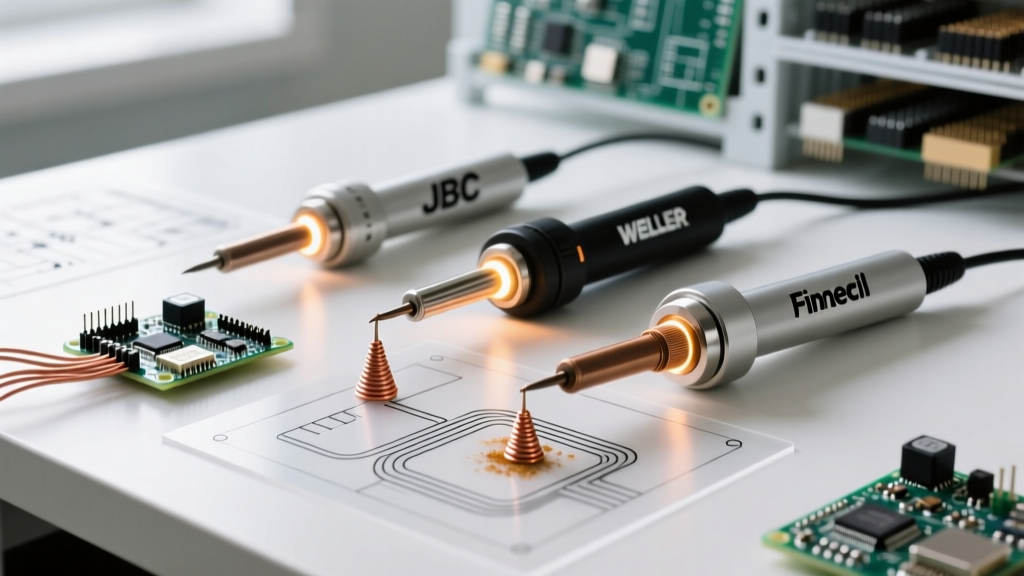
For Elena, the JBC T245 soldering wand remains the undisputed king of the micro-soldering bench. Paired with JBC's C245 cartridge tips, the T245 handle delivers an astonishing 75W of power despite its pencil-thin profile. 'When I am working on a 20-layer smartphone logic board, the thermal mass of the ground planes will instantly rob heat from a standard iron,' Elena explains. 'The T245 wand, combined with a C245-112 conical tip, detects the thermal draw and pushes current to the integrated heater in under 40 milliseconds.'
'The true genius of the JBC T245 wand is the silicone cable articulation. It feels like the cable isn't even attached. When you are maneuvering under a microscope at 40x magnification, cable drag is the enemy of precision.' — Elena Rostova
Technical Specifics & Pricing (2026): The T245 handle retails for approximately $165. However, the ecosystem lock-in is real: genuine C245 tips cost between $45 and $60 each. While expensive, the tips feature a built-in sleep sensor that drops the temperature to 180°C the moment the wand is placed in its magnetic holder, virtually eliminating tip oxidation and extending cartridge life by up to 400% compared to manual standby modes.
Expert Pick 2: The High-Mass Workhorse (Weller WXMP Micro Pencil)
Nominated by: Marcus Thorne, IPC Master Trainer
Best For: Automotive ECUs, heavy-gauge through-hole components, and aerospace wiring.
Marcus deals with high-thermal-mass joints that require strict adherence to IPC J-STD-001 soldering requirements. For these tasks, he champions the Weller WXMP soldering wand. Unlike JBC's cartridge system, the WXMP utilizes Weller's RT (Rapid Thermal) micro tips, which feature a welded heater-sensor-tip design. While the WXMP is rated at 40W, its thermal transfer efficiency on heavy joints rivals older 80W traditional irons.
'A lot of hobbyists look at 40W and assume it is weak,' Marcus notes. 'But wattage is just a measure of energy consumption, not thermal transfer. The WXMP wand's RT4 micro-chisel tip has virtually zero thermal resistance between the heater and the joint. I can solder a 14AWG wire to a massive copper pour on an automotive ECU without the joint turning dull or grainy.'
Technical Specifics & Pricing (2026): The WXMP wand costs around $135, with RT tips averaging $38 each. The wand features a unique push-button tip ejection system, allowing technicians to swap tips without waiting for the wand to cool down or using metal tweezers, which can damage the internal ceramic alignment pins.
Expert Pick 3: The Open-Source Disruptor (Pine64 Pinecil V2)
Nominated by: David Chen, Hardware Hacker
Best For: Field repairs, drone technicians, budget-conscious DIYers, and firmware tinkerers.
David's pick represents the massive shift toward USB-C PD in the soldering space. The Pine64 Pinecil V2 soldering wand is a bare-bones, open-source handpiece that negotiates up to 65W via USB-C Power Delivery 3.1. Powered by a 32-bit RISC-V chip, the wand runs IronOS, an open-source firmware that allows for granular control over PID tuning, voltage thresholds, and tip calibration.
'The Pinecil V2 wand completely destroyed the $100 portable iron market,' David states. 'I power mine with a 65W GaN laptop charger. The tip resistance calibration feature in IronOS ensures that the temperature reading is accurate to within 2°C, which is critical when working with temperature-sensitive RF components.'
Technical Specifics & Pricing (2026): The bare Pinecil V2 wand is an unbelievable $26. Tips (compatible with the older TS100 form factor) are roughly $2.50 to $4.00 each. While it lacks a proprietary sleep stand, the wand's internal accelerometer detects motion and will automatically enter standby mode when left motionless on a silicone mat.
Head-to-Head: Soldering Wand Comparison Matrix
| Wand Model | Max Power | Heat-up (Room to 350°C) | Tip Ecosystem | 2026 Price (Wand Only) | Ideal Use Case |
|---|---|---|---|---|---|
| JBC T245 | 75W | ~2.0 seconds | C245 Cartridge | $165 | Precision micro-soldering, SMD |
| Weller WXMP | 40W | ~3.5 seconds | RT Micro Welded | $135 | High-mass joints, automotive |
| Pinecil V2 | 65W (PD) | ~4.5 seconds | TS100 Compatible | $26 | Field repair, DIY, portable |
| Hakko FX-951 | 70W | ~8.0 seconds | T15 / T12 (Adapter) | $95 | General bench work, production |
Critical Failure Modes: Why Soldering Wands Die
Even premium soldering wands are subject to physical and thermal degradation. Based on our panel's combined decades of bench experience, here are the most common failure modes and how to identify them before they ruin a PCB.
1. Internal Thermocouple Wire Fatigue
In active-tip wands, the thermocouple wires run mere millimeters from the heating element. Repeated thermal cycling (heating to 400°C and cooling to room temperature) causes microscopic crystalline fractures in the sensor wire. Symptom: The station display shows erratic temperature spikes (e.g., jumping from 350°C to 480°C) or throws an 'Open Sensor' error code. Fix: Replace the tip cartridge immediately; continuing to use it will cause the PID controller to overdrive the heater, potentially melting the wand's internal PTFE insulation.
2. Galvanic Corrosion at the Collar
Technicians who use highly activated, acidic fluxes (often found in plumbing or heavy-duty electrical pastes) often allow flux vapor to condense on the wand's metal tip collar. Over time, this causes galvanic corrosion, seizing the tip inside the wand. Symptom: Inability to remove the tip without pliers. Fix: Wipe the wand collar with an isopropyl alcohol (IPA) swab at the end of every shift. Never apply anti-seize compounds to the tip barrel, as they will outgas toxic fumes when heated.
3. Cable Strain Relief Severing
The most vulnerable point on any soldering wand is the junction where the silicone cable meets the rigid handle. Wrapping the cable tightly around the wand for storage, or allowing it to hang off the edge of a high bench, puts sheer stress on the internal 4-pin or 5-pin wiring. Symptom: Intermittent power loss or a wand that only works when the cable is bent at a specific, awkward angle. Fix: Always store wands in a loose coil with a minimum bend radius of 3 inches. If the internal wires snap, the wand handle must be rewired or replaced.
Expert Maintenance Protocols for Maximum Longevity
To ensure your soldering wand and tips survive for years, our experts recommend strictly adhering to the following maintenance protocols, which align with Hakko's official soldering tip care guidelines and general industry best practices:
- Abandon the Wet Sponge: Wiping a 380°C tip on a wet cellulose sponge causes instantaneous thermal shock. This micro-fractures the iron plating on the tip, leading to rapid oxidation and copper core dissolution. Switch to dry brass wire wool.
- The 'Tin Before Bin' Rule: Never power down your station with a bare tip. Before turning off the wand, melt a generous blob of rosin-core (SAC305 or 63/37) solder over the entire working surface of the tip. This sacrificial layer prevents atmospheric oxygen from oxidizing the iron plating while it cools.
- Respect the Temperature Ceiling: Running a wand at 450°C to compensate for a lack of thermal mass is a rookie mistake that destroys tips in days. If your solder isn't flowing at 350°C - 365°C, you are using the wrong tip geometry or the wrong flux, not insufficient heat. Increase the tip mass (e.g., switch from a conical to a chisel), not the temperature.
- Calibrate Open-Source Wands: If you are using a USB-C wand like the Pinecil V2, refer to the Pine64 Pinecil Wiki to perform a tip resistance calibration every time you install a new batch of tips. Manufacturing tolerances on budget tips can vary by up to 8%, which will skew your temperature readings if left uncalibrated.
Final Verdict: Choosing Your Wand
The 'best' soldering wand is entirely dependent on your thermal requirements and budget. If your daily work involves micro-soldering under a microscope, the JBC T245 is a mandatory investment that will pay for itself in saved PCB pads and reduced eye strain. For heavy-duty automotive and aerospace through-hole work, the Weller WXMP offers unmatched thermal stability. However, for the modern field technician, drone racer, or DIY enthusiast, the Pinecil V2 provides 90% of the performance of a $500 station for the price of a takeout dinner, proving that in 2026, you no longer need to mortgage your workbench to get precision temperature control.