
The Financial Reality of Online Soldering Training in 2026
The landscape of electronics manufacturing education has fundamentally shifted. By 2026, online soldering training has evolved from a niche alternative into a primary pathway for both hobbyists and aerospace-level professionals. Augmented reality (AR) kit integrations and remote proctoring have made it possible to achieve IPC certifications without stepping foot in a physical classroom. However, while the sticker price of an online course often appears lower than in-person instruction, the true cost involves a complex matrix of hardware requirements, material consumption, and certification fees.
This cost analysis breaks down the exact financial commitment required for online soldering training across different skill tiers, exposing the hidden material costs and calculating the real-world return on investment (ROI) for buyers and employers.
Tiered Cost Breakdown: From Hobbyist to Aerospace
Not all soldering training serves the same purpose. A drone enthusiast repairing a flight controller has vastly different educational needs—and budget constraints—than a manufacturing technician soldering life-saving medical devices. Below is the 2026 pricing matrix for the most prominent online training tiers.
| Training Tier | Target Audience | Base Tuition (Online) | Certification Included? |
|---|---|---|---|
| Hobbyist / Maker (e.g., Udemy, Skillshare) | DIYers, Arduino enthusiasts, basic repair | $25 - $85 | No |
| Pro-Maker / Advanced (e.g., MakerPortals) | Contractors, custom PCB designers | $150 - $300 | No (Certificate of Completion only) |
| IPC J-STD-001 CIS (Online + Remote Proctor) | Electronics assembly technicians | $850 - $1,400 | Yes (IPC Certified IPC Specialist) |
| IPC-7711/7721 Rework & Repair (Online) | Rework operators, QA inspectors | $1,200 - $1,900 | Yes (IPC Rework Certification) |
While hobbyist courses are practically disposable expenses, professional IPC Certification Guidelines dictate rigorous practical exams. Even in an online format, you cannot pass an IPC exam by simply clicking through multiple-choice questions; you must physically solder test coupons and submit them or perform them under live camera supervision.
The "Hidden" Hardware and Material Costs
The most common miscalculation buyers make when budgeting for online soldering training is assuming the tuition covers the physical practice environment. In a traditional classroom at a facility like the Blackfox Training Institute, the lab provides the soldering stations, fume extractors, microscopes, and practice boards. In an online setting, the burden of the Bill of Materials (BOM) shifts entirely to the student or their employer.
Required Home-Lab BOM for Professional Online Training
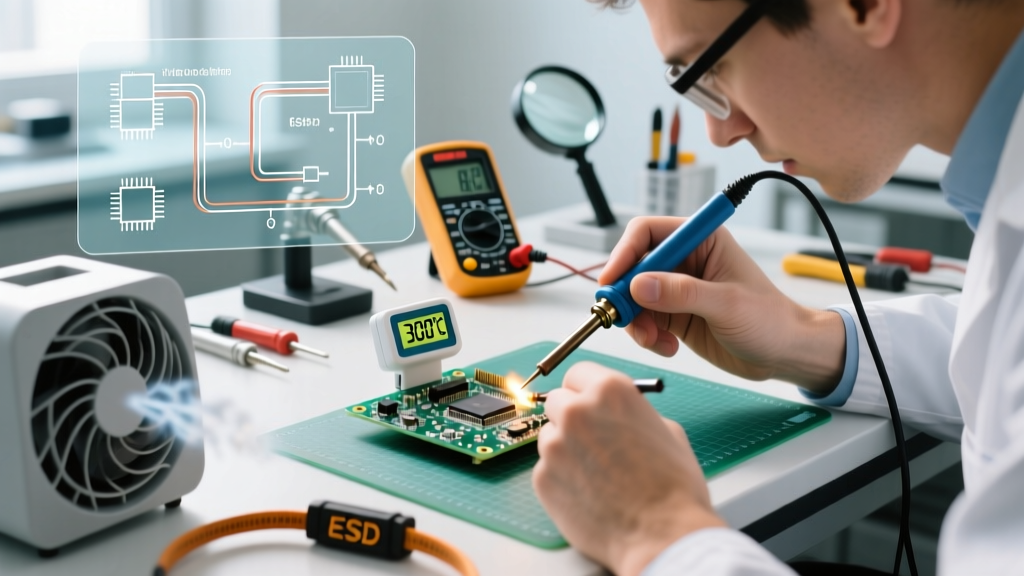
If you are pursuing an IPC J-STD-001 certification online, you must replicate a professional ESD-safe workspace. Here are the realistic 2026 costs for the minimum viable hardware:
- Soldering Station: Hakko FX-888D ($110) or Weller WE1010NA ($115). You need precise thermal recovery for lead-free SAC305 alloys.
- Fume Extraction: Hakko FA-400 ($55). Essential for home setups lacking industrial HVAC ventilation.
- Magnification: AmScope SE400-Z Boom Arm Microscope ($120). IPC inspection criteria require magnification up to 10x or 40x for micro-BGA rework.
- Consumables: Kester 44 63/37 Sn/Pb wire ($32), Amtech NC-559-V2-TF Flux ($28), and Chemtronics desoldering braid ($15).
- Official IPC Practice Kits: You must purchase the specific IPC training boards and test coupons ($180 - $350) to submit for your practical exam.
Total Hidden Hardware Cost: $540 to $750+
Expert Insight: Many online students fail their first practical IPC submission not because of poor technique, but because they used consumer-grade, uncalibrated irons that caused cold solder joints or thermal damage (delamination) on the official test coupons. Investing in a calibrated, professional station is a non-negotiable training cost.
Online vs. In-Person: The Total Cost of Attendance Matrix
To understand the true value of online soldering training, we must compare it against the traditional 4-day in-person bootcamp model. The following matrix illustrates the total financial impact for an employed technician sent to training.
| Cost Category | Online Training (Remote) | In-Person Bootcamp (4 Days) |
|---|---|---|
| Base Tuition | $1,200 | $1,400 |
| Travel / Airfare | $0 | $450 |
| Lodging (4 Nights) | $0 | $600 |
| Per Diem / Meals | $0 | $250 |
| Lost Productivity (Wages) | $0 (Asynchronous/Hybrid) | $960 (Assuming $30/hr x 32 hrs) |
| Home Lab Setup (One-Time) | $600 | $0 |
| Total First-Year Cost | $1,800 | $3,660 |
Even factoring in the $600 one-time home lab setup, online training yields a 50% cost reduction per employee. Furthermore, the home lab remains a permanent asset for ongoing practice and rework, whereas the in-person lab experience ends when the student flies home.
Calculating Your Return on Investment (ROI)
Does the investment in professional online soldering training pay off? The ROI depends heavily on your employment status and the industry you serve.
For the Employed Technician
In the aerospace, medical device, and automotive sectors, IPC certification is rarely optional. According to data referenced by the NASA Electronic Parts and Packaging (NEPP) Program, high-reliability soldering requires strict adherence to workmanship standards. Technicians who hold an active IPC J-STD-001 CIS certification typically command a wage premium of $2.50 to $5.00 per hour over non-certified peers.
The Math: A $3.00/hour raise equates to $6,240 annually. Against a total online training cost of $1,800 (tuition + lab setup), the break-even point is achieved in just 3.5 months. After that, the certification generates pure profit for the technician and unlocks higher-tier manufacturing contracts for the employer.
For the Hobbyist or Freelance Repair Tech
If you are repairing consumer electronics (e.g., HDMI port replacements on PS5s, iPhone logic board microsoldering), an $80 Udemy course combined with a $300 hardware investment is the ceiling. The ROI here is measured in saved devices. Successfully reflowing a single GPU or replacing a torn trace on a MacBook logic board can net a freelance technician $150 to $400 per repair, paying for the entire online training curriculum in a single afternoon.
Strategic Cost-Saving Tactics for 2026 Buyers
If you are procuring online soldering training for yourself or a team, implement these strategies to maximize your budget:
- Leverage Employer Grants: Many regional manufacturing associations offer upskilling grants that cover 50-100% of IPC online tuition. Check with your local MEP (Manufacturing Extension Partnership) center.
- Buy Refurbished Lab Gear: You do not need a brand-new $800 JBC soldering station to pass an online IPC exam. Refurbished Metcal or Hakko stations from authorized dealers perform identically for training purposes at a 40% discount.
- Consolidate Consumables: Do not buy individual flux pens and solder spools. Purchase bulk manufacturing lots (e.g., 1lb spools of Kester and 50cc syringes of Amtech flux) to reduce your per-gram cost by up to 70%.
- Opt for Hybrid Proctoring: Some training providers offer a hybrid model where you learn the theory online at your own pace, but attend a local, certified testing center just for the 4-hour practical exam. This eliminates the need to buy expensive microscopes and fume extractors for your home, saving $300+ upfront.
Frequently Asked Questions
Can I use lead-free solder for my online IPC training exams?
Yes, but it is significantly more difficult for beginners. Lead-free alloys (like SAC305) require higher temperatures, exhibit poor wetting, and result in dull, grainy joints that are harder to inspect. Unless your employer specifically mandates lead-free training, request a Sn63/Pb37 (Tin/Lead) training kit for your online coursework to ensure you master the thermal fundamentals first.
Are YouTube tutorials sufficient for professional soldering training?
No. While YouTube is excellent for visual demonstrations of specific techniques (like drag-soldering QFP chips), it lacks the structured curriculum, IPC-standard defect recognition (target vs. acceptable vs. defect conditions), and formalized testing required for professional liability and aerospace manufacturing compliance.
How long does an online IPC certification last?
Standard IPC certifications (both CIS and CIT) are valid for two years from the date of issue. You will need to budget for an online recertification course and a new set of test coupons every 24 months to maintain your active status.