
The Hidden Hazards of Re Soldering
Initial PCB assembly is highly controlled, but rework is where most safety and reliability failures occur. When re soldering PCB components, technicians face a compounding matrix of risks: toxic flux vaporization, electrostatic discharge (ESD) vulnerabilities, and severe thermal degradation of the substrate. Unlike first-pass soldering, re soldering requires you to overcome the existing thermal mass of the board, often pushing equipment and materials past their safe operating limits. As of 2026, with the industry heavily reliant on dense, multi-layer FR-4 boards and lead-free SAC305 alloys, understanding the precise safety and reliability protocols for rework is non-negotiable. This guide breaks down the exact thermal thresholds, chemical hazards, and IPC-compliant procedures required to execute safe and reliable re soldering.
Thermal Management: Preventing Pad Cratering and IMC Overgrowth
The most catastrophic failure mode during re soldering is thermal damage to the PCB substrate and the solder joint's metallurgy. When a board undergoes its initial reflow or wave soldering, an Intermetallic Compound (IMC) layer—primarily Cu6Sn5—forms between the copper pad and the solder. When you apply heat for re soldering, this IMC layer thickens and transforms into Cu3Sn, a highly brittle phase that drastically reduces the joint's mechanical shock resistance.
Furthermore, the FR-4 substrate has a Glass Transition Temperature (Tg), typically between 130°C and 170°C. Repeatedly pushing the localized area past its Tg weakens the epoxy resin, leading to pad cratering (where the copper pad tears away from the laminate) or barrel cracks in plated through-holes (PTHs).
Temperature Profiles and Dwell Time Limits
To mitigate thermal damage, you must strictly control tip temperature and dwell time. Using a high-thermal-recovery station like the JBC CD-2BQE (priced around $480) allows you to use lower tip temperatures because the cartridge heats the joint instantly, preventing the operator from applying excessive physical pressure or lingering on the pad.
| Solder Alloy | Melting Point | Max Recommended Tip Temp | Max Dwell Time Per Joint | Primary Thermal Risk |
|---|---|---|---|---|
| Sn63/Pb37 (Leaded) | 183°C | 315°C - 340°C | 3 - 5 Seconds | Flux burn-off, pad lifting |
| SAC305 (Lead-Free) | 217°C - 220°C | 350°C - 380°C | 2 - 4 Seconds | IMC overgrowth, pad cratering |
| Sn96.5/Ag3/Cu0.5 (Low-Ag) | 217°C | 340°C - 360°C | 3 - 5 Seconds | Component delamination |
Fume Extraction and Respiratory Protection
Soldering fumes are not merely an annoyance; they are a severe occupational hazard. The primary danger comes from the flux core, not the metal alloy. Rosin-based (colophony) fluxes vaporize into sub-micron particulates and volatile organic compounds (VOCs) that are known respiratory sensitizers, capable of inducing occupational asthma. According to the CDC National Institute for Occupational Safety and Health (NIOSH), prolonged exposure to colophony fumes can lead to chronic respiratory issues and skin sensitization.
When re soldering, technicians often use higher temperatures and apply extra flux, which exponentially increases the volume of toxic vaporization. A standard desk fan simply disperses these hazardous particulates across the room, exposing bystanders.
Extractor Comparison: Benchtop vs. Industrial
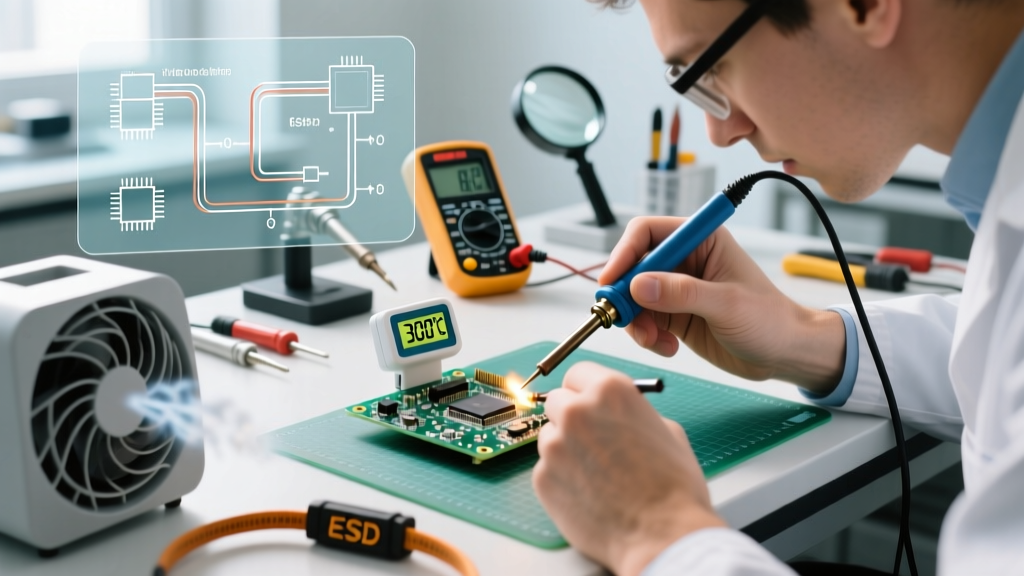
For safe re soldering, you must capture fumes at the source (within 2 to 4 inches of the iron tip) using a system equipped with both a HEPA filter (for particulates) and an activated carbon bed (for VOCs and acidic gases).
- Hakko FA-400 (~$45): A basic benchtop fan with a replaceable carbon filter. Verdict: Insufficient for heavy rework. It lacks the static pressure to pull dense SAC305 flux fumes away from the breathing zone and only offers minimal VOC adsorption.
- Metcal BVX-500 (~$850): A professional-grade, multi-stage extraction system with a HEPA main filter and a deep activated carbon bed. Verdict: The gold standard for rework stations. Its variable speed motor and specialized nozzle attachments ensure 99.97% particulate capture, keeping the operator's breathing zone entirely clear of rosin dust and acidic vapors.
Flux Chemistry and Chemical Reactivation
A common and dangerous mistake during re soldering is attempting to reflow an existing joint without adding fresh flux. During the initial soldering process, the flux's chemical activators (such as adipic or succinic acid) are entirely consumed to strip oxidation from the copper. If you reheat a "no-clean" joint without adding new flux, the solder will oxidize instantly, resulting in a grainy, cold joint with high electrical resistance.
Moreover, reheating residual no-clean flux can cause the unactivated resins to cross-link and harden into a dark, brittle crust that traps corrosive byproducts against the copper trace. Always apply a fresh, high-reliability tacky flux like Amtech NC-559-V2-TF (approx. $25 per syringe) or a liquid pen like Kester 245NC-VOC before applying the iron. This ensures proper wetting, lowers the surface tension of the molten solder, and reduces the required dwell time, thereby protecting the PCB from thermal shock.
ESD and Electrical Safety Protocols
Re soldering often involves handling highly sensitive microcontrollers, MOSFETs, and RF modules outside the protected environment of an automated assembly line. The human body can easily accumulate static charges exceeding 3,000 volts, which will instantly puncture the gate oxide of a MOSFET or corrupt the flash memory of an IC.
Before touching the PCB or the soldering iron handle, the operator must be grounded. Use a verified ESD wrist strap, such as the 3M 3011 (approx. $18), which contains a built-in 1-megohm safety resistor. This resistor is critical: it bleeds off static charges slowly while protecting the operator from lethal electrical shocks if they accidentally touch a live AC circuit. The workstation mat must also be grounded to a common point, which is then tied to the facility's verified earth ground. Never rely on the soldering iron's grounding pin alone to protect the component.
IPC-7711/7721 Compliance for Rework
For professional and aerospace/medical electronics, re soldering must adhere to the IPC-7711/7721 standard for Rework, Modification, and Repair. This standard dictates not just how to apply heat, but how to prepare the site. Key IPC mandates for safe re soldering include:
- Site Preparation: Cleaning the area with high-purity isopropyl alcohol (IPA) and inspecting for existing micro-fractures under magnification.
- Thermal Profiling: Using thermocouples attached to adjacent components to ensure the ambient temperature of surrounding parts does not exceed their moisture sensitivity level (MSL) thresholds.
- Cleaning Post-Rework: Even if using no-clean flux, IPC-7711 recommends cleaning the rework area with an aerosol flux remover (like Techspray Ecoline) and a lint-free swab to prevent ionic contamination that could lead to electrochemical migration (dendrite growth) in high-humidity environments.
Quick-Reference Re Soldering Safety Checklist
Keep this protocol at your workstation to ensure every rework operation is executed safely and reliably:
- PPE: ESD wrist strap connected and verified; safety glasses worn to prevent flux splatter.
- Extraction: Fume extractor nozzle positioned exactly 3 inches from the soldering iron tip; airflow verified.
- Preparation: Original joint cleaned with IPA; fresh tacky or liquid flux applied generously to pads and component leads.
- Thermal Control: Soldering station set to the correct alloy profile (e.g., 360°C for SAC305); tip size matched to the thermal mass of the pad.
- Execution: Iron applied for a maximum of 3 seconds; solder wire fed into the joint (not onto the iron tip) to utilize the wire's flux core for additional wetting.
- Post-Solder: Joint allowed to cool naturally (no blowing on it); site cleaned to remove ionic residues.
By treating re soldering not as a simple repair, but as a complex chemical and thermal process, you protect both your long-term respiratory health and the operational integrity of the electronic assemblies you service.