
The Short Answer: Do You Need Eye Protection for Soldering?
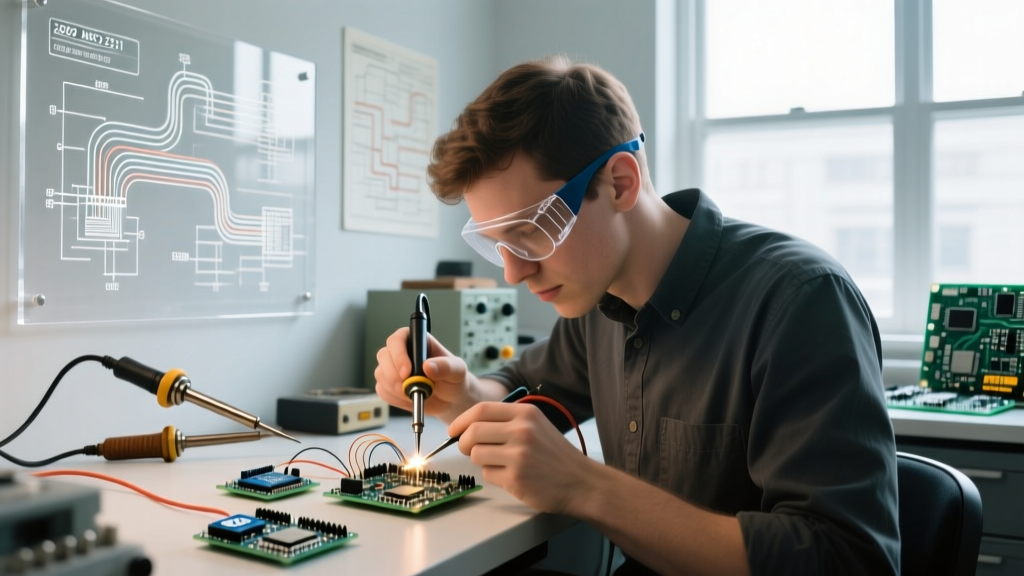
If you are asking, do you need eye protection for soldering, the unambiguous answer is yes. Whether you are a hobbyist building a custom mechanical keyboard or a production technician assembling PCBs, safety glasses are non-negotiable. However, the reasoning behind this requirement—and the technology used to protect our eyes—has evolved dramatically over the last seven decades. To understand why modern safety standards are so strict, we must look at the history of soldering hazards, the shift in solder chemistry, and the physics of flux spatter.
Historical Callout: In the 1950s and 60s, it was common practice for radio technicians and plumbers to solder with bare eyes. The resulting epidemic of corneal burns and embedded foreign bodies eventually forced regulatory bodies like OSHA to intervene, permanently changing the electronics manufacturing landscape.
The Wild West: Soldering Before Safety Standards (Pre-1970)
Before the establishment of the Occupational Safety and Health Administration (OSHA) in 1970, the electronics and plumbing industries operated with minimal personal protective equipment (PPE) oversight. Early soldering primarily utilized tin-lead alloys with mildly active rosin fluxes. The soldering irons of the era were heavy, slow to heat, and lacked precise temperature control.
Because the standard Sn63/Pb37 (tin-lead) eutectic solder melts at a relatively low 183°C (361°F), technicians often kept their irons hovering around 250°C to 300°C. At these temperatures, flux activation was gentle. Spattering occurred, but the velocity and volume of ejected material were generally low. Consequently, the industry suffered from a high rate of undetected micro-abrasions on the cornea, and the long-term respiratory and ocular effects of colophony (pine rosin) exposure were largely ignored. It wasn't until the push for standardized workplace safety that the true dangers of soldering without PPE were quantified.
The Regulatory Awakening and the ANSI Z87.1 Standard
The turning point for soldering eye safety came with the codification of the OSHA Standard 1910.133, which mandates eye and face protection when workers are exposed to chemical, environmental, or radiological hazards. This aligned with the American National Standards Institute (ANSI) Z87.1 standard, which established rigorous impact and optical clarity requirements for safety eyewear.
By the 1990s, any reputable electronics manufacturing services (EMS) facility required ANSI-rated safety glasses on the production floor. However, the hobbyist and DIY communities largely remained unaware of these standards, continuing to solder bare-eyed in garages and basements.
The RoHS Shockwave: How Lead-Free Solder Changed Eye Safety (2006–Present)
The most significant event in the history of soldering hazards was the implementation of the Restriction of Hazardous Substances (RoHS) directive, which forced the industry to transition to lead-free solders like SAC305 (Sn96.5/Ag3.0/Cu0.5). This chemical shift fundamentally altered the thermal dynamics of soldering and exponentially increased the risk of eye injury.
The Thermal Reality of Lead-Free Soldering
- Higher Melting Points: SAC305 melts at 217°C–227°C, compared to 183°C for leaded solder.
- Increased Iron Temperatures: To achieve proper wetting and thermal recovery, modern soldering stations must be set between 350°C and 400°C (662°F–752°F).
- Violent Flux Vaporization: At 380°C, rosin-based and synthetic fluxes do not just melt; they flash-boil. The rapid expansion of flux vapors creates micro-explosions that eject molten solder and boiling flux resin at high velocities directly toward the operator's face.
This thermal reality is why modern IPC soldering standards heavily emphasize PPE. The kinetic energy of a spatter droplet at 350°C is more than enough to cause severe thermal and chemical burns to the sclera and cornea.
| Era | Dominant Solder Alloy | Average Iron Temp | Flux Behavior | Eyewear Standard / Adoption |
|---|---|---|---|---|
| 1950s–1970s | Sn63/Pb37 (Leaded) | 250°C – 300°C | Gentle melting, low spatter | Minimal / Bare eyes common |
| 1980s–2005 | Sn63/Pb37 (Leaded) | 300°C – 320°C | Moderate spatter | ANSI Z87.1 (Industrial only) |
| 2006–2026 | SAC305 (Lead-Free) | 350°C – 400°C | Violent flash-boiling, high-velocity spatter | ANSI/ISEA Z87.1-2020 (Universal) |
The Anatomy of a Soldering Eye Injury
When evaluating the hazards, occupational safety research categorizes soldering eye injuries into three distinct mechanisms:
- Thermal Burns: Molten solder droplets (220°C+) or boiling flux (300°C+) striking the eye. The moisture on the surface of the eye can instantly vaporize upon contact, causing severe tissue damage.
- Chemical Keratitis: Activated flux contains mild acids (like adipic or succinic acid) and rosin. When these chemicals land in the eye, they cause acute inflammation, redness, and photophobia.
- Blunt Force / Laceration: Often overlooked, the act of trimming component leads with flush cutters sends microscopic shards of copper and steel flying at bullet-like speeds. This is statistically the most common cause of penetrating eye injuries at the workbench.
2026 Buyer’s Framework: Choosing the Right Safety Glasses
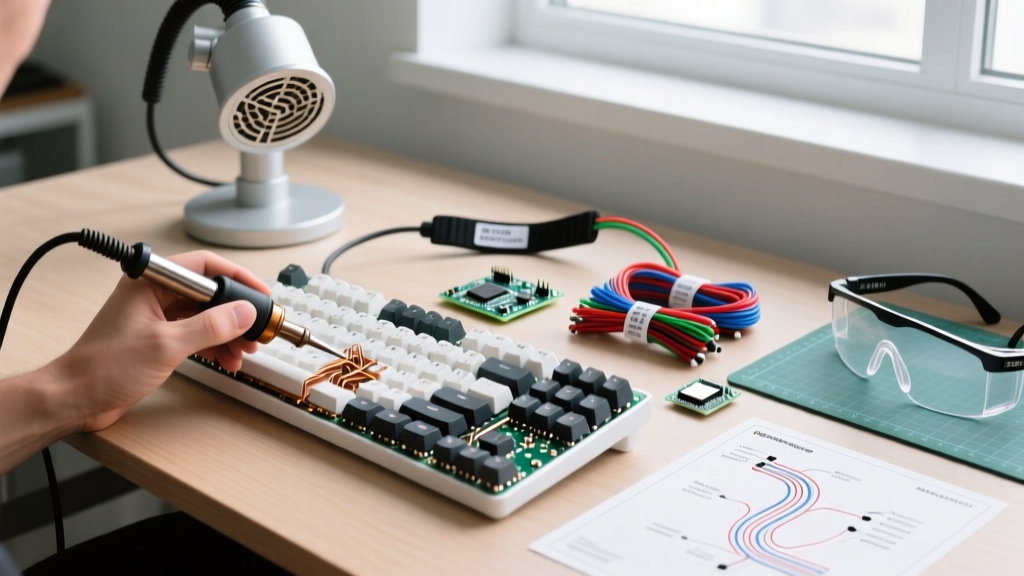
If you are outfitting your workbench today, standard hardware store safety glasses are no longer the benchmark. You need eyewear that meets the ANSI/ISEA Z87.1-2020 standard, featuring wraparound protection and advanced anti-fog coatings. When soldering, your face is often close to the workpiece, and the heat from the iron can cause cheap lenses to fog instantly, creating a secondary hazard.
1. 3M SecureFit 400 (SF401AF) — Best Budget Option
Price Range: $7 – $10
Key Features: Pressure Diffusion Temples (PDT) that self-adjust to the wearer's head size, providing all-day comfort without pinching. The polycarbonate lenses feature 3M's proprietary anti-fog coating. They offer excellent wraparound coverage, blocking peripheral wire clippings.
2. Uvex Genesis XC (2300X) — Best Extended Coverage
Price Range: $13 – $18
Key Features: The Genesis XC features an extended orbital seal that sits close to the face, preventing flux vapors and fine particulates from drifting behind the lens. The Uvextreme® anti-fog coating is chemically bonded to the lens, meaning it won't wash off after a few cleanings—a critical feature for daily use.
3. Edge Eyewear Kazu (Vapor Shield) — Premium Anti-Fog
Price Range: $24 – $30
Key Features: Edge utilizes military-grade Vapor Shield technology. Unlike traditional hydrophilic coatings that absorb moisture, Vapor Shield is a dual-layer system that prevents fogging even in extreme temperature differentials (e.g., leaning over a 380°C rework station in a cool room).
Frequently Asked Questions
Are regular prescription glasses sufficient for soldering?
No. Standard prescription glasses are not manufactured to withstand high-velocity impacts (like a flying copper lead) and lack side shields. Furthermore, they do not carry the ANSI Z87.1 impact rating. You must either wear ANSI-rated safety glasses over your prescription frames or invest in prescription safety eyewear with polycarbonate lenses and side shields.
Does standard soldering emit harmful UV radiation?
Traditional soldering irons and hot air rework stations do not emit harmful levels of UV radiation; the primary risks are thermal and chemical. However, if your process involves UV-curing adhesives, laser soldering systems, or specific optical inspection tools, you will require specialized wavelength-filtering eyewear in addition to impact protection.
How often should I replace my soldering safety glasses?
Polycarbonate lenses degrade over time when exposed to UV light and harsh chemicals (like isopropyl alcohol used for PCB cleaning). If your lenses become deeply scratched, pitted by flux spatter, or if the anti-fog coating fails, replace them immediately. For daily users, a 6-to-12-month replacement cycle is standard practice.
Final Verdict
The history of soldering safety is a transition from ignorance to strict, science-backed regulation. The shift to high-temperature lead-free solders has made the workbench a more volatile environment than it was in the 20th century. When asking, do you need eye protection for soldering, the physics of flux vaporization and the kinetic energy of clipped wire leads dictate a resounding yes. Invest $15 in a pair of ANSI Z87.1-2020 rated, anti-fog polycarbonate glasses—it is the most cost-effective insurance policy in your entire electronics lab.